MCQ
Armature current in dc motor will be maximum when
  • A
    Motor has acquired maximum speed
  • B
    Motor has acquired intermediate speed
  • Motor has just started moving
  • D
    Motor is switched off

Answer

Correct option: C.
Motor has just started moving
c
(c)Motor e.m.f. equation ${E_b} = V - {I_a}{R_a}$

At starting ${E_b} = 0,$ so ${I_a}$will be maximum.

Need a full question paper?

Generate a complete, print-ready paper with questions like this in minutes — across 16+ boards, with answer keys.

Start Generating Free

Similar questions

A signal of $0.1\, kW$ is transmitted in a cable. The attenuation of cable is $-5 \,dB$ per $km$ and cable length is $20\, km$. The power received at receiver is $10^{-x} \, W$. The value of $x$ is ....... .

$\left[\right.$ Gain in $\left. dB =10 \log _{10}\left(\frac{ P _{0}}{ P _{i}}\right)\right]$

A block of mass $m$ is kept in an elevation which starts moving downward with an acceleration $a$ as shown in figure. The block is observed by two observers $A$ and $B$ for a time interval $t_0$. The observer $B$ finds that the work done by gravity on the block is
The total power content of an $AM$ wave is $1500\, W.$ For $100\%$ modulation, the power transmitted by the carrier is........$W$
The phase difference between two points separated by $0.8 m$ in a wave of frequency is $120 Hz$ is $\frac{\pi }{2}.$ The velocity of wave is .....  $m/s$
A small soap bubble of radius $4\,cm$  is trapped inside another bubble of radius $6\,cm$ without any contact. Let $P_2$  be the pressure inside the inner bubble and $P_0$  the pressure outside the outer bubble. Radius of another bubble with pressure difference $P_2 - P_0$  between its inside and outside would be....... $cm$
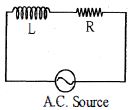
In a simple $L-R$ circuit with $A.C$. source the potential difference at any instant across inductor and resistance are $V_L$ and $V_R$ respectively and $A.C.$ souree has potential difference $V_{Ac}$ at the same instant. Then
$STATEMENT-1$ If there is no external torque on a body about its center of mass, then the velocity of the center of mass remains constant. because

$STATEMENT-2$ The linear momentum of an isolated system remains constant.

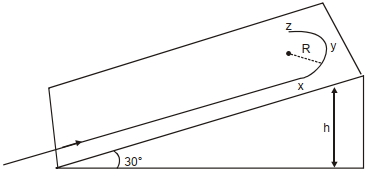
A student skates up a ramp that makes an angle $30^{\circ}$ with the horizontal. $He /$ she starts (as shown in the figure) at the bottom of the ramp with speed $v_0$ and wants to turn around over a semicircular path xyz of radius $R$ during which he/she reaches a maximum height $h$ (at point y) from the ground as shown in the figure. Assume that the energy loss is negligible and the force required for this turn at the highest point is provided by his/her weight only. Then ( $g$ is the acceleration due to gravity)

$(A)$ $v_0^2-2 g h=\frac{1}{2} g R$

$(B)$ $v_0^2-2 g h=\frac{\sqrt{3}}{2} g R$

$(C)$ the centripetal force required at points $x$ and $z$ is zero

$(D)$ the centripetal force required is maximum at points $x$ and $z$
$1 \,\,kg$ of a gas does $20\,\, kJ$ of work and receives $16 \,\,kJ$ of heat when it is expanded between two states. $A$ second kind of expansion can be found between the initial and final state which requires a heat input of $9\,\, kJ$. The work done by the gas in the second expansion is  ....... $kJ$
The coefficient of linear expansion of brass and steel are ${\alpha _1}$ and ${\alpha _2}$. If we take a brass rod of length ${l_1}$ and steel rod of length ${l_2}$ at $0°C$, their difference in length $({l_2} - {l_1})$ will remain the same at a temperature if