MCQ
$Assertion$ : A body with constant acceleration always moves along a straight line.

$Reason$ : A body with constant acceleration may not speed up.

  • A
    If both Assertion and Reason are correct and the Reason is a correct explanation of the Assertion.
  • B
    If both Assertion and Reason are correct but Reason is not a correct explanation of the Assertion.
  • C
    If the Assertion is correct but Reason is incorrect.
  • If the Assertion is incorrect but the Reason is correct.
Answer

Correct option: D.
If the Assertion is incorrect but the Reason is correct.
d
In case of circular motion, constant acceleration creates circular motion. In circular motion (uniform) the body in motion does not speed up inspite of acceleration.

Need a full question paper?

Generate a complete, print-ready paper with questions like this in minutes — across 16+ boards, with answer keys.

Start Generating Free

Similar questions

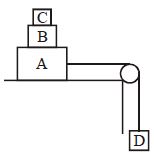
Three blocks $A$, $B$ and $C$ of equal mass $m$ are placed on a smooth surface as shown. Coefficient of friction between any block $A, B$ and $C$ is $μ$. The maximum value of mass $D$ so the block $A, B$ & $C$ move without slipping over each other is
Water has maximum density at
How many times is escape velocity $({V_e})$, of orbital velocity $({V_0})$ for a satellite revolving near earth
A lift is coming from $8^{th}$ floor and is just about to reach $4^{th}$ floor. Taking ground floor as origin and positive direction upwards for all quantities, which one of the following is correct?
A person of height $1.6 \mathrm{~m}$ is walking away from a lamp post of height $4 \mathrm{~m}$ along a straight path on the flat ground. The lamp post and the person are always perpendicular to the ground. If the speed of the person is $60 \mathrm{~cm} \mathrm{~s}^{-1}$, the speed of the tip of the person's shadow on the ground with respect to the person is. . . . $\mathrm{cm} \mathrm{s}^{-1}$.
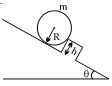
Find minimum height of obstacle so that the sphere can stay in equilibrium. 
In an isothermal change, an ideal gas obeys
If $Y, K$ and $\eta$ are the values of Young's modulus, bulk modulus and modulus of rigidity of any material respectively. Choose the correct relation for these parameters.
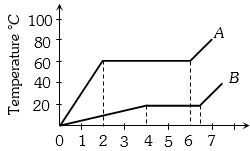
Two substances $A$ and $B$ of equal mass m are heated at uniform rate of $6\, cal s^{-1}$ under similar conditions. $A$ graph between temperature and time is shown in figure. Ratio of heat absorbed ${H_A}/{H_B}$ by them for complete fusion is
A particle of mass ${m}$ is suspended from a ceiling through a string of length $L$. The particle moves in a horizontal circle of radius $r$ such that ${r}=\frac{{L}}{\sqrt{2}}$. The speed of particle will be: