MCQ
$Assertion$ : A helicopter must necessarily have two propellers.
$Reason$ : Two propellers are provided in helicopter in order to conserve linear momentum
  • A
    If both Assertion and Reason are correct and the Reason is a correct explanation of the Assertion.
  • B
    If both Assertion and Reason are correct but Reason is not a correct explanation of the Assertion.
  • If the Assertion is correct but Reason is incorrect.
  • D
    If both the Assertion and Reason are incorrect.
Answer

Correct option: C.
If the Assertion is correct but Reason is incorrect.
c
If there were only one propeller in the helicopter, the helicopter itself, would have turned in opposite direction of the direction of propeller due to conservation of angular momentum. Thus two propeller provides helicopter a steady movement.

Need a full question paper?

Generate a complete, print-ready paper with questions like this in minutes — across 16+ boards, with answer keys.

Start Generating Free

Similar questions

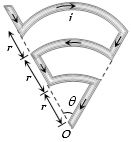
Find magnetic field at $O$
A proton, a neutron, an electron and an $\alpha\,-$particle have same energy. If $\lambda_{ p }, \lambda_{ n }, \lambda_{ e }$ and $\lambda_{\alpha}$ are the de Broglie's wavelengths of proton, neutron, electron and $\alpha$ particle respectively, then choose the correct relation from the following
Assertion : The Coulomb force is the dominating force in the universe.

Reason : The Coulomb force is weaker than the gravitational force.

If on heating liquid through $80°C$, the mass expelled is $(1/100)^{th}$ of mass still remaining, the coefficient of apparent expansion of liquid is
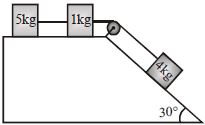
What will be the acceleration of the system and tension in the rope connecting $5\,kg$ and  $1\,kg$ :-
If in the experiment of Wheatstone's bridge, the positions of cells and galvanometer are interchanged, then balance points will
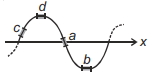
Figure shows a snapshot for a travelling sine wave along a string. Four elemental portions $a, b, c$ and $d$ are indicated on the string. The elemental portion which has maximum potential energy is/are
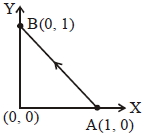
Consider a force $\overrightarrow{\mathrm{F}}=-\mathrm{x} \hat{\mathrm{i}}+\mathrm{y} \hat{\mathrm{j}}$. The work done by this force in moving a particle from point $\mathrm{A}(1,0)$ to $\mathrm{B}(0,1)$ along the line segment is 

(all quantities are in $SI$ units)

Four electrons, each of mass $m_{e}$ are in a one dimensional box of size $L$. Assume that, the electrons are non-interacting, obey the Pauli exclusion principle and are described by standing de Broglie waves confined within the box. Define $\alpha=h^{2} / 8 m_{e} L^{2}$ and $U_{0}$ to be the ground state energy. Then,
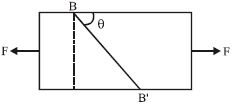
A bar of cross-sectional area $A$ is subjected two equal and opposite tensile forces at its ends as shown in figure. Consider a plane $BB'$ making an angle $\theta $ with the length The ratio of tensile stress to the shearing stress on the plane $BB'$ is