MCQ
$Assertion :$ Air pressure in a car tyre increases during driving.
$Reason :$ Absolute zero temperature is not zero energy temperature.
  • A
    If both Assertion and Reason are correct and the Reason is a correct explanation of the Assertion.
  • If both Assertion and Reason are correct but Reason is not a correct explanation of the Assertion.
  • C
    If the Assertion is correct but Reason is incorrect.
  • D
    If both the Assertion and Reason are incorrect.
Answer

Correct option: B.
If both Assertion and Reason are correct but Reason is not a correct explanation of the Assertion.
b
When a person is driving a car then the temperature of air inside the tyre is increased because of motion. From the Gay Lussac’s law,
$P \propto T$
Hence, when temperature increases the pressure also increase.

Need a full question paper?

Generate a complete, print-ready paper with questions like this in minutes — across 16+ boards, with answer keys.

Start Generating Free

Similar questions

A particle of mass $M,$ starting from rest , undergoes uniform acceleration. If the speed acquired in time $T$ is $V,$ the power delivered to the particle is
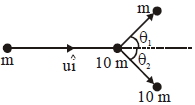
A particle of mass $m$ is moving along the $x$ -axis with initial velocity $u \hat i$. It collides elastically with a particle of mass $10\, m$ at rest and then moves with half its initial kinetic energy (see figure). If $\sin \theta_{1}=\sqrt{n} \sin \theta_{2}$ then value of $n$ is.....
A sound source is moving towards a stationary observer with $(1/10)$ of the speed of sound. The ratio of apparent to real frequency is .........
The dimensional formula of Avagadro's number is:
Given below are two statements: one is labelled as Assertion $A$ and the other is labelled as Reason $R$.

Assertion $A$ : Body $'P'$ having mass $M$ moving with speed $'u'$ has head-on collision elastically with another body $'Q'$ having mass $'m'$ initially at rest. If $m< < M,$ body $'Q'$ will have a maximum speed equal to $'2u'$ after collision.

Reason $R$ : During elastic collision, the momentum and kinetic energy are both conserved.

In the light of the above statements, choose the most appropriate answer from the options given below:

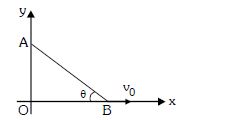
The end $B$ of the rod $AB$ which makes angle $\theta$ with the floor is being pulled with, a constant velocity $v_0$ as shown. The length of the rod is $l.$ At the instant when $\theta = 37^o $ then
Water rises upto $10\, cm$ height in a long capillary tube. If this tube is immersed in water so that the height above the water surface is only $8 \,cm,$  then
A body falls from rest in the gravitational field of the earth. The distance travelled in the fifth second of its motion is.........$m$ $(g = 10\,m/{s^2})$
A mass falls from a helght $h$ and its time of fall $t$ is recorded in terms of time period $T$ of a simple pendulum. On the surface of earth it is found that $t =2 T$. The entre setup is taken on the surface of another planet whose mass is half of that of earth and radius the same. Same experiment is repeated and corresponding times noted as $t'$ and $T'$.
 A $10 \;N$ force is applied on a body produce in it an acceleration of $1 \;m / s ^{2} .$ The mass of the body is ...... $kg$