Assertion: Electron move away from a region of higher potential to a region of lower potential.
Reason: An electron has a negative charge.
AIIMS 1999, Easy


Download our appand get started for free
Experience the future of education. Simply download our apps or reach out to us for more information. Let's shape the future of learning together!No signup needed.*
Similar Questions
- 1There exists a uniform electric field $E=4 \times 10^5 \,Vm ^{-1}$ directed along negative $x$-axis such that electric potential at origin is zero. Acharge of $-200 \,\mu C$ is placed at origin, and a charge of $+200 \,\mu C$ is placed at $(3 \,m , 0)$. The electrostatic potential energy of the system is ...........$J$View Solution
- 2View SolutionA parallel plate capacitor is charged. Then battery is removed now If the plates are pulled apart
- 3A thin metal plate $P$ is inserted half way between the plates of a parallel plate capacitor of capacitance $C$ in such a way that it is parallel to the two plates. The capacitance now becomesView Solution
- 4In a hollow spherical shell potential $(V)$ changes with respect to distance $(r)$ from centreView Solution
- 5A parallel plate capacitor having capacitance $12\, pF$ is charged by a battery to a potential difference of $10\, V$ between its plates. The charging battery is now disconnected and a porcelain slab of dielectric constant $6.5$ is slipped between the plates. The work done by the capacitor on the slab is.......$pJ$View Solution
- 6The electric potential $V(x)$ in a region around the origin is given by $V(x) = 4x^2\,volts$ . The electric charge enclosed in a cube of $1\,m$ side with its centre at the origin is (in coulomb)View Solution
- 7In a uniform electric field, a cube of side $1\ cm$ is placed. The total energy stored in the cube is $8.85\mu J$ . The electric field is parallel to four of the faces of the cube. The electric flux through any one of the remaining two faces is.View Solution
- 8Three capacitors each of capacity $4\,\mu \,F$ are to be connected in such a way that the effective capacitance is $6\,\mu \,F$. This can be done byView Solution
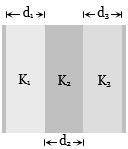
- 9The expression for the capacity of the capacitor formed by compound dielectric placed between the plates of a parallel plate capacitor as shown in figure, will be (area of plate $ = A$)View Solution
- 10Two charged spheres of radii $10\, cm$ and $15\, cm$ are connected by a thin wire. No current will flow, if they haveView Solution