Assertion : Free electrons always keep on moving in a conductor even then no magnetic force act on them in magnetic field unless a current is passed through it.
Reason : The average velocity of free electron is zero.
AIIMS 2011, Easy


Download our appand get started for free
Experience the future of education. Simply download our apps or reach out to us for more information. Let's shape the future of learning together!No signup needed.*
Similar Questions
- 1A student obtained following observations in an experiment of meter bridge to find the unknown resistance of the circuit The most accurate value of unknown resistance is ............ $\Omega$View Solution
S.No. $R$ $l$ $100-l$ $S = \left( {\frac{{100 - l}}{l}} \right)R$ $1$ $20\,\Omega $ $43$ $57$ $26.51\,\Omega $ $2$ $30\,\Omega $ $51$ $49$ $28.82\,\Omega $ $3$ $40\,\Omega $ $59$ $41$ $27.80\,\Omega $ $4$ $60\,\Omega $ $70$ $30$ $25.71\,\Omega $ - 2Match the List $I$ with the List $II$ from the combination shown. In the left side (List $I$) there are four different conditions and in the right side (List $II$), there are ratios of heat produced in each resistance for each condition :View Solution
List $I$ List $II$ $(I)$ Two wires of same resistance are connected in series and same current is passed through them $(A)$ $1:2$ $(II)$ Two wires of resistance $R$ and $2R$ $ohm$ are connected in series and same $P . D .$ is applied across them $(B)$ $4:1$ $(III)$ Two wires of same resistance are connected in parallel and same current is flowing through them $(C)$ $1:1$ $(IV)$ Two wires of resistances in the ratio $1: 2$ are connected in parallel and same $P . D .$ is applied across the $(D)$ $2:1$ - 3If two bulbs of wattage $25$ and $30$, each rated at $220\, volts$, are connected in series with a $440$ $volt$ supply, which bulb will fuseView Solution
- 4View SolutionIn meter bridge or Wheatstone bridge for measurement of resistance, the known and the unknown resistances are interchanged. The error so removed is
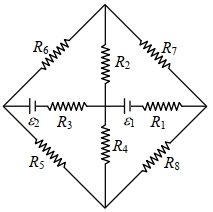
- 5The figure shows a circuit having eight resistances of $1 \Omega$ each, labelled $R_1$ to $R_8$, and two ideal batteries with voltages $\varepsilon_1=12 V$ and $\varepsilon_2=6 V$.View Solution
Which of the following statement($s$) is(are) correct?
$(A)$ The magnitude of current flowing through $R_1$ is $7.2 A$.
$(B)$ The magnitude of current flowing through $R_2$ is $1.2 A$.
$(C)$ The magnitude of current flowing through $R_3$ is $4.8 A$.
$(D)$ The magnitude of current flowing through $R_5$ is $2.4 A$.
- 6$10$ resistors, each of resistance $R$ are connected in series to a battery of $emf$ $E$ and negligible internal resistance. Then those are connected in parallel to the same battery, the current is increased $n$ times. The value of $n$ is :View Solution
- 7A piece of fuse wire melts when a current of $15\, ampere$ flows through it. With this current, if it dissipates $22.5\, W$, the resistance of fuse wire will be .............. $\Omega$View Solution
- 8An electric bulb is designed to draw power $P_0$ at voltage $V_0$. If the voltage is $V$ it draws a power $P$. ThenView Solution
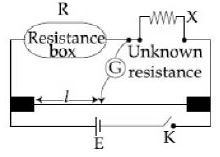
- 9In a meter bridge experiment, the circuit diagram and the corresponding observation table are shown in figureView Solution
$Sl$. $No$. $R\, (\Omega )$ $l\, (cm)$ $1$. $1000$ $60$ $2$. $100$ $13$ $3$. $10$ $1.5$ $4$. $1$ $1.0$ Which of the readings is inconsistent ?
- 10View SolutionA bird sitting on a single high tension wire does not get electrocuted because