MCQ
$Assertion$ : Graph between potential energy of a spring versus the extension or compression of the spring is a straight line.

$Reason$ : Potential energy of a stretched or compressed spring, proportional to square of extension or compression.

  • A
    If both Assertion and Reason are correct and the Reason is a correct explanation of the Assertion.
  • B
    If both Assertion and Reason are correct but Reason is not a correct explanation of the Assertion.
  • C
    If both the Assertion and Reason are incorrect.
  • If the Assertion is incorrect but Reason is correct.
Answer

Correct option: D.
If the Assertion is incorrect but Reason is correct.
d
Potential energy $U = \frac{1}{2}\,K{x^2}$ ie $U \propto {x^2}$ This is a equation of parabola, so graph between $U$ and $x$ is a parabola not a straight line

Need a full question paper?

Generate a complete, print-ready paper with questions like this in minutes — across 16+ boards, with answer keys.

Start Generating Free

Similar questions

The time after which they are closet to each other:
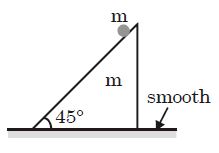
A ball of mass $'m'$ is released from the top of a smooth movable wedge of mass $'m'.$ When the ball collides with the floor,velocity of the wedge is $'v'.$ Then the maximum height attained by the ball after an elastic collision with the floor is :(Neglect any edge at the lower end of the wedge).
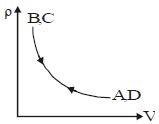
Density $vs$  volume graph is shown in the figure. Find corresponding pressure $vs$  temperature graph
An infinite number of masses, each of one $kg$ are placed on the $+ve\, X$ axis at $1\,m, 2\,m, 4\,m,$ origin. The magnitude of the gravitational field at origin due to this distribution of masses is :
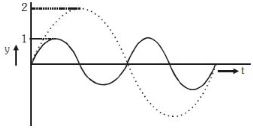
Dependence of disturbances due to two waves on time is shown in the figure. The ratio of their intensities $I_1 / I_2$ will be
Angular momentum and angular velocity for a rolling sphere of radius $R$ are related by the formula:
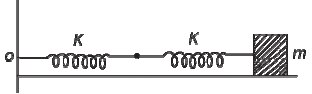
The frequency of oscillations of a mass $m$ connected horizontally by a spring of spring constant $k$ is $4 Hz$. When the spring is replaced by two identical spring as shown in figure. Then the effective frequency is,
A simple pendulum has time period $T_1$. The point of suspension is now moved upward according to equation $y = k{t^2}$ where $k = 1\,m/se{c^2}$. If new time period is $T_2$ then ratio $\frac{{T_1^2}}{{T_2^2}}$ will be
If the length of the second's hand in a stop clock is $3 \,cm$ the angular velocity and linear velocity of the tip is
Two particles $A$ and $B$ initially at rest, move towards each other, under mutual force of attraction. At an instance when the speed of $A$ is $v$ and speed of $B$ is $2v,$ the speed of centre of mass $(CM)$ is: