Assertion : Long distance power transmission is done at high voltage.
Reason : At high voltage supply power losses are less.
AIIMS 2014, Easy
Download our app for free and get started
Power loss $ = \,{i^2}R\, = \,{\left( {\frac{P}{V}} \right)^2}R$
[ $P =$ Transmitted power]

Download our appand get started for free
Experience the future of education. Simply download our apps or reach out to us for more information. Let's shape the future of learning together!No signup needed.*
Similar Questions
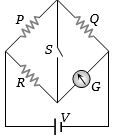
- 1In the circuit shown $P \ne R$, the reading of the galvanometer is same with switch $S$ open or closed. ThenView Solution
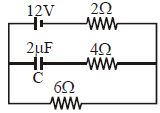
- 2Find the charge on the capacitor $C$ in the following circuit ............. $\mu C$View Solution
- 3View SolutionA steel wire has a resistance twice that of an aluminium wire. Both of them are connected with a constant voltage supply. More heat will be dissipated in
- 4View SolutionExpress which of the following setups can be used to verify Ohm’s law
- 5View SolutionWhich of the following quantities do not change when a resistor connected to a battery is heated due to the current?
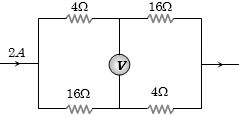
- 6In the circuit shown below, The reading of the voltmeter $V$ is ...........View Solution
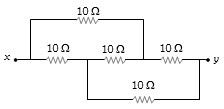
- 7The equivalent resistance between $x$ and $y$ in the circuit shown is ............. $\Omega$View Solution
- 8The resistance of the filament of a lamp increases with the increase in temperature. A lamp rated $100\, W, 220\, V$ is connected across $220\, V$ power supply. If the voltage drops by $10\%$ then the power of lamp will beView Solution
- 9View SolutionIn charging a battery of motor-car, the following effect of electric current is used
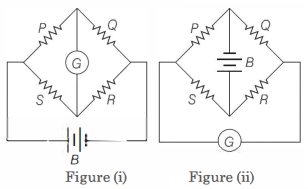
- 10Figure $(i)$ below shows a Wheatstone's bridge in which $P, Q, R$ and $S$ are fixed resistances, $G$ is a galvanometer and $B$ is a battery. For this particular case, the galvanometer shows zero deflection. Now, only the positions of $B$ and $G$ are interchanged, as shown in figure $(ii)$. The new deflection of the galvanometerView Solution