In the diagram shown, the difference in the two tubes of the manometer is $5\, \ cm$, the cross section of the tube at $A$ and $B$ is $6\, mm^2$ and $10\, mm^2$ respectively. The rate at which water flows through the tube is $........ cc/s$
$(g\, = 10\, ms^{-2})$
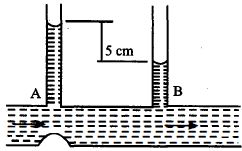
$(g\, = 10\, ms^{-2})$
JEE MAIN 2014, Diffcult
Download our app for free and get started
According to Bernoulli's theorem $,{p_1} + \frac{1}{2}\rho v_1^2 = {P_2} + \frac{1}{2}\rho v_2^2$
$\therefore v_2^2 - v_1^2 = 2gh$ $...\left( 1 \right)$
According to the equation of continuty
${A_1}{v_1} = {A_2}{v_2}$ $...(2)$
$\frac{{{A_1}}}{{{A_2}}} = \frac{{6\,m{m^2}}}{{10\,m{m^2}}}$
From equation $\left( 2 \right),\frac{{{A_1}}}{{{A_2}}} = \frac{{{v_2}}}{{{v_1}}} = \frac{6}{{16}}$
$or,\,\,{v_2} = \frac{6}{{10}}{v_1}$
Putting this value of $v_2$ in equation $(1)$
${\left( {\frac{6}{{10}}{v_1}} \right)^2} - {\left( {{v_1}} \right)^2} = 2 \times {10^3} \times 5$
$\left[ \begin{array}{l} g = 10m/{s^2} = {10^3}cm/{s^2}\\ and\,h = 5\,cm\end{array} \right]$
Solving we get $,{v_1} = \frac{{10}}{8}$
Therefore the rate at which water flows through the tube
$ = {A_1}{v_1} = {A_2}{v_2} $
$= \frac{{6 \times 10}}{8} = 7.5cc/s$
$\therefore v_2^2 - v_1^2 = 2gh$ $...\left( 1 \right)$
According to the equation of continuty
${A_1}{v_1} = {A_2}{v_2}$ $...(2)$
$\frac{{{A_1}}}{{{A_2}}} = \frac{{6\,m{m^2}}}{{10\,m{m^2}}}$
From equation $\left( 2 \right),\frac{{{A_1}}}{{{A_2}}} = \frac{{{v_2}}}{{{v_1}}} = \frac{6}{{16}}$
$or,\,\,{v_2} = \frac{6}{{10}}{v_1}$
Putting this value of $v_2$ in equation $(1)$
${\left( {\frac{6}{{10}}{v_1}} \right)^2} - {\left( {{v_1}} \right)^2} = 2 \times {10^3} \times 5$
$\left[ \begin{array}{l} g = 10m/{s^2} = {10^3}cm/{s^2}\\ and\,h = 5\,cm\end{array} \right]$
Solving we get $,{v_1} = \frac{{10}}{8}$
Therefore the rate at which water flows through the tube
$ = {A_1}{v_1} = {A_2}{v_2} $
$= \frac{{6 \times 10}}{8} = 7.5cc/s$

Download our appand get started for free
Experience the future of education. Simply download our apps or reach out to us for more information. Let's shape the future of learning together!No signup needed.*
Similar Questions
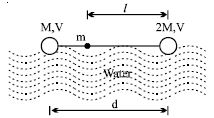
- 1A dumbbell is placed in water of density $\rho$ . It is observed that by attaching a mass $m$ to the rod, the dumbbell floats with the rod horizontal on the surface of water and each sphere exactly half submerged as shown in the figure. The volume of the mass $m$ is negligible. The value of length $l$ isView Solution
- 2Two identical cylindrical vessels with their bases at same level each contains a liquid of density $\rho$. The height of the liquid in one vessel is ${h_1}$ and that in the other vessel is ${h_2}$. The area of either base is $A$. The work done by gravity in equalizing the levels when the two vessels are connected, isView Solution
- 3The rate of steady volume flow of water through a capillary tube of length $ 'l' $ and radius $ 'r' $ under a pressure difference of $P$ is $V$. This tube is connected with another tube of the same length but half the radius in series. Then the rate of steady volume flow through them is (The pressure difference across the combination is $ P$)View Solution
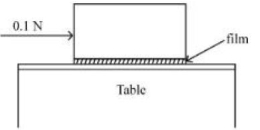
- 4A metal block of base area $0.20\,m ^2$ is placed on a table, as shown in figure. A liquid film of thickness $0.25\,mm$ is inserted between the block and the table. The block is pushed by a horizontal force of $0.1\,N$ and moves with a constant speed. If the viscosity of the liquid is $5.0 \times 10^{-3} \;Pa-s$, the speed of block is $.........\times 10^{-3}\,m / s$View Solution
- 5A small spherical ball of radius $r$, falling through a viscous medium of negligible density has terminal velocity ' $v$ '. Another ball of the same mass but of radius $2 r$, falling through the same viscous medium will have terminal velocity:View Solution
- 6A vessel of area of cross-section A has liquid to a height $H$ . There is a hole at the bottom of vessel having area of cross-section a. The time taken to decrease the level from ${H_1}$ to ${H_2}$ will beView Solution
- 7Eight equal drops of water are falling through air with a steady speed of $10\,cm / s$. If the drops coalesce, the new velocity is $.........\,cm/s$View Solution
- 8A liquid of mass $1$ $kg$ is filled in a flask as shown in figure. The force exerted by the flask on the liquid is $(g = 10\ m/s^2)$[Neglect atmospheric pressure]:View Solution
- 9A metal ball of density $7800\ kg/m^3$ is suspected to have a large number of cavities . It weighs $9.8$ $kg$ when weighed directly on a balance and $1.5$ $kg$ less when immersed in water . The fraction by volume of the cavities in the metal ball is approximately ....... $\%$View Solution
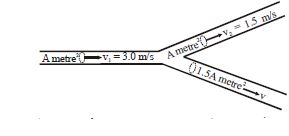
- 10An incompressible liquid flows through a horizontal tube as shown in the figure. Then, the velocity $v$ of the fluid is ......... $m/s$View Solution