MCQ
$Assertion :$ Strain causes the stress in an elastic body.
$Reason :$ An elastic rubber is more plastic in nature.
  • If both Assertion and Reason are correct but Reason is not a correct explanation of the Assertion.
  • B
    If both Assertion and Reason are correct and the Reason is a correct explanation of the Assertion.
  • C
    If the Assertion is correct but Reason is incorrect.
  • D
    If both the Assertion and Reason are incorrect.
Answer

Correct option: A.
If both Assertion and Reason are correct but Reason is not a correct explanation of the Assertion.
a
Young'smodulus$(Y)=\frac{\text {stress}}{\text {strain}}$

If strain changes stress also changes since $Y$ is constant for a material.

Also, poisson's ratio $=\frac{\text { lateralstrain }}{\text { longitudinalstrain }}$

$\nu=0.5$ for rubber and is most elastic material.

So, both are correct but not reason of assertion.

Need a full question paper?

Generate a complete, print-ready paper with questions like this in minutes — across 16+ boards, with answer keys.

Start Generating Free

Similar questions

The potential energy function (in J) of a particle in a region of space is given as $U=\left(2 x^2+3 y^3+2 z\right)$. Here $\mathrm{x}, \mathrm{y}$ and $\mathrm{z}$ are in meter. The magnitude of $\mathrm{x}$ - component of force (in $\mathrm{N}$ ) acting on the particle at point $\mathrm{P}(1,2,3)\ \mathrm{m}$ is:
An object performs action due to force acting towards a point. The mgnitude of force is inversely proportional to the square of the distance. The path of the object will be:
The coefficient of apparent expansion of mercury in a glass vessel is $153 \times 10^{-6} /{ }^{\circ} C$ and in steel vessel is $144 \times 10^{-6} /{ }^{\circ} C$. If $\alpha$ for steel is $12 \times 10^{-6} /{ }^{\circ} C ,$ then that of glass is
The position coordinates of a projectile projected from ground on a certain planet (with no atmosphere) are given by $y=\left(4 t-2 t^2\right) m$ and $x =(3 t)$ metre, where $t$ is in second and point of projection is taken as origin. The angle of projection of projectile with vertical is .........
Consider the following two equations:
  1. $\overrightarrow{\text{R}}=\frac{1}{\text{M}}\sum\limits_{\text{i}}\text{m}_\text{i}\overrightarrow{\text{r}}_\text{i}$
  2. $\overrightarrow{\text{a}}_\text{cm}=\frac{\overrightarrow{\text{F}}}{\text{M}}$
In a noninertial frame
A cricket ball of mass 150g moving with a speed of 126km/ h hits at the middle of the bat, held firmly at its position by the batsman. The ball moves straight back to the bowler after hitting the bat. Assuming that collision between ball and bat is completely elastic and the two remain in contact for 0.001s, the force that the batsman had to apply to hold the bat firmly at its place would be:
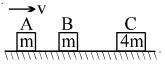
Three blocks are initially placed as shown in the figure. Block $A$ has mass $m$ and initial velocity $v$ to the right. Block $B$ with mass $m$ and block $C$ with mass $4m$ are both initially at rest. Neglect friction. All collisions are elastic. The final velocity of block $A$ is
Abody performs simple harmonic oscillations along the straight line $ABCDE$ with $C$ as the midpoint of $AE.$ Its kinetic energies at $B$ and $D$ are each one fourth of its maximum value. If $AE = 2R,$ the distance between $B$ and $D$ is
Two tuning forks when sounded together produced $4$ beats/sec. The frequency of one fork is $256.$ The number of beats heard increases when the fork of frequency $256$ is loaded with wax. The frequency of the other fork is
A cube of wood supporting $200\,gm$ mass just floats in water. When the mass is removed, the cube rises by $2\, cm$. ............ $cm$ is the side of cube .
