$Assertion :$ The pressure of water reduces when it flows from a narrow pipe to a wider pipe.
$Reason :$ Since for wider pipe area is large, so flow of speed is small and pressure also reduces proportionately.
$Reason :$ Since for wider pipe area is large, so flow of speed is small and pressure also reduces proportionately.
AIIMS 2017, Easy
Download our app for free and get started
Pressure of water reduces when it comes from wide pipe to narrow pipe. According to equation of continuity, $av =$ constant. As the water flows from wider tube to narrow tube, its velocity increases. According to Bernouli prinicple, where velocity is large pressure is less.

Download our appand get started for free
Experience the future of education. Simply download our apps or reach out to us for more information. Let's shape the future of learning together!No signup needed.*
Similar Questions
- 1Two identical cylindrical vessels with their bases at same level each contains a liquid of density $\rho$. The height of the liquid in one vessel is ${h_1}$ and that in the other vessel is ${h_2}$. The area of either base is $A$. The work done by gravity in equalizing the levels when the two vessels are connected, isView Solution
- 2Eight equal drops of water are falling through air with a steady speed of $10\,cm / s$. If the drops coalesce, the new velocity is $.........\,cm/s$View Solution
- 3A $0.5\ kg$ mass of lead is submerged in a container filled to the brim with water and a block of wood floats on top. The lead mass is slowly lifted from the container by a thin wire and as it emerges into air the level of the water in the container drops a bit. The lead mass is now placed on the block of wood. As the lead is placed on the wood.View Solution
- 4The reading of spring balance when a block is suspended from it in air, is $60\,N$. This reading is changed to $40\, N$ when the block is immersed in water. The specific density of the block isView Solution
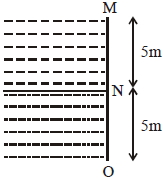
- 5Two liquids of densities $\rho_{1}$ and $\rho_{2}\left(\rho_{2}=2 \rho_{1}\right)$ are filled up behind a square wall of side $10\; \mathrm{m}$ as shown in figure. Each liquid has a height of $5 \;\mathrm{m} .$ The ratio of the forces due to these liquids exerted on upper part $MN$ to that at the lower pait $NO$ is (Assume that the liquids are not mixing)View Solution
- 6The terminal velocity $\left( v _{ t }\right)$ of the spherical rain drop depends on the radius ( $r$ ) of the spherical rain drop asView Solution
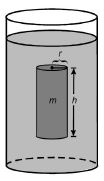
- 7A right circular cylinder has a mass $m$, radius $r$, and a height $h$. The cylinder is completely submerged in a fluid of density $\rho$, as shown in the diagram. What is the magnitude of the net force on the cylinder?View Solution
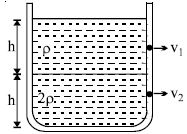
- 8Equal volumes of two immiscible liquids of densities $\rho$ and $2\rho$ are filled in a vessel as shown in figure. Two small holes are punched at depth $h/ 2$ and $3h/2$ from the surface of lighter liquid. If $v_1 $ and $v_2 $ are the velocities of a flux at these two holes, then $v_1/v_2 $ is :View Solution
- 9A rectangular block is $5 cm × 5 cm × 10cm$ in size. The block is floating in water with $ 5 cm $ side vertical. If it floats with $10 cm $ side vertical, what change will occur in the level of water?View Solution
- 10A uniform rod of density $\rho $ is placed in a wide tank containing a liquid of density ${\rho _0}({\rho _0} > \rho )$. The depth of liquid in the tank is half the length of the rod. The rod is in equilibrium, with its lower end resting on the bottom of the tank. In this position the rod makes an angle $\theta $ with the horizontalView Solution