Question
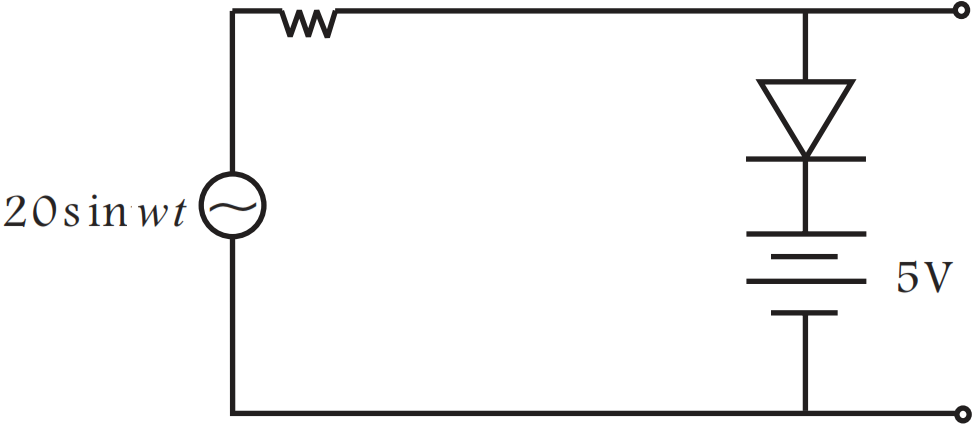
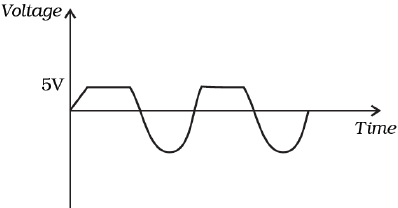
Assuming the ideal diode, draw the output waveform for the circuit given in Fig. Explain the waveform.

Answer

An ideal diode behaves like a perfect conductor when voltage is applied forward biased and like a perfect insulator when voltage is applied reverse biased.
When input voltage is greater than 5V, diode is conducting
When input is less than 5V, diode is open
The correct diagram is shown below:

Need a full question paper?

Generate a complete, print-ready paper with questions like this in minutes — across 16+ boards, with answer keys.
Start Generating Free

Similar questions

Consider the situation of the previous problem.
  1. Calculate the force needed to keep the sliding wire moving with a constant velocity v.
  2. If the force needed just after $t = 0$ is $F_0$, find the time at which the force needed will be $\frac{\text{F}_0}{2}.$
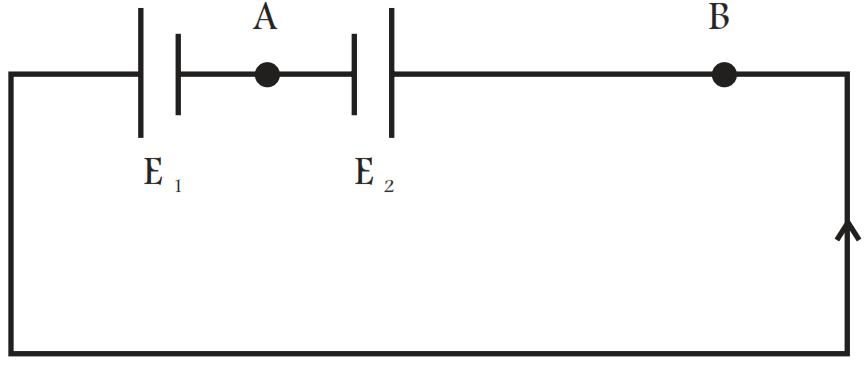
The circuit in Fig. shows two cells connected in opposition to each other. Cell $E_1$ is of emf $6V$ and internal resistance $2\Omega$ ; the cell $E_2$ is of emf $4V$ and internal resistance $8\Omega$ . Find the potential difference between the points $A$ and $B$.
Consider an excited hydrogen atom in state $n$ moving with a velocity $u(ν << c)$. It emits a photon in the direction of its motion and changes its state to a lower state $m$. Apply momentum and energy conservation principles to calculate the frequency $ν$ of the emitted radiation. Compare this with the frequency $ν_0$ emitted if the atom were at rest.
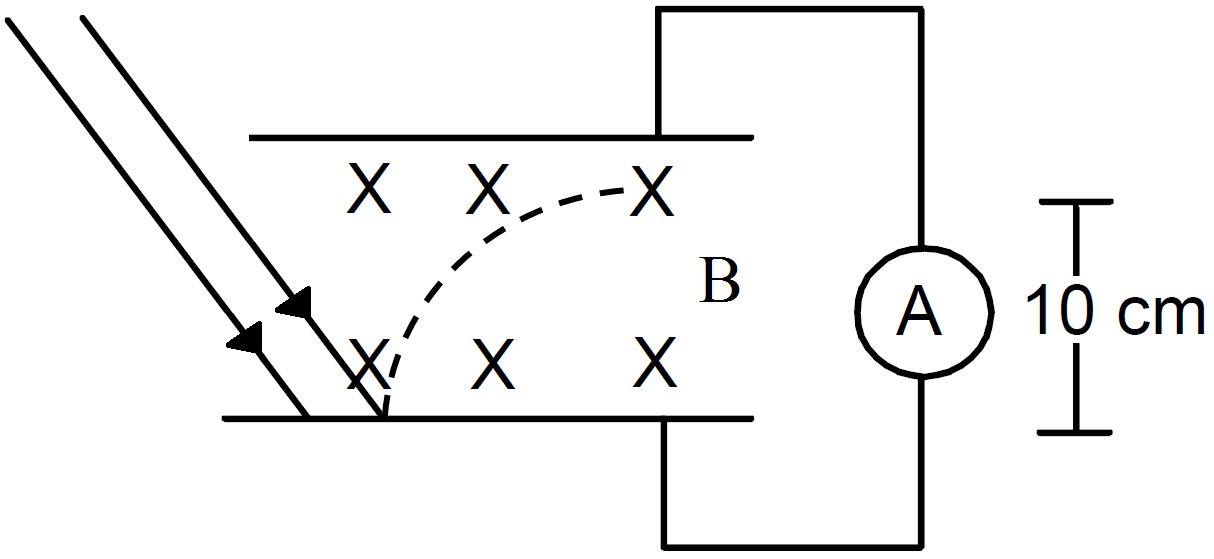
In an experiment on photoelectric effect, the emitter and the collector plates are placed et a separation of 10cm and are connected through en ammeter without any cell A magnetic field B exists parallel to the plates. The work function of the emitter is 2.39eV and the light incident on it has wavelengths between 400nm and 600nm. Find the minimum value of B for which the current registered by the ammeter is zero. Neglect any effect of space charge.
A wire of resistance $15.0\Omega$ is bent to form a regular hexagon ABCDEFA. Find the equivalent resistance of the loop between the points (a) A and B (b) A and C and (c) A and D.
A satellite is projected vertically upwards from an earth station. At what height above the earth's surface will the force on the satellite due to the earth be reduced to half its value at the earth station? (Radius of the earth is 6400km.)
A compound microscope consists of an objective lens of focal length $2.0 \ cm$ and an eyepiece of focal length $6.25 \ cm$ separated by a distance of $15 \ cm.$ How far from the objective should an object be placed in order to obtain the final image at $(a)$ the least distance of distinct vision $(25 \ cm),$ and $(b)$ at infinity? What is the magnifying power of the microscope in each case?
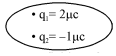
Write the statement of Gauss's law for electrostatics. Draw a diagram and derive an expression for the electric field due to a uniformly charged infinite plane sheet at a point near it.In the given figure, write the value of electric flux emerging from the surface :

Image
Derive an expression for magnetic field intensity due to a magnetic dipole at a point on its axial line.
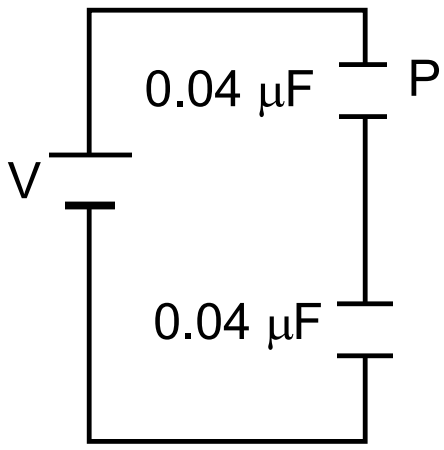
The particle $P$ shown in figure has a mass of $10mg$ and a charge of $-0.01\mu\text{C}.$ Each plate has a surface area $100\ cm^2 $ on one side. What potential difference $V$ should be applied to the combination to hold the particle $P$ in equilibrium?