MCQ
At constant temperature, pressure is inversely proportional to volume is called as:
  • A
    Charle’s law
  • B
    Boyle’s law
  • C
    Zeroth law of thermodynamics
  • D
    First law of thermodynamics

Answer

  1. Boyle’s law

Need a full question paper?

Generate a complete, print-ready paper with questions like this in minutes — across 16+ boards, with answer keys.
Start Generating Free

Similar questions

If the r.m.s. speed of chlorine molecule is $490\,m / s$ at $27^{\circ}\,C$, the r.m.s. speed of argon molecules at the same temperature will be $......\,m/s$ (Atomic mass of argon $=39.9\,u$, molecular mass of chlorine $=70.9\,u )$
$\int\frac{\text{dx}}{\sqrt{2\text{ax}-\text{x}^2}}=\text{a}^{\text{n}}\sin^{-1}\Big[\frac{\text{x}}{\text{a}}-1\Big].$ The value of n is:
  1. 0
  2. -1
  3. 1
  4. None of these.
In an isobaric expansion of an ideal gas, which of the following is zero?
Four particles given, have same momentum which has maximum kinetic energy
An object of mass $3\,m$ splits into three equal fragments. Two fragments have velocities $v\hat j$ and $v\hat i$. The velocity of the third fragment is
A sphere can roll on a surface inclined at an angle $\theta$ if the friction coefficient is more than $\frac{2}{7}\text{g}\tan \theta.$ Suppose the friction coefficient is $\frac{1}{7}\text{g}\tan \theta.$ If a sphere is released from rest on the incline:
  1. It will stay at rest.
  2. It will make pure translational motion.
  3. It will translate and rotate about the centre.
  4. The angular momentum of the sphere about its centre will remain constant.
Steel ruptures when a shear of $3 .5 \times 10^8\,\,N\,m^{-2}$ is applied. The force needed to punch a $1\,cm$ diameter hole in a steel sheet $0.3\,cm$ thick is nearly
A string of length $1\, m$ and mass $5\, g$ is fixed at both ends. The tension in the string is $8.0\, N$. The string is set into vibration using an external vibrator of frequency $100\, Hz$. The separation between successive nodes on the string is close to .... $cm$
According to second law of thermodynamics:
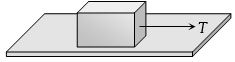
In the figure shown, a block of weight $10 \,N$ resting on a horizontal surface. The coefficient of static friction between the block and the surface ${\mu _s} = 0.4$. A force of $3.5\, N$ will keep the block in uniform motion, once it has been set in motion. A horizontal force of $3 \,N$ is applied to the block, then the block will