MCQ
At nodes in stationary waves
  • Change in pressure and density are maximum
  • B
    Change in pressure and density are minimum
  • C
    Strain is zero
  • D
    Energy is minimum

Answer

Correct option: A.
Change in pressure and density are maximum
a
(a) In a longitudinal standing wave, such as in an organ pipe, there are fixed locations in the pipe where molecules oscillate back and forth at maximum amplitude, but there is no variation in $pressure- the$ density remains constant; this is a pressure node. At $1 / 4$ wavelength away from this node there is a pressure antinode, where the density alternates from high to low, with corresponding alternations in pressure. At the center of this antinode there is no particle motion, but particles on either side alternately move toward and away from the centre

Need a full question paper?

Generate a complete, print-ready paper with questions like this in minutes — across 16+ boards, with answer keys.
Start Generating Free

Similar questions

An electric kettle (rated accurately at $2.5\, kW$) is used to heat $3\, kg$ of water from $15\,^oC$ to boiling point. It takes $9.5$ minute. Then, the amount of heat that has been lost is
A sphere and a cube of same material and same volume are heated upto same temperature and allowed to cool in the same surroundings. The ratio of the amounts of radiations emitted will be
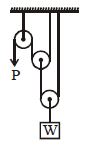
The ideal mechanical advantage of the combination of pulleys shown is
When the gap is closed without placing any object in the screw gauge whose least count is $0.005\ mm$, the $5^{th}$ division on its circular scale with the reference line on main scale, and when a small sphere is placed reading on main scale advances by $4$ divisions, whereas circular scale reading advances by five times to the corresponding reading when no object was placed. There are $200$ divisions on the circular scale. The radius of the sphere is .......... $mm$
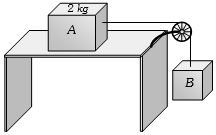
The coefficient of static friction, ${\mu _s},$ between block $A$ of mass $2\, kg$ and the table as shown in the figure is $0.2$. ........ $kg$ would be the maximum mass value of block $B$ so that the two blocks do not move. The string and the pulley are assumed to be smooth and massless. $(g = 10\,m/{s^2})$
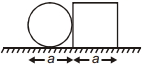
A circular plate of diameter ' $a$ ' is kept in contact with a square plate of side $a$ as shown. The density of the material and the thickness are same everywhere. The centre of mass of composite system will be ...........
Work done by a body against friction always results in:
When red glass is heated in dark room it will seem
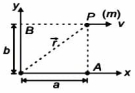
A particle is moving along a straight line parallel to $x$-axis with constant velocity. Find angular momentum about the origin in vector form
The radius of gyration of body depends upon