MCQ
When red glass is heated in dark room it will seem
  • Green
  • B
    Purple
  • C
    Black
  • D
    Yellow

Answer

Correct option: A.
Green
a
(a) Red and green colours are complementary to each other.

When red glass is heated it absorbs green light strongly, hence according to Kirchoff’s law, the emissive power of red glass should be maximum for green light.

That’s why when this heated red glass is taken in dark room it strongly emits green light and looks greenish.

Need a full question paper?

Generate a complete, print-ready paper with questions like this in minutes — across 16+ boards, with answer keys.
Start Generating Free

Similar questions

Saturated vapour is compressed to half its volume without any change in temperature, then the pressure will be
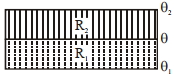
The temperature $\theta$ at the junction of two insulating sheets, having thermal resistances $R _{1}$ and $R _{2}$ as well as top and bottom temperatures $\theta_{1}$ and $\theta_{2}$ (as shown in figure) is given by
Three identical vessels are filled with equal masses of three different liquids $A, B$ and $C$   $({\rho _A} > {\rho _B} > {\rho _C})$. The pressure at the base will be
A particle moves in the $xy$ plane with a constant acceleration $'g'$ in the negative $y$-direction. Its equation of motion is $y = ax-bx^2$, where $a$ and $b$ are constants. Which of the following are correct?
In a sonometer wire, the tension is maintained by suspending a $50.7 kg$ mass from the free end of the wire. The suspended mass has a volume of $ 0.0075 \, m^3$. The fundamental frequency of the wire is $260 Hz$. If the suspended mass is completely submerged in water, the fundamental frequency will become .... $Hz$ (take $g = 10 ms^{-2}$)
The force constant of a wire does not depend on
A container contains $32 \,g$ of $O _2$ at a temperature $T$. The pressure of the gas is $P$. An identical container containing $4 g$ of $H _2$ at a temperature $2 T$ has a pressure of ............
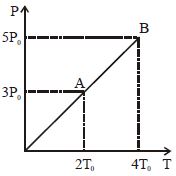
Pressure $Vs$ temperature graph of an ideal gas is shown in figure. Density of the gas at point $A$ is $\rho _0$ , Density at $B$ will be
Which of the following quantities is zero on an average for the molecules of an ideal gas in equilibrium?
An observer moves towards a stationary source of sound with a speed $1/5^{th}$ of the speed of sound. The wavelength and frequency of the source emitted are $\lambda $ and $f$ respectively. The apparent frequency and wavelength recorded by the observer are respectively