At temperature $T$ , the power radiated by a body is $Q$ watts. At the temperature $3T$ the power radiated by it will be
Medium


Download our appand get started for free
Experience the future of education. Simply download our apps or reach out to us for more information. Let's shape the future of learning together!No signup needed.*
Similar Questions
- 1View SolutionWe consider the radiation emitted by the human body. Which of the following statements is true
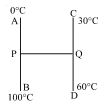
- 2Three identical rods $AB$, $CD$ and $PQ$ are joined as shown. $P$ and $Q$ are mid points of $AB$ and $CD$ respectively. Ends $A, B, C$ and $D$ are maintained at $0^o C, 100^o C, 30^o C$ and $60^o C$ respectively. The direction of heat flow in $PQ$ isView Solution
- 3Two plates $A$ and $B$ have thermal conductivities $84\,Wm ^{-1}\,K ^{-1}$ and $126\,Wm ^{-1}\,K ^{-1}$ respectively. They have same surface area and same thickness. They are placed in contact along their surfaces. If the temperatures of the outer surfaces of $A$ and $B$ are kept at $100^{\circ}\,C$ and $0{ }^{\circ}\,C$ respectively, then the temperature of the surface of contact in steady state is $..........\,{ }^{\circ} C$.View Solution
- 4$Assertion :$ A hollow metallic closed container maintained at a uniform temperature can act as a source of black body radiation.View Solution
$Reason :$ All metals act as black bodies. - 5There is a rough black spot on a polished metallic plate. It is heated upto $1400 K$ approximately and then at once taken in a dark room. Which of the following statements is trueView Solution
- 6Four rods of indentical cross-sectional area and made from the same metal form the sides of a square. The temperature of two diagonally opposite points are $\theta$ and $\sqrt2 \theta$ respectively in the teady state. Assuming that only heat conduction takes place, what will be the temperature difference between other two points ?View Solution
- 7View SolutionThe dimensions of thermal resistance are
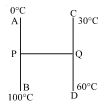
- 8Three identical rods $AB$, $CD$ and $PQ$ are joined as shown. $P$ and $Q$ are mid points of $AB$ and $CD$ respectively. Ends $A, B, C$ and $D$ are maintained at $0^o C, 100^o C, 30^o C$ and $60^o C$ respectively. The direction of heat flow in $PQ$ isView Solution
- 9A copper rod $2\,m$ long has a circular cross-section of radius $1\, cm$. One end is kept at $100^o\,C$ and the other at $0^o\,C$ and the surface is covered by nonconducting material to check the heat losses through the surface. The thermal resistance of the bar in degree kelvin per watt is (Take thermal conductivity $K = 401\, W/m-K$ of copper):-View Solution
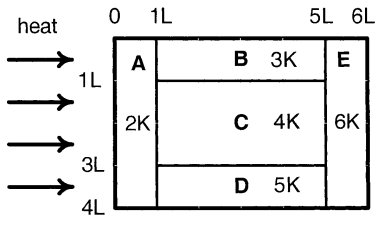
- 10A composite block is made of slabs $A, B, C, D$ and $E$ of different thermal conductivities (given in terms of a constant $K$ ) and sizes (given in terms of length, $L$ ) as shown in the figure. All slabs are of same width. Heat $'Q'$ flows only from left to right through the blocks. Then in steady state $Image$View Solution
$(A)$ heat flow through $A$ and $E$ slabs are same.
$(B)$ heat flow through slab $E$ is maximum.
$(C)$ temperature difference across slab $E$ is smallest.
$(D)$ heat flow through $C =$ heat flow through $B +$ heat flow through $D$.