MCQ
At what speed should a source of sound move so that stationary observer finds the apparent frequency equal to half of the original frequency
  • A
    $\frac{v}{2}$
  • B
    $2v$
  • C
    $\frac{v}{4}$
  • $v$

Answer

Correct option: D.
$v$
d
(d) Frequency is decreasing (becomes half), it means source is going away from the observes. In this case frequency observed by the observer is

$n' = n\left( {\frac{v}{{v + {v_s}}}} \right)$ ==> $\frac{n}{2} = n\,\left( {\frac{v}{{v + {v_S}}}} \right)$ ==>${v_S} = v$

Need a full question paper?

Generate a complete, print-ready paper with questions like this in minutes — across 16+ boards, with answer keys.
Start Generating Free

Similar questions

Two gases have the same initial pressure, volume and temperatue. They expand to the same final volume, one adiabatically and the other isothermally
Let $A_n$ be the area enclosed by the $n^{th}$ orbit in a hydrogen atom. The graph of ln $\Big(\frac{\text{A}_\text{n}}{\text{A}_1}\Big)$ against in $(n):$
The potential energy of a particle varies with distance $x$ from a fixed origin as $U=\frac{A \sqrt{x}}{x^2+B}$, where $A$ and $B$ are dimensional constants then dimensional formula for $A B$ is
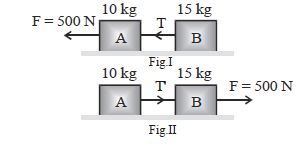
Two bodies $A$ and $B$ of masses $10\,\, kg$ and $15\, kg$ respectively kept on a smooth, horizontal surface are tied to the ends of a light string. If $T$ represents the tension in the string when a horizontal force $F = 500\, N$ is applied to $A$ (as shown in figure $1$) and $T'$ be the tension when it is applied to $B$ (figure $2$), then which of the following is true
The elasticity of invar
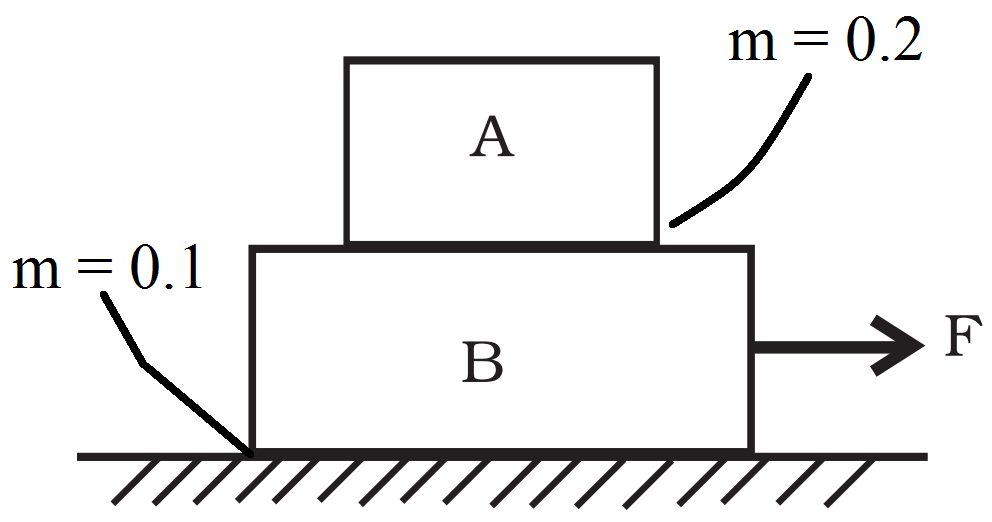
In the co$-$efficient of friction between the floor and the body $B$ is $0.1$ . The co$-$efficient of friction between the bodies $B$ and $A$ is $0.2 .$ A force $F$ is applied as shown on $B$. The mass of $A$ is $m / 2$ and of $B$ is $m$. Which of the following statements are true?
A particle starting from rest and moving with a uniform acceleration along a straight line covers distances $a$ and $b$ in successive intervals of $p$ and $q$ second. The acceleration of the particle is
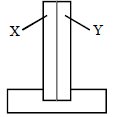
A bimetallic strip consists of metals $X$ and $Y$. It is mounted rigidly at the base as shown. The metal $X$ has a higher coefficient of expansion compared to that for metal $Y$. When the bimetallic strip is placed in a cold bath:
What determines the nature of the path followed by the particle
Two trains ' $A$ ' and ' $B$ ' of length ' $l$ ' and ' $4 l$ ' are travelling into a tunnel of length ' $L$ ' in parallel tracks from opposite directions with velocities $108\,km / h$ and $72\,km / h$, respectively. If train '$A$' takes $35\,s$ less time than train ' $B$ ' to cross the tunnel then, length ' $L$ ' of tunnel is $...........\,m$

$\text { (Given } L=60 l \text { ) }$