Question
Balance the following ionic equations. $\text{Cr}_2\text{O}^{2-}_7+\text{Fe}^{2+}+\text{H}^+\xrightarrow{ \ \ \ \ \ \ \ \ }\text{Cr}^{3+}+\text{Fe}^{3+}+\text{H}_2\text{O}$
Answer


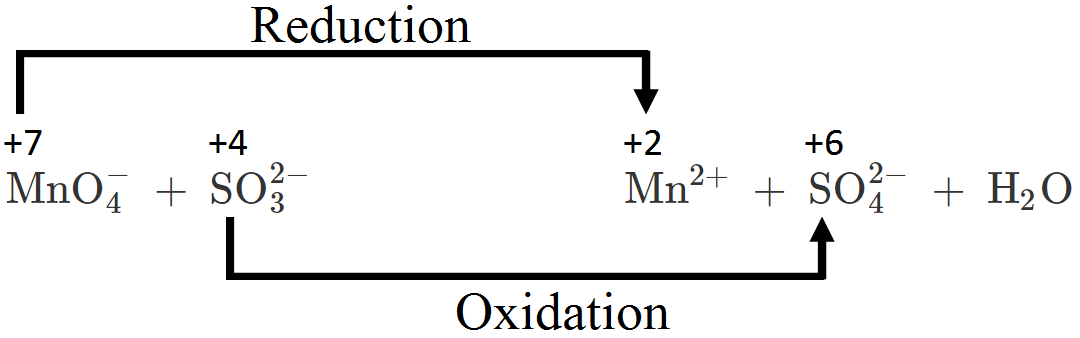
Step-1: Separate the equation into two half reactions.
The oxidation number of various atoms are shown below:
$\stackrel{+6 \ \ -2 \ \ \ \ \ \ \ }{\text{Cr}_2\text{O}^{2-}_7}+\stackrel{+2 \ \ \ \ \ \ \ }{\text{Fe}^{2+}}+\stackrel{+1 \ \ \ }{\text{H}^+}\xrightarrow{ \ \ \ \ \ \ \ \ }\stackrel{+3}{\text{Cr}^{3+}}+\stackrel{+3}{\text{Fe}^{3+}}+\stackrel{+1 \ \ -2}{\text{H}_2\text{O}}$
In this case, chromium undergose reduction, oxidation number decreases from $+6(\text{in }\text{Cr}_2\text{O}^{2-}_7)\text{ to}+3(\text{in Cr}^{3+})$
$Fe^{2+} (O.N. = +2)$ changes to $Fe^{3+}$ (O.N. = +3). The species undergoing oxidation and reduction are:
Oxidation: $\text{Fe}^{2+}\xrightarrow{ \ \ \ \ \ \ \ }\text{Fe}^{3+}$
reduction: $\text{Cr}_2\text{O}^{2-}_7\xrightarrow{ \ \ \ \ \ \ \ \ }\text{Cr}^{3+}$
Step-2: Balance each half reaction separately as:
  1. $\text{Fe}^{2+}\xrightarrow{ \ \ \ \ \ \ \ \ }\text{Fe}^{3+}$
  1. Balance all atoms other than H and O. This step is not needed, because, it is already balanced.
  2. The oxidation number on left is +2 and on right is +3. To account for the difference, the electron is added to the right as: $\text{Fe}^{2+}\xrightarrow{\ \ \ \ \ \ \ \ }\text{Fe}^{3+}+\text{e}^-$
  3. Charge is already balanced.
  4. No need to add H or O.
The balanced half equation is:
$\text{Fe}^{2+}\xrightarrow{ \ \ \ \ \ \ \ }\text{Fe}^{3+}+\text{e}^-...(\text{i})$
Consider the second half equation
$\text{Cr}_2\text{O}^{2-}_7\xrightarrow{ \ \ \ \ \ \ \ \ }\text{Cr}^{3+}$
  1. Balance the atoms other than H and O.
$\text{Cr}_2\text{O}^{2-}_7\xrightarrow{ \ \ \ \ \ \ \ \ }2\text{Cr}^{3+}$
  1. The oxidation number of chromium on the left is +6 and on the right is +3. Each chromium atom must gain three electrons. Since there are two Cr atoms, add $6e^–$ on the left.
$\text{Cr}_2\text{O}^{2-}_7+6\text{e}^-\xrightarrow{ \ \ \ \ \ \ \ \ }2\text{Cr}^{3+}$
  1. Since the reaction takes place in acidic medium add $14H^+$ on the left to equate the net charge on both sides.
$\text{Cr}_2\text{O}^{2-}_7+6\text{e}^-+14\text{H}^+\xrightarrow{ \ \ \ \ \ \ \ \ \ }2\text{Cr}^{3+}$
  1. To balance FI atoms, add $7H_2O$ molecules on the right.
$\text{Cr}_2\text{O}^{2-}_7+6\text{e}^-+14\text{H}^+\xrightarrow{ \ \ \ \ \ \ \ \ }2\text{Cr}^{3+}+7\text{H}_2\text{O}...(\text{ii})$
This is the balanced half equation.
Step-3: Now add up the two half equations. Multiply eq. (i) by 6 so that electrons are balanced.
$ \ \ \ \ \ \ \ \ \ \ \ \ \ \ \ \ \ \ \ \ \ \ \ \ \ \ \ \ \ \ \ \ \ \ \ \ \text{Fe}^{2+}\xrightarrow{ \ \ \ \ \ \ \ \ \ }\text{Fe}^{3+}+\text{e}^-\times6\\ \ \ \ \ \ \ \ \ \text{Cr}_2\text{O}^{2-}_7+6\text{e}^-+14\text{H}\xrightarrow{ \ \ \ \ \ \ \ \ \ }2\text{Cr}^{3+}+7\text{H}_2\text{O} \ \ \ \ \ \ \ \ \ \ \ \ \ \ \ \ \ \ \ \ \\ \underline{ \ \ \ \ \ \ \ \ \ \ \ \ \ \ \ \ \ \ \ \ \ \ \ \ \ \ \ \ \ \ \ \ \ \ \ \ \ \ \ \ \ \ \ \ \ \ \ \ \ \ \ \ \ \ \ \ \ \ \ \ \ \ \ \ \ \ \ \ \ \ \ \ \ \ \ \ \ \ \ \ \ \ \ \ \ \ \ \ \ \ \ \ \ \ \ \ \ \ \ } \\6\text{Fe}^{2+}+\text{Cr}_2\text{O}^{2-}_7+14\text{H}^+\xrightarrow{ \ \ \ \ \ \ \ \ \ \ \ }6\text{Fe}^{3+}+2\text{Cr}^{3+}+7\text{H}_2\text{O}\ \ \ \ \ \ \ \ \ \ \ \ \ \ \ \ \ \ \ \ \ \ \ \ \ \ \ \ \ \ \ \ \ \ \ \ \ \ \ \ \ \ \ \ \ \ \ \ \ \ \ \ \ \ \ \ \ \ \ \ \ \ \ \ \ $

Need a full question paper?

Generate a complete, print-ready paper with questions like this in minutes — across 16+ boards, with answer keys.

Start Generating Free

Similar questions

A liquid with high boiling point decomposes on simple distillation but it can be steam distilled for its purification. Explain how is it possible?
S. No
Column I
Column II
1.
$[Mn(CO)_5]^-$
+6
2.
$[Mn_2(CO)_{10}]$
+2
3.
$K_4[Mn(CN)_6]$
0
4.
$K_2MnO_4$
-1
Match Column I with Column II.
S. No Column I (Reaction) S. No Column II (Equilibrium constant)
1. $2\text{N}_2(\text{g})+6\text{H}_2(\text{g})\rightleftharpoons4\text{NH}_3(\text{g})$ (i) $2\text{K}_{\text{c}}$
2. $2\text{NH}_3(\text{g})\rightleftharpoons\text{N}_2(\text{g})+3\text{H}_2(\text{g})$ (ii) $\text{K}_{\text{c}}^{\frac{1}{2}}$
3. $\frac{1}{2}\text{N}_2\text{(g)}+\frac{3}{2}(\text{g})\rightleftharpoons\text{NH}_3(\text{g})$ (iii) $\frac{1}{\text{K}}$
4.   (iv) $\text{K}^2_{\text{c}}$
  1. The density of the water at room temperature is $0.1g/ mL$. How many molecules are there in a drop of water if its volume is $0.05mL$?
  2. An alloy of iron $(53.6\%)$, nickel $(45.8\%)$ and manganese $(0.6\%)$ has a density of $8.17g cm^{-3}$
Calculate the number of Ni atoms present in the alloy of dimensions $10.0cm \times 20.0cm \times 15.0cm$
Write two points of similarity in properties of Beryllium and Aluminium.
Calculate the degree of ionization of 0.05 M acetic acid if its $pK _{ a }$ value is 4.74 . How is the degree of dissociation affected when its solution also contains
a. 0.01 M
b. 0.1 M HCl ?
1. An organic liquid decomposes below its boiling point. How will you purify it?
2. Name three types of chromatography?
How is heavy water prepared? Compare its physical properties with those of ordinary water.
Calculate the enthalpy change on freezing of 1.0 mol of water at $10.0^{\circ} C$ to ice at $-10.0^{\circ} C$.
$\Delta_{\text {fus }} H=6.03 kJ mol^{-1} \text { at } 0^{\circ} C .$
$C_{p}\left[H_2 O(l)\right]=75.3 J mol^{-1} K^{-1}$
$C_{p}\left[H_2 O(s)\right]=36.8 J mol^{-1} K^{-1}$
Derive the relationship between $\Delta\text{H}$ and $\Delta\text{U}$ for an ideal gas. Explain each term involved in the equation.