Question
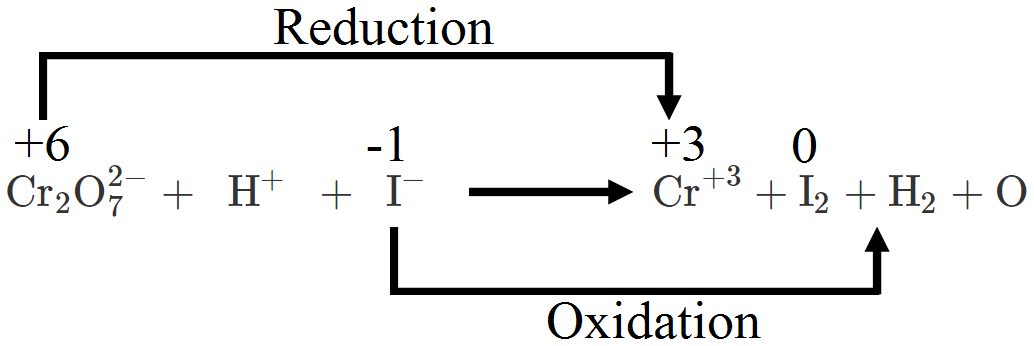
Balance the following ionic equations. $\text{Cr}_2\text{O}^{2-}_7+\text{H}^++\text{I}^-\xrightarrow{ \ \ \ \ \ \ \ \ \ }\text{Cr}^{3+}+\text{I}_2+\text{H}_2\text{O}$
Answer


Dividing the equation into two half reactions:
Oxidation half reaction: $\text{I}^-\xrightarrow{ \ \ \ \ \ \ \ }\text{I}_2$
Reduction half reaction: $\text{Cr}_2\text{O}^{2-}_7\xrightarrow{ \ \ \ \ \ \ \ }\text{Cr}^{3+}$
Balancing oxidation and reduction half reactions separately as:
Oxidation half reaction
$\text{I}^{-}\xrightarrow{ \ \ \ \ \ \ \ }\text{I}_2$
$2\text{I}^-\xrightarrow{ \ \ \ \ \ \ \ }\text{I}_2$
$\text{2I}^-\xrightarrow{ \ \ \ \ \ \ \ \ }\text{I}_2+2\text{e }^-...(\text{i})$
Reduction half reaction
$\text{Cr}_2\text{O}^{2-}_7\xrightarrow{ \ \ \ \ \ \ \ \ }\text{Cr}^{3+}$
$\text{Cr}_2\text{O}^{2-}_7\xrightarrow{ \ \ \ \ \ \ \ }2\text{Cr}^{3+}$
$\text{Cr}_2\text{O}^{2-}_7+6\text{e}^-\xrightarrow{ \ \ \ \ \ \ \ \ }2\text{Cr}^{3+}$
$\text{Cr}_2\text{O}^{2-}_7+14\text{H}^++6\text{e}^-\xrightarrow{ \ \ \ \ \ \ \ \ }2\text{Cr}^{3+}+7\text{H}_2\text{O }...(\text{ii})$
To balance the electrons, multiply eq. (i) by 3 and add to eq. (ii)
$\text{Cr}_2\text{O}^{2-}_7+14\text{H}^++6\text{I}^-\xrightarrow{ \ \ \ \ \ \ \ \ }2\text{Cr}^{3+}+3\text{I}_2+7\text{H}_2\text{O}$

Need a full question paper?

Generate a complete, print-ready paper with questions like this in minutes — across 16+ boards, with answer keys.

Start Generating Free

Similar questions

For the following bond cleavages, use curved-arrows to show the electron flow and classify each as homolysis or heterolysis. Identify reactive intermediate produced as free radical, carbocation and carbanion.
Complete the reactions:
  1. $\text{CH}_3\text{CH}_2\text{CH}_3+\text{HNO}_3\xrightarrow{\text{Vapour phase}}$
  2. $\text{CH}_4+\text{O}_2\xrightarrow[723-773\text{K}]{\text{Copper tube}}$
  3. $\text{C}_2\text{H}_5\stackrel{{\ \ \ \ \ \ \ \ \ -}}{\hbox{COO} }\stackrel{{+}}{\hbox{Na}}+\text{NaOH}\xrightarrow{\text{CaO}}$
  1. What is the state of hybridisation of nitrogen in $\text{NH}_4^+$ ion?
  2. Draw the shape of $\mathrm{PH}_3$ and $\mathrm{SF}_6$ according to VSEPR theory.
  3. Which hybrid orbitals are used by carbon atoms in $\text{CH}_3-\text{CHO}?$
If $6.022 \times 10^{23}$ molecules of $\mathrm{N}_2$, react completely with $\mathrm{H}_2$ according to the equation:
$\mathrm{N}_2(\mathrm{~g})+3 \mathrm{H}_2(\mathrm{~g}) \rightarrow 2 \mathrm{NH}_3(\mathrm{~g})$
then calculate the number of molecules of $\mathrm{NH}_3$ formed.
With help of following values calculate energy of $> C = C <$ bond :
$
\begin{array}{l}
2 C(s)+2 H_2(g)=C_2 H_4(g) ; \Delta H=52.6 kJ \\
C(s) \rightarrow C(g) ; \Delta H=716.68 kJ \\
H_2(g)=2 H(g) ; \Delta H=435.84 kJ \\
\text { and } C-H \text { bond energy }=+413 kJ
\end{array}
$
10 mL of H , combine with 5 mL of $\mathrm{O}_2$ to form water. When 200 mL of H , at STP is passed over heated CuO, the CuO loses 0.144 g of its weight. Does the above data correspond to the law of constant composition?
135mL of a gas is collected over water at 25°C and 0.993bar. If the gas weighs 0.160g and the aqueous tension at 25°C is 0.0317, calculate the molar mass of the gas.
Explain the deviation in ionisation enthalpy of some elements from the general trend by using.
Note: Consider structures I to VII and answer the questions:
  1. $\text{CH}_3-\text{CH}_2-\text{CH}_2-\text{CH}_2-\text{OH}$
  2. $\text{CH}_3-\text{CH}_2-\text{CH}-\text{CH}_3\\\ \ \ \ \ \ \ \ \ \ \ \ \ \ \ \ \ \ \ \ \ \ \ \ \ \ |\\\ \ \ \ \ \ \ \ \ \ \ \ \ \ \ \ \ \ \ \ \ \ \ \ \ \text{OH}$
  3. $\ \ \ \ \ \ \ \ \ \ \ \ \text{CH}_3\\\ \ \ \ \ \ \ \ \ \ \ \ \ |\\\text{CH}_3-\text{C}-\text{CH}_3\\\ \ \ \ \ \ \ \ \ \ \ \ \ |\\\ \ \ \ \ \ \ \ \ \ \ \ \text{OH}$
  4. $\text{CH}_3-\text{CH}-\text{CH}_2-\text{OH}\\\ \ \ \ \ \ \ \ \ \ \ \ \ \ \ \ \ \ \ \ \ \ \ \ |\\\ \ \ \ \ \ \ \ \ \ \ \ \ \ \ \ \ \ \ \ \ \ \ \text{CH}_3$
  5. $\text{CH}_3-\text{CH}_2-\text{O}-\text{CH}_2-\text{CH}_3$
  6. $\text{CH}_3-\text{O}-\text{CH}_2-\text{CH}_2-\text{CH}_3$
  7. $\text{CH}_3-\text{O}-\text{CH}-\text{CH}_3\\\ \ \ \ \ \ \ \ \ \ \ \ \ \ \ \ \ \ \ \ \ \ |\\\ \ \ \ \ \ \ \ \ \ \ \ \ \ \ \ \ \ \ \ \ \text{CH}_3$
Identify the pairs of compounds which are functional group isomers.
Calculate the atomic mass (average) of chlorine using the following data:
 
% Natural Abundance
Molar Mass
${ }^{35} \mathrm{Cl}$
75.77
34.9689
${ }^{35} \mathrm{Cl}$
24.23
36.9659