Beats are produced by two waves given by $y_1 = a\,\, sin\,\,2000\,\, \pi t$ and $y_2 = a\,\, sin\,\, 2008\,\, \pi t$ . The number of beats heard per second is
Medium


Download our appand get started for free
Experience the future of education. Simply download our apps or reach out to us for more information. Let's shape the future of learning together!No signup needed.*
Similar Questions
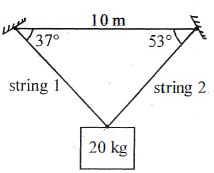
- 1A mass of $20\ kg$ is hanging with support of two strings of same linear mass density. Now pulses are generated in both strings at same time near the joint at mass. Ratio of time, taken by a pulse travel through string $1$ to that taken by pulse on string $2$ isView Solution
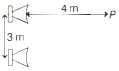
- 2Two small identical speakers are connected in phase to the same source. The speakers are $3 \,m$ apart and at ear level. An observer stands at $P, 4 \,m$ in front of one speaker as shown alongside. The sound she hears is least intense when the wavelength is $\lambda_1$ and most intense when the wavelength is $\lambda_2$. Then, the possible values of $\lambda_1$ and $\lambda_2$ areView Solution
- 3The vibrations of a string of length $60\, cm$ fixed at both the ends are represented by the equation $y = 2\,\sin \,\left( {\frac{{4\pi x}}{{15}}} \right)\,\cos \,\left( {96\pi t} \right)$ where $x$ and $y$ are in $cm$. The maximum number of loops that can be formed in it isView Solution
- 4A whistle revolves in a circle with an angular speed of $20\; rad/sec$ using a string of length $50 \;cm.$ If the frequency of sound from the whistle is $385\; Hz,$ then what is the minimum frequency heard by an observer, which is far away from the centre in the same plane ... $Hz$ ? ($v = 340 \;m/s$)View Solution
- 5Two closed organ pipes of length $100\,cm$ and $101\,cm$ long give $16$ beats in $20\,sec$ when each pipe is sounded in fundamental mode. Calculate velocity of sound .... $ms^{-1}$View Solution
- 6View SolutionSound travels in rocks in the form of
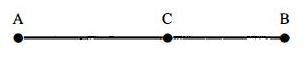
- 7$A$ and $B$ are two sources generating sound waves. A listener is situated at $C$ . The frequency of the source at $A$ is $500\,Hz$ . $A,$ now, moves towards $C$ with a speed $4\,m/s.$ The number of beats heard at $C$ is $6.$ When $A$ moves away from $C$ with speed $4\,m/s,$ the number of beats heard at $C$ is $18.$ The speed of sound is $340\,m/s.$ The frequency of the source at $B$ is ..... $Hz$View Solution
- 8The intensity of sound after passing through a slab decreases by $30\%$. On passing through two such slabs, the intensity will decrease by ..... $\%$View Solution
- 9Two interfering waves have the same wavelength, frequency, and amplitude. They are traveling in the same direction but are $90^o$ out of phase. Compared to the individual waves, the resultant wave will have the same.View Solution
- 10An open organ pipe of length $l$ is sounded together with another organ pipe of length $l + x$ in their fundamental tones $(x < < l)$. The beat frequency heard will be (speed of sound is $v$) :View Solution