MCQ
Bond dissociation enthalpy of $H_2, Cl_2$ and $HCl$ are $434, 242$ and $431\ kJ\, mol^{-1}$ respectively. Enthalpy of formation of $HCl$ is ............... $\mathrm{kJ \,mol}^{-1}$
- ✓$-93$
- B$245$
- C$93$
- D$-245 $
$\Delta H_{\text {reaction }}=\Sigma(\mathrm{B.E})_{\text {reactant }}-\Sigma(\mathrm{B.E})_{\text {product }}$
$=\left[(\mathrm{B.E})_{\mathrm{H}-\mathrm{H}}+(\mathrm{B.E})_{\mathrm{Cl}-\mathrm{Cl}}\right]-\left[2 \mathrm{B.E}_{(\mathrm{H}-\mathrm{Cl})}\right]$
$=434+242-(431) \times 2$
$\Delta H_{\text {reaction }}=-186 \mathrm{kJ}$
Heat of formation is the amount of heat absorbed or evolved when one mole of substance is directly obtained from its constituent element.
Hence, enthalpy of formation of $\mathrm{HCl}=-186 / 2\; \mathrm{kJ}$
$=-93 \;\mathrm{kJ} \mathrm{mol}^{-1}$
Generate a complete, print-ready paper with questions like this in minutes — across 16+ boards, with answer keys.
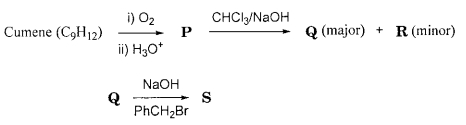
(image)
($A$) $R$ is steam volatile
($B$) $Q$ gives dark violet coloration with $1 \%$ aqueous $FeCl_3$ solution
($C$) $S$ gives yellow precipitate with $2, 4$-dinitrophenylhydrazine
($D$) $S$ gives dark violet coloration with $1 \%$ aqueous $FeCl_3$ solution