Question
Briefly discuss Lamarckian Theory of Inheritance citing an appropriate example.

Answer

  • According to the theory of inheritance of acquired characters, 'the changes in structure or function of any organ acquired during the life-time of an individual in response to changes in the surrounding environment are inherited by offspring and keep on adding over a period of time'.
  • This theory states that characters are acquired by animals in two ways:

  • - Effects of environment
    - Use and disuse of body parts
  • For example, the long neck of giraffe is explained by Lamarck on the same principle. Giraffe, which lived in the dry and arid deserts of Africa, tried to reach the foliage high up on the trees to eat them as there was no vegetation on the ground. In the process, its neck and forelegs got stretched a bit and this was inherited by the next generation. Then, in the next generation, the same efforts continued. Gradually, through many successive generations, we got a giraffe having a long neck and long forelegs.
  • Need a full question paper?

    Generate a complete, print-ready paper with questions like this in minutes — across 16+ boards, with answer keys.

    Start Generating Free

    Similar questions

    Is ozone depletion related to global warming?
    Given below are a few situations. What effective change will occur in the organ/body part mentioned and which part (sympathetic or parasympathetic) of the autonomic nervous system brings it about?
    SituationOrgan/body partChange/actionPart of autonomic nervous system involved
    1. You have entered a dark roomEye
    2. Your body is consuming lot of glucose while running a raceLiver
    3. You are chewing a tasty foodSalivary gland
    4. You are running a raceAdrenal gland
    5. You are retiring to bed for sleepHeart
    6. You are shivering in intense coldBody hairs
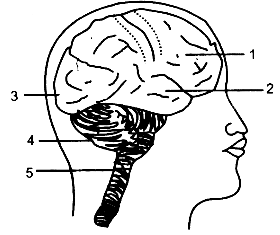
    The following diagram is that of a human brain. Guidelines 1 to 5 indicate different parts of the surface of the brain and these are as follows:
    1. The frontal lobe of the cerebrum
    2. The temporal lobe of the cerebrum
    3. The occipital lobe of the cerebrum
    4. Cerebellum
    5. Medulla oblongata
    Study the diagram and answer the following questions:
    (i) What handicaps would result from:
    (a) Damage toçart numbered 3.
    (b) Damage to part numbered 4.
    (ii) Mention one main function of each of the parts numbered 1,2, and 5.
    Name and explain the various stages of the cell cycle.
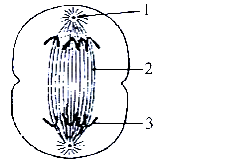
    The diagram below represents a stage during cell division. Study the same and then answer the question that follow:

    a) Name the parts labelled 1, 2, and 3.
    b) Identify the above stage and give a reason to support your answer.
    c) Mention where in the body this type of cell division occurs.
    d) Name the stage prior to this stage and draw a diagram to represent the same.
    Describe an experiment to prove that transpiration occurs more from the lower surface of a leaf.
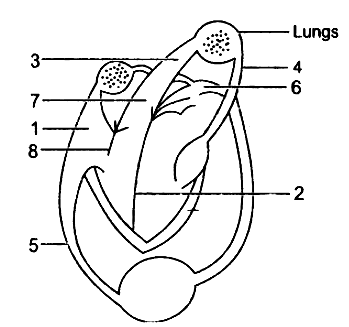
    The figure below represents the internal structure of a mammalian heart and the associated blood vessels.

    (i) (a) Name each of the structures labeled 1, 2, 3, 4, 5, 6, 7 and 8.
    (b) State the function of each of the structures 5, 6, 7, and 8.
    (ii) (a) State the function of the heart as an entire organ.
    (b) Why are the walls of the left ventricle more muscular than the right?
    Differentiate between:
    genotype and phenotype
    Explain the functioning of kidney.
    Differentiate between:
    Red blood cells and White blood cells