Question
Briefly explain the concept of GST.

Answer

Goods and Services Tax (GST): It is a tax levied and collected on supply (sale) of goods and/ or services or both. It is charged by the seller on the net sale value, i.e., sale value less trade discount. The seller is bound to charge GST on sale made and deposit it in the Government Account. For the seller of goods, it is not sale because it is collected on behalf of the Government and is to be paid into Government Account.
In the case of intra-state (i.e., within the state) sale of goods, both CGST and SGST is charged at half the prescribed rate of GST. And in the case of inter-state (i.e., outside the state) sale of goods, IGST is charged at the prescribed rate of GST.
CGST and SGST charged on intra-state sale of goods is credited to 'Output CGST Account and Output SGST Account' respectively. IGST charged on inter-state sale of goods is credited to Output IGST Account.

Need a full question paper?

Generate a complete, print-ready paper with questions like this in minutes — across 16+ boards, with answer keys.

Start Generating Free

Similar questions

On 1st January, 2019, Ram of Kolkata commenced business with a capital of ₹ 50,000 and entered into following transactions:
Pass the following transactions through proper books to the Ledger. Take out a Trial Balance as on 31st January, 2019. The Cash Book must be balanced.
2019  
Jan. 1 Opened a Bank Account and Deposited ........ 12,500
  Purchased Goods against Cash Payment* ........ 20,000
  Purchased furniture for Shop* ........ 5,000
  Sold goods to R. Raman, Kolkata* ........ 5,000
Jan. 2 Bought goods from Man Mohan, Delhi** ........ 10,000
Jan. 3 Bought stationery and paid by cash ........ 1,000
Jan. 5 Received cash from R. Raman ........ 5,300
  Discount allowed to him ........ 300
Jan. 6 Sold goods to Bimal, Kolkata* ........ 7,500
Jan. 8 Bimal returned part of the goods supplied on the 6th instant ........ 1,500
Jan. 10 Paid cash into bank ........ 1,000
Jan. 12 Paid wages ........ 1,500
Jan. 13 Bought on credit from the Union Furniture Co., Kolkata office desk* ........ 1,500
Jan. 19 Paid wages ........ 1,500
Jan. 21 Paid to Man Mohan by cheque ........ 10,700
  Discount received ........ 500
Jan. 21 Sold goods to Ramesh, Guwahati including IGST** ........ 6,720
Jan. 22 Received cheque from Bimal ........ 6,000
Jan. 23 Bought goods from Man Mohan, Delhi** ........ 7,000
Jan. 24 Drew by cheque for personal use ........ 2,000
Jan. 27 Paid wages ........ 1,500
Jan. 31 Rent due to landlord* ........ 1,000
Transactions marked with (*) are intra-state transactions subject to CGST and SGST @ 6% each.
Transactions marked with (**) are inter-state transactions subject to IGST @ 12%.
Explain any five type of accounting vouchers in Tally.
Tulsi started business on $1^{st}$April, $2016$ with a capital of ₹ 4,50,000. On $31^{st}$​​​​​​​ March,$ 2017:$ her position was as under:

She owed ₹ $45,000$ to her friend Parvati on that date. She withdrew ₹ $8,000 $per month for household purposes. Ascertain her profit or loss for the year ended $31^{st}​​​​​​​$​​​​​​​ March,$ 2017:$
What do you understand by database. How does it differ from DBMS?
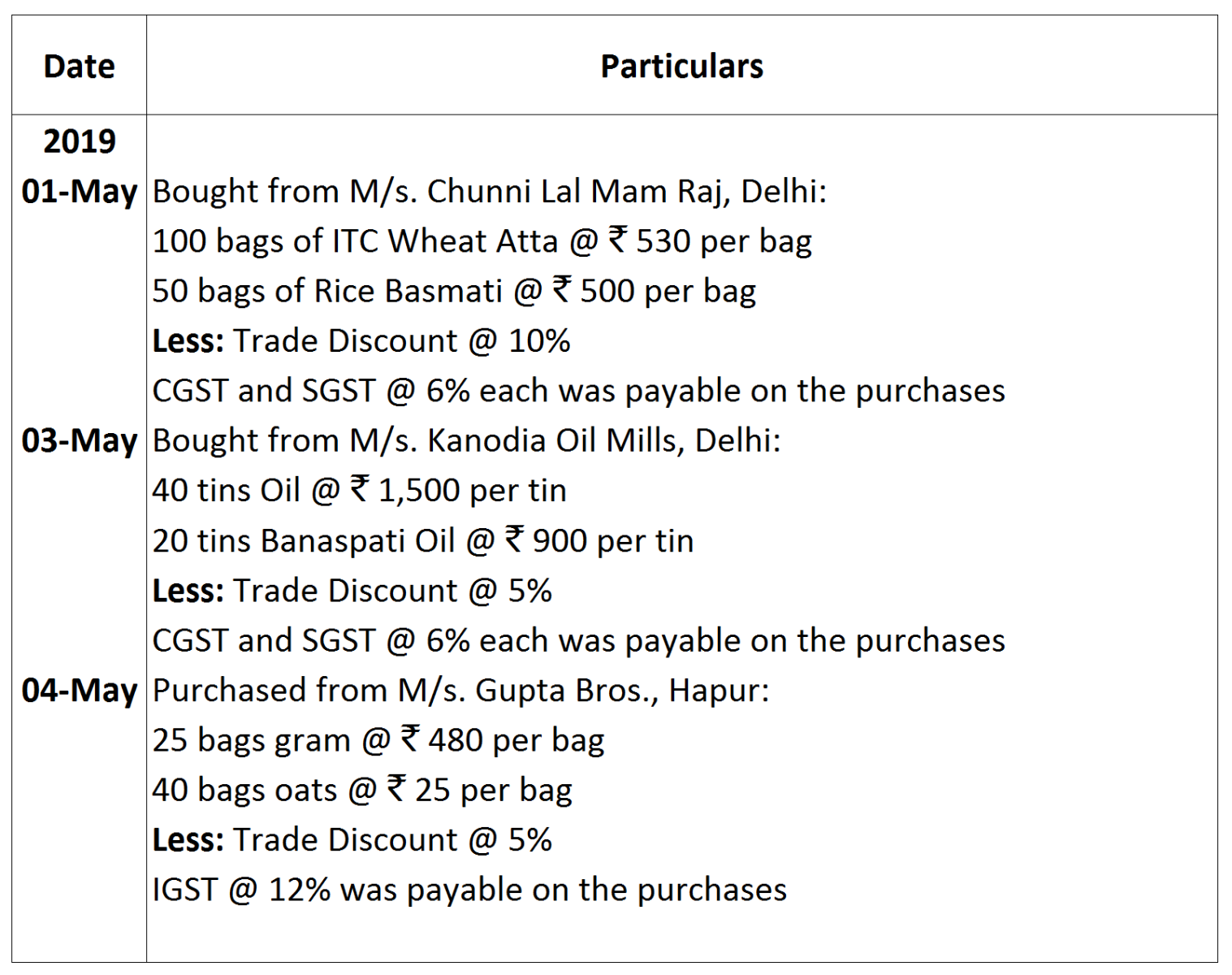
Record the following transactions in the Purchases Book of Subhash General Stores, Delhi:
Leena sold goods to Meena on 1st March, 2009 for ₹ 68,000 and drew two Bills of Exchange of the equal amount upon Meena payable after three months. Leena immediately discounted the first bill with her bank at 12% p.a. The bill was dishonoured by Meena and Bank paid ₹ 55 as noting charges.
The second bill was retired on 4th May, 2009 under a rebate of 6% p.a. with mutual agreement.
Journalise the above in the books of Leena and Meena.
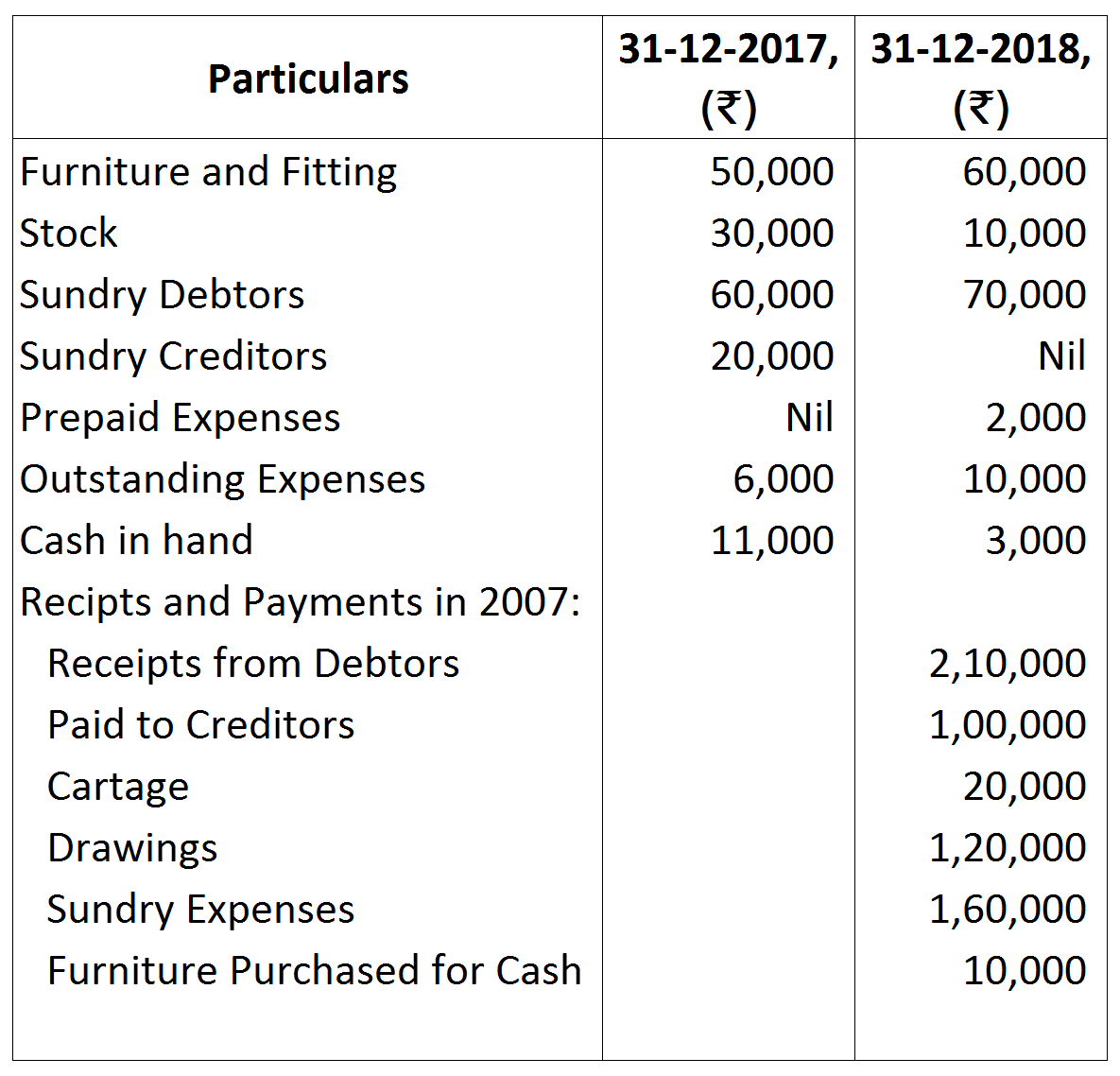
Sonam keeps his books on single entry and provides you with the following information:
Prepare Trading and Profit & Loss Account for the year ended 31 December, 2018 after providing for bad debts at 10%.
There was a considerable amount of Cash Sales.
On 1st October, 2011, X Ltd. purchased a machinery for ₹ 2,50,000. A part of machinery which was purchased for ₹ 20,000 on 1st October, 2011 became obsolete and was disposed off on 1st January, 2014 (having a book value ₹ 17,100 on 1st April, 2013) for ₹ 2,000. Depreciation is charged @ 10% annually on written down value. Prepare Machinery Disposal Account and also show your workings. The books being closed on 31st March of every year.
Bring out the relationship between AIS and Marketing Information System.
Ashok keeps incomplete records. The position of his business on $1^{st}$ April, $2016$ was as follows:
Cash in Hand $₹\ 2,200;$ Cash at Bank $₹\ 5,400;$ Stock $₹\ 25,100;$ Sundry Debtors $₹\ 18,700;$ Furniture $₹\ 6,000; $Sundry Creditors ₹\ $13,500$.
His position on $31^{st}$ March, $2017$ was as follows:
Cash in Hand $₹\ 1,500$; Cash at Bank $₹\ 8,400;$ B/R $₹\ 3,300;$ Stock $₹\ 26,000$; Sundry Debtors $₹\ 24,600;$ Furniture $₹\ 8,000;$ Sundry Creditors $₹\ 14,200.$
During the year he had withdrawn from the business $₹\ 18,000,$ of which $₹\ 9,200$ were spent in purchasing a Typewriter for the business.
  1. Depreciate furniture and typewriter by $10\%.$
  2. Write off $₹\ 600$ as Bad-Debts.
  3. Make a provision of $5\%$ on Debtors for doubtful debts.
Calculate the profit or loss of his business for the year ended $31^{st}$ March, $201$7 and prepare a final statement of affairs, after the above adjustments.