Question
By explaining diamagnetic, paramagnetic and ferromagnetic substances, analyse their characteristic properties.###Define diamagnetic, paramagnetic and ferromagnetic substances and analyse their characteristics on the basis of (a) reason for magnetic property (b) relative magnetic permeability (c) magnetic susceptibility (d) intensity of magnetisation (e) magnetic induction.
Answer

SELF

Need a full question paper?

Generate a complete, print-ready paper with questions like this in minutes — across 16+ boards, with answer keys.

Start Generating Free

Similar questions

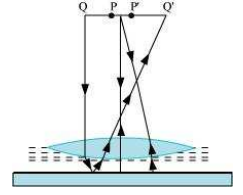
equiconvex lens $($of refractive index $1.50)$ in contact with a liquid layer on top of a plane mirror. A small needle with its tip on the principal axis is moved along the axis until its inverted image is found at the position of the needle. The distance of the needle from the lens is measured to be $45.0 \ cm.$ The liquid is removed and the experiment is repeated. The new distance is measured to be $30.0 \ cm.$ What is the refractive index of the liquid?
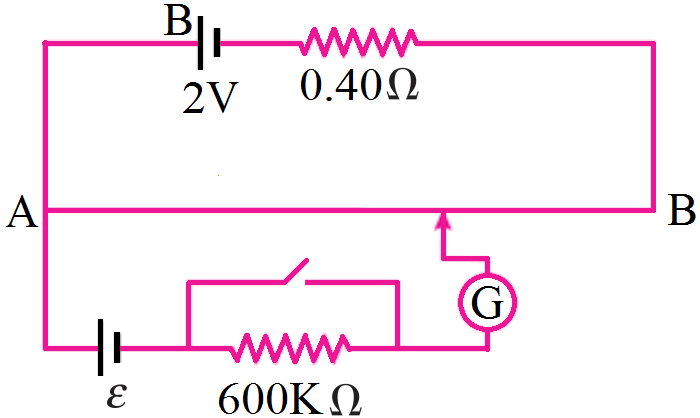
Figure shows a potentiometer with a cell of $2.0V$ and internal resistance of $0.40\Omega$ maintaining a potential drop across the resistor wire $AB.$ A standard cell which maintains a constant emf of $1.02V ($for very moderate currents upto a few $mA)$ gives a balance point at $67.3\ cm$ length of the wire. To ensure very low currents drawn from the standard cell, a very high resistance of $600\ \text{k}\Omega$ is put in series with it, which is shorted close to the balance point. The standard cell is then replaced by a cell of unknown $emf$ and the balance point found similarly, turns out to be at $82.3\ cm$ length of the wire.
  1. What is the value of $\varepsilon?$
  2. What purpose does the high resistance of $600\ \text{k}\Omega$ have?
  3. Is the balance point affected by this high resistance?
  4. Is the balance point affected by the internal resistance of the driver cell?
  5. Would the method work in the above situation if the driver cell of the potentiometer had an $emf$ of $1.0V$ instead of $2.0V$?
  6. Would the circuit work well for determining extremely small $emf,$ say of the order of few $mV ($such as the typical $emf$ of a thermo couple$)$? If not, how would you modify the circuit?
Prove : $n_{12}=\frac{1}{n_{21}}$
State and Prove Gauss theorem in electrostatics.
A wave is described by the equation$\text{y}=(1.0\text{mm})\sin\pi\Big(\frac{\text{x}}{2.0\text{cm}}-\frac{\text{t}}{0.01\text{s}}\Big).$
  1. Find the time period and the wavelength.
  2. Write the equation for the velocity of the particles. Find the speed of the particle at x = 1.0cm at time t = 0.01s.
  3. What are the speeds of the particles at x = 3.0cm, 5.0cm and 7.0cm at t 0.01s?
  4. What are the speeds of the particles at x 1.0cm at t = 0.011, 0.012, and 0.013s?
Find the value of $\frac{\text{t}}{\tau}$ for which the current in an LR circuit builds up to:
  1. 90%,
  2. 99%
  3. 99·9% of the steady-state value.
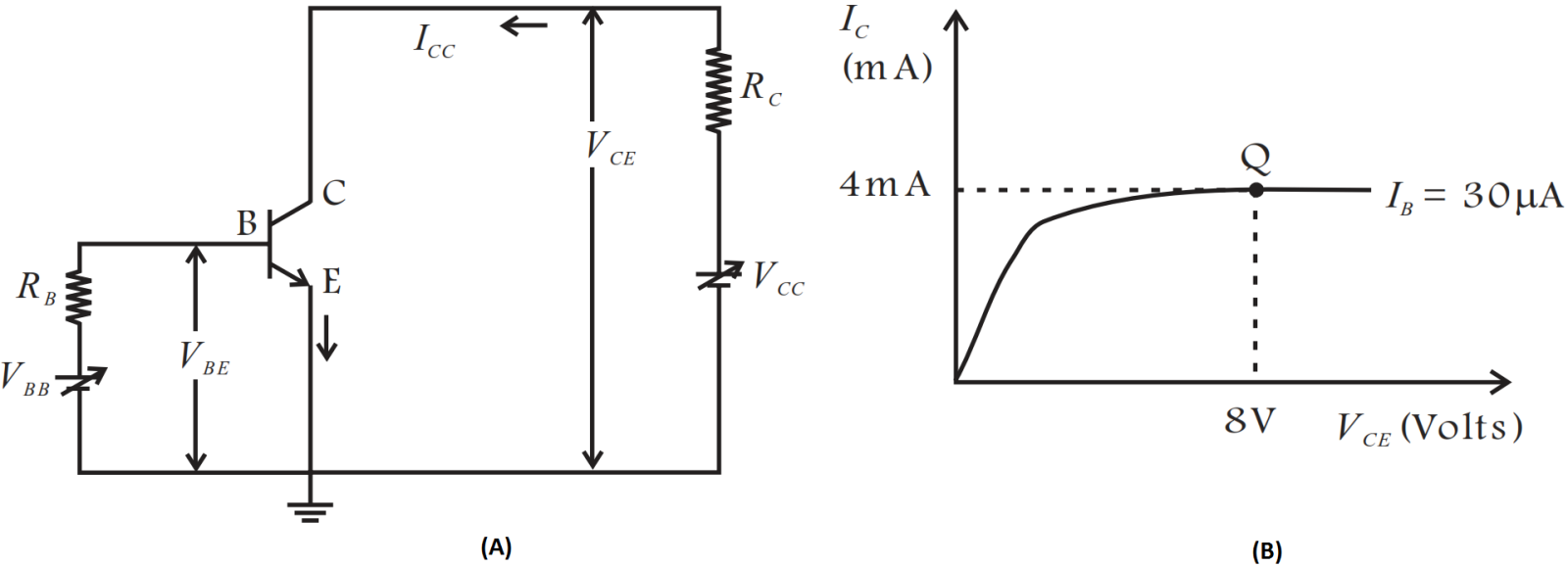
Consider the circuit arrangement shown in Fig $(a)$ for studying input and output characteristics of npn transistor in $CE$ configuration.

Select the values of $R_B$ and $R_C$ for a transistor whose $V_{BE} = 0.7V,$ so that the transistor is operating at point $Q$ as shown in the characteristics shown in Fig. $(b).$
Given that the input impedance of the transistor is very small and $V_{CC} = V_{BB} = 16V,$ also find the voltage gain and power gain of circuit making appropriate assumptions.
A professor reads a greeting card received on his 50th birthday with +2.5D glasses keeping the card 25cm away. Ten years later, he reads his farewell letter with the same glasses but he has to keep the letter 50cm away. What power of lens should he now use?
  1. Draw the circuit diagram of a fullwave rectifier using $p-n$ junction diode. Explain its working and show the output, input waveforms.
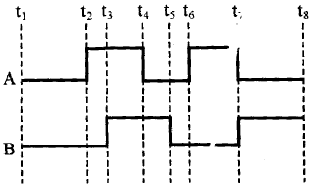
  2. Show the output waveforms $(Y)$ for the following inputs $A$ and $B$ of
    1. $OR$ gate.
    2. $\ce{NAND}$ gate.
Define common potential. Find the expression for redistribution of charges and energy loss when capacitors are connected together.