Calculate the focal length of a convex lens which produces a virtual image at a distance of 50cm of an object placed 20cm in front of it.
Download our app for free and get started
v = -50cm (Virtual image) u = -20cm$\frac{1}{\text{v}}-\frac{1}{\text{u}}=\frac{1}{\text{f}}$
$\frac{1}{-50}-\frac{1}{-20}=\frac{1}{\text{f}}$
$\frac{-2+5}{100}=\frac{1}{\text{f}}$
$\frac{3}{100}=\frac{1}{\text{f}}$
$\text{f}=33.3\text{cm}$
$\frac{1}{-50}-\frac{1}{-20}=\frac{1}{\text{f}}$
$\frac{-2+5}{100}=\frac{1}{\text{f}}$
$\frac{3}{100}=\frac{1}{\text{f}}$
$\text{f}=33.3\text{cm}$

Download our appand get started for free
Experience the future of education. Simply download our apps or reach out to us for more information. Let's shape the future of learning together!No signup needed.*
Similar Questions
- 1View SolutionGive two circumstances in which a concave mirror can form a magnified image of an object placed in
front of it. Illustrate your answer by drawing labelled ray diagrams for both. - 2View SolutionHow far should an object be placed from a convex lens of focal length 20 cm to obtain its image at a distance of 30 cm from the lens? What will be the height of the image if the object is 6 cm tall?
- 3View SolutionA 3 cm tall object is placed 18 cm in front of a concave mirror of focal length 12 cm. At what distance from the mirror should a screen be placed to see a sharp image of the object on the screen. Also calculate the height of the image formed.
- 4View SolutionDescribe the New Cartesian Sign Convention used in optics. Draw a labelled diagram to illustrate this sign convention.
- 5View SolutionA mirror forms an image which is 30cm from an object and twice its height.
- Where must the mirror be situated?
- What is the radius of curvature?
- Is the mirror convex or concave?
- 6View Solution(i) Explain why the refractive index of any material with respect to air is always greater 1 .
(ii) In the figure below a light ray travels from air into the semi-circular plastic block. Give a reason why the ray does not deviate at the semi-circular boundary of the plastic block.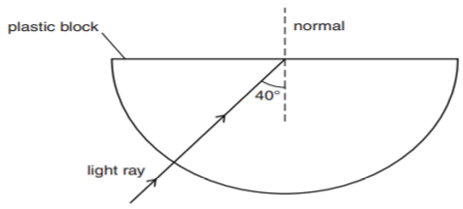
(iii) Complete the ray diagram of the above scenario when the light ray comes out of the plastic block from the top flat end. - 7View SolutionThe image formed by a spherical mirror is real, inverted and is of magnification - 2. If the image is at a distance of 30 cm from the mirror, where is the object placed ? Find the focal length of the mirror. List two characteristics of the image formed if the object is moved 10 cm towards the mirror.
- 8View SolutionA spherical mirror produces an image of magnification -1.0 on a screen placed at a distance of 30 cm from the pole of the mirror.
- Write the type of mirror in this case.
- What is the focal length of the mirror?
- What is the nature of the image formed?
- Draw the ray diagram to show the image formation in this case.
- 9View SolutionUnder what condition in an arrangement of two plane mirrors, incident ray and reflected ray will always be parallel to each other, whatever may be angle of incidence. Show the same with the help of diagram.
- 10View SolutionState the type of mirror preferred as,
- Rear view mirror in vehicles.
- Shaving mirror. Justify your answer giving two reasons in each case.