(i) Explain why the refractive index of any material with respect to air is always greater 1 .
(ii) In the figure below a light ray travels from air into the semi-circular plastic block. Give a reason why the ray does not deviate at the semi-circular boundary of the plastic block.
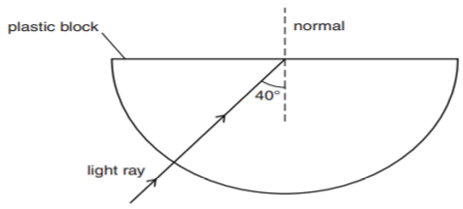
(iii) Complete the ray diagram of the above scenario when the light ray comes out of the plastic block from the top flat end.
(ii) In the figure below a light ray travels from air into the semi-circular plastic block. Give a reason why the ray does not deviate at the semi-circular boundary of the plastic block.
(iii) Complete the ray diagram of the above scenario when the light ray comes out of the plastic block from the top flat end.
[CBSE S.P - 2024]
Download our app for free and get started
i. The refractive index of a medium with respect to air is given by speed of light in air . Since speed of light in the medium is always less than the speed of light in the medium speed of light in air, hence the above ratio is always greater than 1.
ii. The ray of light is undergoing normalincidence at the air-plastic block interface. And for normal incidence there is no deviation.
iii.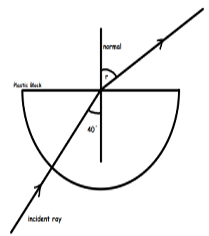
ii. The ray of light is undergoing normalincidence at the air-plastic block interface. And for normal incidence there is no deviation.
iii.

Download our appand get started for free
Experience the future of education. Simply download our apps or reach out to us for more information. Let's shape the future of learning together!No signup needed.*
Similar Questions
- 1View SolutionA man standing in front of a special mirror finds his image having a very small head, a fat body and legs of normal size. What is the shape of:
- Top part of the mirror?
- Middle part of the mirror?
- Bottom part of the mirror?
- 2View SolutionIf the image formed by a lens for all positions of an object placed in front of it is always erect and diminished, what is the nature of this lens? Draw a ray diagram to justify your answer. If the numerical value of the power of this lens is 10 D, what is its focal length in the Cartesian system?
- 3View SolutionAn object is placed at a distance equal to 2f in front of a convex lens. Draw a labelled ray diagram to show the formation of image. State two characteristics of the image formed.
- 4View SolutionExplain why, a stick half immersed in water appears to be bent at the surface. Draw a labelled diagram to illustrate your answer.
- 5View SolutionDraw a diagram to show how a converging lens held close to the eye acts as a magnifying glass. Why is it usual to choose a lens of short focal length for this purpose rather than one of long focal length?
- 6View SolutionTwo lenses A and B have power of (i) + 2 D and (ii) -4D respectively. What is the nature and focal length of each lens?
- 7View SolutionAn object of size 7.0 cm is placed at 27 cm in front of a concave mirror of focal length 18 cm. At what distance from the mirror should a screen be placed, so that a sharp focussed image can be obtained? Find the size and the nature of the image.
- 8View SolutionAn object 60cm from a lens gives a virtual image at a distance of 20cm in front of the lens. What is the focal length of the lens? Is the lens converging or diverging? Give reasons for your answer.
- 9View SolutionA student wants to project the image of a candle flame on a screen 90 cm in front of a mirror by keeping the flame at a distance of 15 cm from its pole.
- Suggest the type of mirror he should use.
- Determine the linear magnification in this case.
- Find the distance between the object and its image.
- Draw ray diagram to show the image formation in this case.
- 10View SolutionAn object 20cm from a spherical mirror gives rise to a virtual image 15cm behind the mirror. Determine the magnification of the image and the type of mirror used.