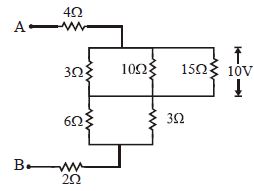
Calculate the potential difference between, points $A$ and $B$ and current flowing in $10\,\Omega $ resistor in the part of network below
Medium
Download our app for free and get started
$15\,\Omega $ and $ 10\, \Omega$ are in parallel current through
$10\, \Omega$ resistance $=\frac{\mathrm{V}}{\mathrm{R}}=\frac{10}{10}=1 \mathrm{\,A}$
$I=\frac{10}{2}=5 \,A$
$\mathrm{V}_{\mathrm{AB}}=\mathrm{IR}_{\mathrm{eq}}$
$=5 \times 10=50 \mathrm{\,V}$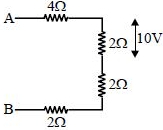

Download our appand get started for free
Experience the future of education. Simply download our apps or reach out to us for more information. Let's shape the future of learning together!No signup needed.*
Similar Questions
- 1The number of electrons flowing per second in the filament of a $110 \mathrm{~W}$ bulb operating at $220 \mathrm{~V}$ is : (Given $\mathrm{e}=1.6 \times 10^{-19} \mathrm{C}$ )View Solution
- 2A resistance wire connected in the left gap of a meter bridge balances a $10\, \Omega$ resistance in the right gap at a point which divides the bridge wire in the ratio $3: 2 .$ If the length of the resistance wire is $1.5 m ,$ then the length of $1\, \Omega$ of the resistance wire is $....... \times 10^{-2}\;m$View Solution
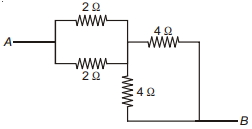
- 3Effective resistance across $A B$ in the network shown in .......... $\Omega$View Solution
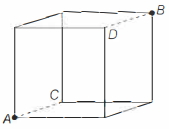
- 4A cube is formed with ten identical resistances $R$ (thick lines) and two shorting wires (dotted lines) along the arms $A C$ and $B D$ as shown in the figure below. Resistance between point $A$ and $B$ is ...........$\Omega$View Solution
- 5View SolutionElectroplating does not help in
- 6The heat generated through $2 \,ohm$ and $8\, ohm$ resistances separately, when a condenser of $200\,\mu F$ capacity charged to $200\, V$ is discharged one by one, will beView Solution
- 7At what rate the potential difference between the plates of a capacitor be changed to set up a displacement current of $1\, A$ in a capacitor of $2\,\mu F$ ?View Solution
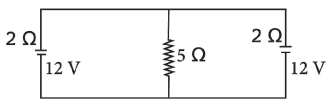
- 8In the arrangement shown in figure, the current through $5\,\Omega$ resistor is ............. $A$View Solution
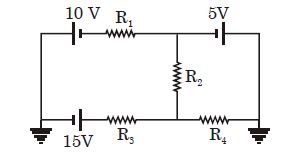
- 9In the circuit shown, current through $R_2$ is zero. If $R_4 = 2\,\Omega $ and $R_3 = 4\,\Omega $ , current through $R_3$ will be ................. $\mathrm{A}$View Solution
- 10A wire of length ' $r$ ' and resistance $100 \Omega$ is divided into $10$ equal parts. The first $5$ parts are connected in series while the next $5$ parts are connected in parallel. The two combinations are again connected in series. The resistance of this final combination is:View Solution