Calculate the work done, if a wire is loaded by $'Mg'$ weight and the increase in length is $'l'$
Medium


Download our appand get started for free
Experience the future of education. Simply download our apps or reach out to us for more information. Let's shape the future of learning together!No signup needed.*
Similar Questions
- 1View SolutionShearing stress causes change in
- 2A rubber cord catapult has cross-sectional area $25\,m{m^2}$ and initial length of rubber cord is $10\,cm.$ It is stretched to $5\,cm.$ and then released to project a missile of mass $5gm.$ Taking ${Y_{rubber}} = 5 \times {10^8}N/{m^2}$ velocity of projected missile is ......... $ms^{-1}$View Solution
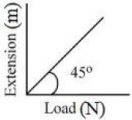
- 3As shown in the figure, in an experiment to determine Young's modulus of a wire, the extension-load curve is plotted. The curve is a straight line passing through the origin and makes an angle of $45^{\circ}$ with the load axis. The length of wire is $62.8\,cm$ and its diameter is $4\,mm$. The Young's modulus is found to be $x \times$ $10^4\,Nm ^{-2}$. The value of $x$ isView Solution
- 4An elastic material of Young's modulus $Y$ is subjected to a stress $S$. The elastic energy stored per unit volume of the material isView Solution
- 5A rubber cord $10\, m$ long is suspended vertically. How much does it stretch under its own weight $($Density of rubber is $1500\, kg/m^3, Y = 5×10^8 N/m^2, g = 10 m/s^2$$)$View Solution
- 6Find the depth of lake at which density of water is $1\%$ greater than at the surface. Given compressibility ........... $km$ . $K = 50\times10^{-6}/atm$ ?View Solution
- 7A glass slab is subjected to a pressure of $10\, atm$. The fractional change in its volume is (Bulk modulus of glass $= 37 \times 10^9\, N\, m^{-2}$, $1\, atm = 1 \times 10^5\, N\, m^{-2}$)View Solution
- 8A brass rod of length $2\,m$ and cross-sectional area $2.0\,cm^2$ is attached end to end to a steel rod of length $L$ and cross-sectional area $1.0\,cm^2$ . The compound rod is subjected to equal and opposite pulls of magnitude $5 \times 10^4\,N$ at its ends. If the elongations of the two rods are equal, then length of the steel rod $(L)$ is ........... $m$ $(Y_{Brass}=1.0\times 10^{11}\,N/m^2$ and $Y_{Steel} = 2.0 \times 10^{11}\,N/m^2)$View Solution
- 9If $x$ longitudinal strain is produced in a wire of Young's modulus $y,$ then energy stored in the material of the wire per unit volume isView Solution
- 10$Assertion :$ Solids are least compressible and gases are most compressible.View Solution
$Reason :$ solids have definite shape and volume but gases do not have either definite shape or definite volume.