Shearing stress causes change in
Easy


Download our appand get started for free
Experience the future of education. Simply download our apps or reach out to us for more information. Let's shape the future of learning together!No signup needed.*
Similar Questions
- 1Stress required in a wire to produce $0.1\%$ strain is $4 \times10^8\, N/m^2$. Its yound modulus is $Y_1$. If stress required in other wire to produce $0.3\%$ strain is $6 \times 10^8\, N/m^2$. Its young modulus is $Y_2$. Which relation is correctView Solution
- 2A rigid bar of mass $15\ kg$ is supported symmetrically by three wire each of $2 m$ long. These at each end are of copper and middle one is of steel. Young's modulus of elasticity for copper and steel are $110 \times 10^9 N / m ^2$ and $190 \times 10^9 N / m ^2$ respectively. If each wire is to have same tension, ratio of their diameters will be $............$View Solution
- 3A wire can be broken by applying a load of $20\,\,kg$ weight. The force required to break the wire of twice the diameter is ......... $kg\,wt$View Solution
- 4Two similar wires under the same load yield elongation of $0.1$ $mm$ and $0.05$ $mm$ respectively. If the area of cross- section of the first wire is $4m{m^2},$ then the area of cross section of the second wire is..... $mm^2$View Solution
- 5The normal density of a material is $\rho$ and its bulk modulus of elasticity is $K$. The magnitude of increase in density of material, when a pressure $P$ is applied uniformly on all sides, will beView Solution
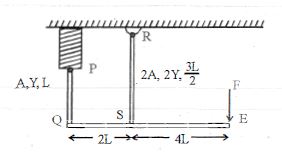
- 6A rigid massless rod of length $6\ L$ is suspended horizontally by means of two elasticrods $PQ$ and $RS$ as given figure. Their area of cross section, young's modulus and lengths are mentioned in figure. Find deflection of end $S$ in equilibrium state. Free end of rigid rod is pushed down by a constant force . $A$ is area of cross section, $Y$ is young's modulus of elasticityView Solution
- 7A metal rod of cross-sectional area $10^{-4} \,m ^{2}$ is hanging in a chamber kept at $20^{\circ} C$ with a weight attached to its free end. The coefficient of thermal expansion of the rod is $2.5 \times 10^{-6} \,K ^{-1}$ and its Young's modulus is $4 \times 10^{12} \,N / m ^{2}$. When the temperature of the chamber is lowered to $T$, then a weight of $5000 \,N$ needs to be attached to the rod, so that its length is unchanged. Then, $T$ is ............ $^{\circ} C$View Solution
- 8The Young's modulus of a steel wire of length $6\,m$ and cross-sectional area $3\,mm ^2$, is $2 \times 11^{11}\,N / m ^2$. The wire is suspended from its support on a given planet. A block of mass $4\,kg$ is attached to the free end of the wire. The acceleration due to gravity on the planet is $\frac{1}{4}$ of its value on the earth. The elongation of wire is (Take $g$ on the earth $=10$ $\left.m / s ^2\right):$View Solution
- 9When load of $5\,kg$ is hung on a wire then extension of $3\,m$ takes place, then work done will be ....... $joule$View Solution
- 10A body of mass $\mathrm{m}=10\; \mathrm{kg}$ is attached to one end of a wire of length $0.3\; \mathrm{m} .$ The maximum angular speed (in $rad \;s^{-1}$ ) with which it can be rotated about its other end in space station is (Breaking stress of wire $=4.8 \times 10^{7} \;\mathrm{Nm}^{-2}$ and area of cross-section of the wire $=10^{-2}\; \mathrm{cm}^{2}$ ) isView Solution