Question
Can static friction do nonzero work on an object? If yes, give an example. If no, give reason.

Answer

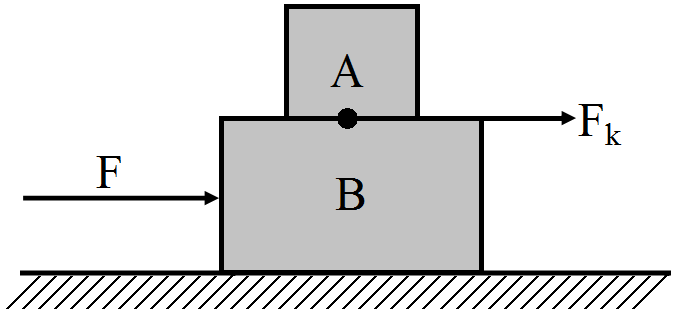
Yes. Let us consider a block A which is resting on another block B. Block B is resting on a smooth horizontal surface. Let the coefficient of kinetic friction between the blocks be $\mu\text{k}.$
When a force is applied on block B in the forward direction as shown in the above figure, block A moves with block B in the direction of the applied force. The friction force on block A and the displacement will be in the forward direction. Therefore, work done by the friction force is positive. In this case, block A will remain in contact with block B. This shows that static friction is doing a nonzero work on an object.

Need a full question paper?

Generate a complete, print-ready paper with questions like this in minutes — across 16+ boards, with answer keys.
Start Generating Free

Similar questions

Three capacitors having capacitances $20\mu\text{F},\ 30\mu\text{F}$ and $40\mu\text{F}$ are connected in series with a 12V battery. Find the charge on each of the capacitors. How much work has been done by the battery in charging the capacitors?
With the help of a labelled diagram, explain how does an AC works. There are $N$ turns in coil of AC generator. Area of each turn is A and the coil is rotating with a uniform angular velocity. Establish an expression for generated induced electromotive force. What is the source of energy production by this method?
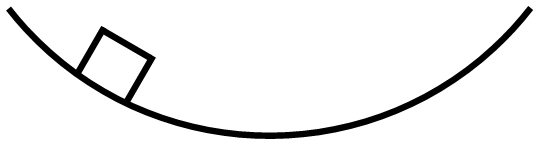
A small block oscillates back and forth on a smooth concave surface of radius R figure. Find the time period of small oscillation.
$a.$ Explain why, for any charge configuration, the equipotential surface through a point is normal to the electric field at that point.
Draw a sketch of equipotential surfaces due to a single charge $(-q),$ depicting the electric field lines due to the charge.
$b.$ Obtain an expression for the work done to dissociate the system of three charges placed at the vertices of an equilateral triangle of side a as shown alongside.
  1. Plot a graph showing variation of voltage vs the current drawn from the cell. How can one get information from this plot about the emf of the cell and its internal resistance?
  2. Two cells of emf’s $E_1$ and $E_2$ and internal resistance $r_1$ and $r_2$ are connected in parallel. Obtain the expression for the emf and internal resistance of a single equivalent cell that can replace this combination?
Two charges $5 \times 10^{–8} C$ and $–3 \times 10^{–8} C$ are located $16 \ cm$ apart. At what point $(s)$ on the line joining the two charges is the electric potential zero? Take the potential at infinity to be zero.
In a Young's double slit experiment using monochromatic light, the fringe pattern shifts by a certain distance on the screen when a mica sheet of refractive index $1.6$ and thickness $1.964$ micron $(1$ micron $= 10^{-6}m)$ is introduced in the path of one of the interfering waves. The mica sheet is then removed and the distance between the screen and the slits is doubled. It is found that the distance between the successive maxima now is the same as the observed fringe$-$shift upon the introduction of the mica sheet. Calculate the wavelength of the monochromatic light used in the experiment.
The resistance of the rheostat shown in the figure. is $30\Omega.$ Neglecting the meter resistance, find the minimum and maximum currents through the ammeter as the rheostat is varied.
What will be the path difference between two light waves $y_1=a_1 \sin \omega t$ and $y_2=a_2 \cos (\omega t+$ $\phi)$ ?
Find an expression for the electric field strength at a distant point situated $(i)$ on the axis and $(ii)$ along the equatorial line of an electric dipole. $OR$
Derive an expression for the electric field intensity at a point on the equatorial line of an electric dipole of dipole moment $\vec{\text{p}}$ and length $2a$. What is the direction of this field?