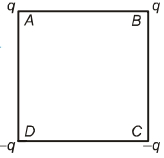
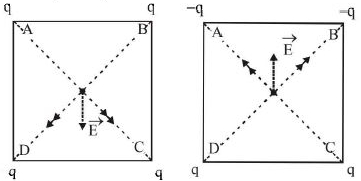
Charges are placed on the vertices of a square as shown Let $\vec E$ be the electric field and $V$ the potential at the centre. If the charges on $A$ and $B$ are interchanged with those on $D$ and $C$ respectively, then
AIEEE 2007, Easy


Download our appand get started for free
Experience the future of education. Simply download our apps or reach out to us for more information. Let's shape the future of learning together!No signup needed.*
Similar Questions
- 1A positively charged ring is in $y-z$ plane with its centre at origin. A positive test charge $q_0$, held at origin is released along $x$-axis, then its speedView Solution
- 2The energy required to charge a capacitor of $5\,\mu \,F$ by connecting a $d.c$. source of $20\, kV$ is......$kJ$View Solution
- 3View SolutionIf the distance between parallel plates of a capacitor is halved and dielectric constant is doubled then the capacitance will become
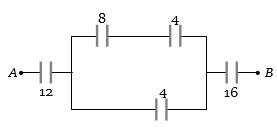
- 4What is the equivalent capacitance between $A$ and $B$ in the given figure (all are in farad)View Solution
- 5The material filled between the plates of a parallel plate capacitor has resistivity $200 \Omega \, {m}$. The value of capacitance of the capacitor is $2\, {pF}$. If a potential difference of $40 \,{V}$ is applied across the plates of the capacitor, then the value of leakage current flowing out of the capacitor isView Solution
(given the value of relative permitivity of material is $50$ )
- 6A pellet carrying charge of $0.5\, coulombs$ is accelerated through a potential of $2,000\, volts$. It attains a kinetic energy equal toView Solution
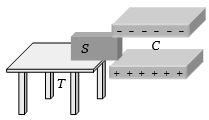
- 7A frictionless dielectric plate $S$ is kept on a frictionless table $T$. A charged parallel plate capacitance $C$ (of which the plates are frictionless) is kept near it. The plate $S$ is between the plates. When the plate $S$ is left between the platesView Solution
- 8$X $ and $Y$ are large, parallel conducting plates closed to each other. Each face has an area $A$. $X$ is given a charge $Q$. $Y$ is without any charge. Points $A, B$ and $C$ are as shown in figure.View Solution

- 9From a supply of identical capacitors rated $8\ \mu F$, $250\ V$, the minimum number of capacitors required to form a composite $16$ $\mu F$, $1000$ $V$ is :View Solution
- 10A capacitance of $2\ μF$ is required in an electrical circuit across a potential difference of $1.0\ kV$. A large number of $1\ μF$ capacitors are available which can withstand a potential difference of not more than $300\ V$. The minimum number of capacitors required to achieve this isView Solution