MCQ
Check up the only correct statement in the following :-
  • A
    A body has a constant velocity and still it can have a varying speed.
  • A body has a constant speed but it can have a varying velocity.
  • C
    A body having constant speed cannot have any acceleration.
  • D
    A body in motion under a force acting upon it must always have work done upon it.
Answer

Correct option: B.
A body has a constant speed but it can have a varying velocity.
b
When a body possesses constant velocity, both its magnitude (i.e., seed) and direction must remain constant. On the other hand, if the speed of a body is constant, then its velocity may or may not remain constant. For example, in uniform circular motion, through the speed of a body remains constant, velocity changes from point to point due to a change in direction. A body moving with a constant speed along a circular path constantly experiences a centripetal acceleration.

Need a full question paper?

Generate a complete, print-ready paper with questions like this in minutes — across 16+ boards, with answer keys.

Start Generating Free

Similar questions

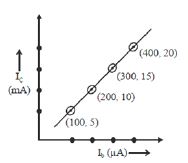
The transfer characteristic curve of a transistor, having input and output resistance $100\,\Omega $ and $100\,k\Omega $ respectively, is shown in the figure. The Voltage and Power gain, are respectively
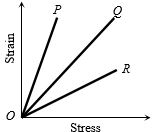
The strain-stress curves of three wires of different materials are shown in the figure. $P, Q$ and $R$ are the elastic limits of the wires. The figure shows that
A $p-n$ photodiode is made of a material with a band gap of $2.0\, eV.$ The minimum frequency of the radiation that can be absorbed by the material is nearly 
Which source is associated with a line emission spectrum
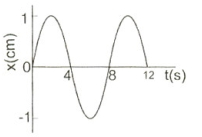
The $x$-t graph of a particle undergoing simple harmonic motion is shown below. The acceleration of the particle at $t=4 / 3 \mathrm{~s}$ is
The activity of a sample reduces from $A_0$ to ${A_0} / \sqrt{3}$ in one hour. The activity after $3$ hours more will be
A biconvex lens with equal radii curvature has refractive index $1.6$ and focal length $10 cm.$ Its radius of curvature will be.......$cm$
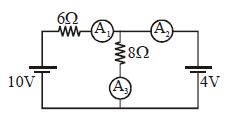
Reading of ammeter $A_1, A_2$ and $A_3$ will be respectively
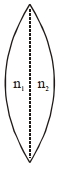
A thin convex lens is made of two materials with refractive indices $n_1$ and $n_2$, as shown in figure. The radius of curvature of the left and right spherical surfaces are equal. $f$ is the focal length of the lens when $n_1=n_2=n$. The focal length is $f+\Delta f$ when $n_1=n$ and $n_2=n+\Delta n$. Assuming $\Delta n \ll$ (n-1) and $1< n <2$, the correct statement(s) is/are :

$(1)$ The relation between $\frac{\Delta f}{f}$ and $\frac{\Delta n}{n}$ remains unchanged if both the convex surfaces are replaced by concave surfaces of the same radius of curvature.

$(2)$ $\left|\frac{\Delta f }{ f }\right|<\left|\frac{\Delta n }{ n }\right|$

$(3)$ For $n =1.5, \Delta n =10^{-3}$ and $f =20 cm$, the value of $|\Delta f |$ will be $0.02 cm$ (round off to $2^{\text {nd }}$ decimal place)

$(4)$ If $\frac{\Delta n }{ n }<0$ then $\frac{\Delta f }{ f }>0$

A body of mass $1\,kg$ is executing simple harmonic motion. Its displacement $y(cm)$ at $t$ seconds is given by $y = 6\sin (100t + \pi /4)$. Its maximum kinetic energy is ..... $J$