Question
Check whether 301 is in the sequence
$5,11,17,23, \ldots \text { ? }$

Answer

In the sequence $5,11,17,23, \ldots$
$ t_1=5, t_2=11, t_3=17, t_4=23, \ldots$
$t_2-t_1=11-5=6$
$t_3-t_2=17-11=6 $
$\therefore$ This sequence is an A.P.
First term $a=5$ and $d=6$
If 301 is $n^{\text {th }}$ term, then.
$ t=a+(n-1) d=301$
$\therefore 301=5+(n-1) \times 6$
$=5+6 n-6$
$\therefore 6 n=301+1=302$
$\therefore n=\frac{302}{6}$. But it is not an integer.
$\therefore 301$ is not in the given sequence.

Need a full question paper?

Generate a complete, print-ready paper with questions like this in minutes — across 16+ boards, with answer keys.
Start Generating Free

Similar questions

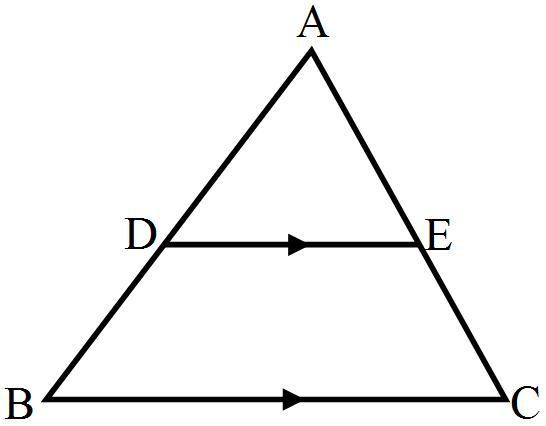
D and E are points on the sides AB and AC respectively of a $\triangle\text{ABC}$ such that DE || BC:
AD = (7x - 4)cm, AE = (5x - 2)cm, DB = (3x + 4)cm and EC = 3x cm.
Prove the following trigonometric identities.
$\frac{1+\cos\text{A}}{\sin\text{A}}=\frac{\sin\text{A}}{1-\cos\text{A}}$
Show that points P(2, -2), Q(7, 3), R(11, -1) and S (6, -6) are vertices of a parallelogram.

Prove that $\frac{\cot A}{1-\cot A}+\frac{\tan A}{1-\tan A}=-1$
Solve the following simultaneous equation graphically.
2x + 3y = 12; x – y = 1
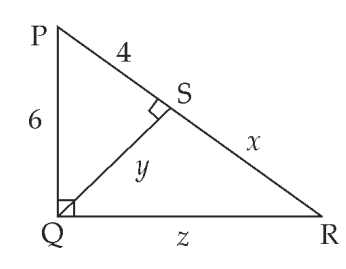
In the adjoining figure, $\angle PQR =90^{\circ}$ $\operatorname{seg} QS \perp$ side $PR , PS =4, PQ =6$. Find $x, y$ and $z$.
Image
Find the type of the quadrilateral if points A(-4, -2), B(-3, -7) C(3, -2) andD(2, 3) are joined serially.
Construction of a tangent to a circle at a point on the circle Without using the centre of the circle.
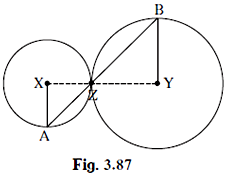
In the adjoining figure circles with centres X and Y touch each other at point Z. A secant passing through Z intersects the circles at points A and B respectively. Prove that, radius XA || radius YB. Fill in the blanks and complete the proof.

Construction: Draw segments XZ and ..YZ........ .
Proof: By theorem of touching circles, points X, Z, Y are ..concyclic........ .
$\therefore \angle XZA \cong \ldots \angle YZB \ldots \ldots \ldots$.....vertically opposite angles
Let $\angle XZA =\angle BZY = a \cdots( l )$
Now, seg XA $\cong \operatorname{seg} X Z$........ (...radius of the same circle......)
$\therefore \angle XAZ =\ldots . \angle XZA \ldots \ldots=$ a $\ldots \ldots \ldots$ (isosceles triangle theorem) (II)
similarly, seg $Y B \cong . Y Z . \ldots . \ldots \ldots .$. ........ (radius of the same circle........)
$\therefore \angle BZY =\angle Z B Y \ldots \ldots \ldots= a$ $\qquad$ (isosceles triangle theorem. $\qquad$
$\therefore$ from (I), (II), (III),
$\angle XAZ =. \angle ZBY \ldots \ldots \ldots$.
$\therefore$ radius $XA \|$ radius YB $\qquad$ (..since alternate interior angles are equal.......)