Question
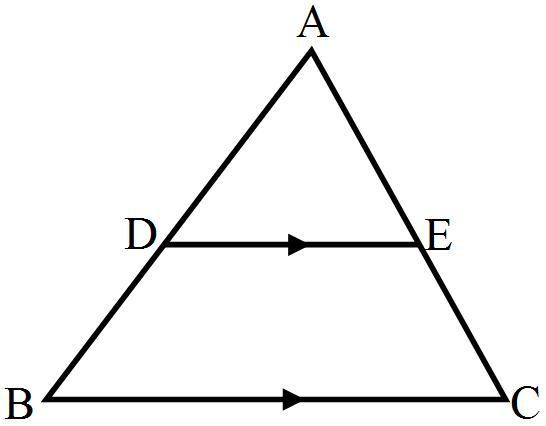
D and E are points on the sides AB and AC respectively of a $\triangle\text{ABC}$ such that DE || BC:
AD = (7x - 4)cm, AE = (5x - 2)cm, DB = (3x + 4)cm and EC = 3x cm.
Answer

In $\triangle\text{ABC},$ it is given that DE || BC.
Applying Thales' theorem, we get:
$\frac{\text{AD}}{\text{DB}}=\frac{\text{AE}}{\text{EC}}$
$\Rightarrow\frac{7\text{x}-4}{3\text{x}+4}=\frac{5\text{x}-2}{3\text{x}}$
$\Rightarrow3\text{x}(7\text{x}-4)=(5\text{x}-2)(3\text{x}+4)$
$\Rightarrow21\text{x}^2-12\text{x}=15\text{x}^2+14\text{x}-8$
$\Rightarrow6\text{x}^2-26\text{x}+8=0$
$\Rightarrow\big(\text{x}-4\big)\big(6\text{x}-2\big)=0$
$\Rightarrow\text{x}=4,\frac{1}{3}$
$\therefore\text{x}\not=\frac{1}{3}$ (as if $\text{x}=\frac{1}{3}$ then AE will become negative)
$\therefore\text{x}=4\text{cm}$

Need a full question paper?

Generate a complete, print-ready paper with questions like this in minutes — across 16+ boards, with answer keys.

Start Generating Free