Question 13 Marks
Find how many three digit natural numbers are divisible by 5.
AnswerList of three digit number divisible by 5 are
100, 105,110,115,……….. 995
Let us find how many such number are there?
From the above sequence, we know that
$t_n=995, a=100$
$t_1=105, t_2=110$
Thus, $d=t_2-t_1=110-105=5$
Now, By using $n^{\text {th }}$ term of an A.P. formula
$t_n=a+(n-1) d$
we can find value of " $n$ "
Thus, on substituting all the value in formula we get
$995=100+(n-1) \times 5$
$\Rightarrow 995-100=(n-1) \times 5$
$\Rightarrow 895=(n-1) \times 5$
$\Rightarrow n -1=\frac{895}{5}=179$
$\Rightarrow n=179+1=180$
View full question & answer→Question 23 Marks
Find the 27th term of the following A.P.
$9, 4, – 1, – 6, – 11, . . .$
AnswerGiven A.P. is $9, 4, – 1, – 6, – 11, . . .$
Where first term $a = 9$
Second term $t_1 = 4$
Third term $t_2 = – 1$
Common Difference $d = t_2 – t_1 = – 1 – 4 = – 5$
We know that, $n^{th}$ term of an A.P. is
$t_n = a + (n – 1)d$
We need to find the $27^{th}$ term,
Here $n = 27$
Thus, $t_{27} = 9 + (27 – 1)\times ( – 5)$
$t_{27} = 9 + (26)\times ( – 5) = 9 – 130 = – 121$
Thus, $t_{27} = – 121$
View full question & answer→Question 33 Marks
Find the 19th term of the following A.P.
$7, 13, 19, 25, . . .$
AnswerGiven A.P. is $7, 13, 19, 25, . . .$
Where first term $a = 7$
Second term $t_1 = 13$
Third term $t_2 = 19$
Common Difference $d = t_2 – t_1 = 19 – 13 = 6$
We know that, $n^{th}$ term of an A.P. is
$t_n = a + (n – 1)d$
We need to find the $19^{th}$ term,
Here $n = 19$
Thus, $t_{19} = 7 + (19 – 1)\times 6$
$t_{19} = 7 + (18)\times 6 = 7 + 108 = 115$
Thus, $t_{19} = 115$
View full question & answer→Question 43 Marks
Given Arithmetic Progression $12, 16, 20, 24, . . .$ Find the $24th$ term of this progression.
AnswerGiven A.P. is $12,16,20,24, \ldots$
Where first term $a =12$
Second term $t_1=16$
Third term $t _2=20$
Common Difference $d=t_2-t_1=20-16=4$
We know that, $n^{\text {th }}$ term of an A.P. is
$t_n=a+(n-1) d$
We need to find the $24^{\text {th }}$ term,
Here $n=24$
Thus, $t _{24}=12+(24-1) \times 4$
$t_{24}=12+(23) \times 4=12+92=104$
Thus, $t _{24}=104$
View full question & answer→Question 53 Marks
Decide whether following sequence is an A.P., if so find the $20th$ term of the progression.
$– 12, – 5, 2, 9, 16, 23, 30, . . .$
AnswerGiven A.P. is $-12,-5,2,9,16,23,30, \ldots$
Where first term $a=-12$
Second term $t _1=-5$
Third term $t _2=2$
Common Difference $d=t_2-t_1=2-(-5)=2+5=7$
We know that, $n ^{\text {th }}$ term of an A.P. is
$t_n=a+(n-1) d$
We need to find the $20^{\text {th }}$ term,
Here $n=20$
Thus, $t _{20}=-12+(20-1) \times 7$
$t_{20}=-12+(19) \times 7=-12+133=121$
Thus, $t _{20}=121$
View full question & answer→Question 63 Marks
₹ 1000 is invested at 10 percent simple interest. Check at the end of every year if the total interest amount is in A.P. If this is an A.P. then find interest amount after 20 years. For this complete the following activity.
$\text { Simple interest }=\frac{P \times R \times N}{100}$
Simple interest after 1 year $=\frac{1000 \times 10 \times 1}{100}=\square$
Simple interest after 2 year $=\frac{1000 \times 10 \times 2}{100}=\square$
Simple interest after 3 year $=\frac{\square \times \square \times \square}{100}=300$
According to this the simple interest for $4,5,6$ years will be 400, $\square$ $\square$ respectively.
From this $d =$ $\square$ and $a =$ $\square$
Amount of simple interest after 20 years
$t_n+a+(n-1) d $
$t_{20}=\square+(20-1) \square $
$t_{20}=\square$
Amount of simple interest after 20 years is $=$ $\square$
AnswerGiven: Principal Amount P = 1000
Rate of interest $R = 10\%$
Also, Simple Interest $=\frac{( P \times R \times N )}{100}$
Simple interest after 1 year $=\frac{1000 \times 10 \times 1}{100}=100$
Simple interest after 2 year $=\frac{1000 \times 10 \times 2}{100}=200$
Simple interest after 3 year $=\frac{1000 \times 10 \times 3}{100}=300$
According to this the simple interest for 4, 5, 6 years will be 400,
500, 600 respectively.
Let first term $a =100$
Second term $t_1=200$
Third term $t _3=300$
Common difference $d=t_3-t_2=300-200=100$
Amount of simple interest after 20 years
We use $n^{\text {th }}$ term of an A.P. formula $t_n=a+(n-1) d$
where $n =$ no. of terms
$a=$ first term
$d=$ common difference
$t_n=n^{\text {th }} \text { terms }$
$\Rightarrow t_{20}=100+(20-1) \times 100$
$\Rightarrow t_{20}=100+19 \times 100$
$\Rightarrow t_{20}=100+1900=2000$
View full question & answer→Question 73 Marks
If $m$ times the $m$ th term of an A.P. is equal to $n$ times $n$th term then show that the $(m+n)^{\text {th }}$ term of the A.P. is zero.
AnswerWe use $n ^{\text {th }}$ term of an A.P. formula
$t_n=a+(n-1) d$
$\text { where } n=n o \text {. of terms }$
$a=\text { first term }$
$d=\text { common difference }$
$t_n=n^{\text {th }} \text { terms }$
$\text { Thus } m^{\text {th }} \text { term }=t_m=a+(m-1) d$
$\text { Given: } m \times t_m=n \times t_n$
$\Rightarrow m \times[a+(m-1) d]=n \times[a+(n-1) d]$
$\Rightarrow a m+m(m-1) d=a n+n(n-1) d$
$\Rightarrow a m-a n+m(m-1) d-n(n-1) d=0$
$\Rightarrow a(m-n)+d[m(m-1)-n(n-1)]=0$
$\Rightarrow a(m-n)+d\left[m^2-m-n^2+n\right]=0$
$\Rightarrow a(m-n)+d\left[\left(m^2-n^2\right)-m+n\right]=0$
$\Rightarrow a(m-n)+d[(m-n)(m+n)-(m-n)]=0$
$\left(s i n c e,(a-b)(a+b)=a^2-b^2\right)$
$\Rightarrow a(m-n)+d(m-n)[(m+n)-1]=0$
$\Rightarrow(m-n)[a+d(m+n-1)]=0$
Since, $m \neq n$
$\therefore m-n \neq 0$
$\Rightarrow a+d(m+n-1)=0$
$\Rightarrow t_{m+n}=0$
Hence proved
View full question & answer→Question 83 Marks
In an A.P. $17^{\text {th }}$ term is $7$ more than its $10^{\text {th }}$ term. Find the common difference.
AnswerGiven: $t_{17}=7+t_{10}$
$\text { In } t _{17}, n =17$
$\text { In } t _{10}, n =10$
By using $n ^{\text {th }}$ term of an A.P. formula,
$t_n=a+(n-1) d$
where $n =$ no. of terms
$a =\text { first term }$
$d=$ common difference
$t _{ n }= n ^{\text {th }} \text { term }$
Thus, on using formula in eq. (1) we get,
$\Rightarrow a+(17-1) d=7+(a+(10-1) d)$
$\Rightarrow a+16 d=7+(a+9 d)$
$\Rightarrow a+16 d-a-9 d=7$
$\Rightarrow 7 d=7$
$\Rightarrow d=\frac{7}{7}=1$
Thus, common difference “d” = 1
View full question & answer→Question 93 Marks
In the natural numbers from 10 to 250, how many are divisible by 4?
AnswerList of number divisible by 4 in between 10 to 250 are
12, 16,20,24,……….. 248
Let us find how many such number are there?
From the above sequence, we know that
$t_n=248, a=12$
$t_1=16, t_2=20$
Thus, $d=t_2-t_1=20-16=4$
Now, By using $n ^{\text {th }}$ term of an A.P. formula
$t_n=a+(n-1) d$
we can find value of " n "
Thus, on substituting all the value in formula we get,
$248=12+(n-1) \times 4$
$\Rightarrow 248-12=(n-1) \times 4$
$\Rightarrow 236=(n-1) \times 4$
$\Rightarrow n -1=\frac{236}{4}=59$
$\Rightarrow n=59+1=60$
View full question & answer→Question 103 Marks
11, 8, 5, 2, . . . In this A.P. which term is number – 151?
AnswerBy, given A.P. 11, 8, 5, 2, .
we know that
$a=11, t_1=8, t_2=5$
Thus, $d=t_2-t_1=5-8=-3$
Given: $t_n=-151$
Now, By using $\mathrm{n}^{\text {th }}$ term of an A.P. formula
$t_n=a+(n-1) d$
we can find value of " $n$ "
Thus, on substituting all the value in formula we get,
$-151=11+(n-1) \times(-3)$
$\Rightarrow-151-11=(n-1) \times(-3)$
$\Rightarrow-162=(n-1) \times(-3)$
$\Rightarrow n-1=\frac{-162}{-3}=54$
$\Rightarrow n=54+1=55$
View full question & answer→Question 113 Marks
The $11^{th}$ term and the 21st term of an A.P. are 16 and 29 respectively, then find the 41th term of that A.P.
AnswerGiven: $\mathrm{t}_{11}=16$ and $\mathrm{t}_{21}=29$
To find: $t_{41}$
Using $\mathrm{n}^{\text {th }}$ term of an A.P. formula
$t_n=a+(n-1) d$
we will find value of "a" and "d"
$\text { Let, } t_{11}=a+(11-1) d$
$\Rightarrow 16=a+10 d \ldots \ldots(1)$
$t_{21}=a+(21-1) d$
$\Rightarrow 29=a+20 d \ldots \ldots .(2)$
Subtracting eq. (1) from eq. (2), we get,
$\Rightarrow 29-16=(a-a)+(20 d-10 d)$
$\Rightarrow 13=10 d$
$\Rightarrow d =\frac{13}{10}=1.3$
Substitute value of "d" in eq. (1) to get value of "a"
$\Rightarrow 16=a+10 \times \frac{13}{10} $
$\Rightarrow 16=a+13 $
$\Rightarrow a=16-13=3$
Now, we will find the value of $t _{41}$ using $n ^{\text {th }}$ term of an A.P. formula
$\Rightarrow t_{41}=3+(41-1) \times \frac{13}{10} $
$\Rightarrow t_{41}=3+40 \times \frac{13}{10} $
$\Rightarrow t_{41}=3+4 \times 13=3+52=55$
Thus, $t _{41}=55$
View full question & answer→Question 123 Marks
Divide 207 in three parts, such that all parts are in A.P. and product of two smaller parts will be 4623.
AnswerLet 3 parts of 207 be a – d, a, a + d such that,
⇒ (a – d) + a + (a + d) = 207
⇒ 3a = 207
$\Rightarrow a = \frac{207}{3} = 69$
Since, product of two smaller terms is 4623
⇒ (a – d) × a = 4623
⇒ (69 – d) × 69 = 4623
$\Rightarrow 69-d=\frac{4623}{69}=67$
⇒ d = 69 – 67 = 2
Thus, a – d = 69 – 2 = 67
a = 69
a + d = 69 + 2 = 71
Thus, the A.P so formed is 67, 69, 71
View full question & answer→Question 133 Marks
Sum of 1 to n natural numbers is 36, then find the value of n.
AnswerList of $n$ natural number is
$1,2,3, \ldots \ldots n$
First term $\mathrm{a}=1$
Second term $\mathrm{t}_1=2$
Third term $\mathrm{t}_3=3$
Thus, common difference $d=t_3-t_2=3-2=1$
Given $\mathrm{S}_{\mathrm{n}}=36$
Thus, By using sum of $n^{\text {th }}$ term of an A.P. we will find it's sum
$S_n=\frac{n}{2}[2 a+(n-1) d]$
Where, $\mathrm{n}=$ no. of terms
$a=\text { first term }$
$\mathrm{d}=$ common difference
$S_n=$ sum of $n$ terms
We need to find no. of terms $n$
$\Rightarrow 36=\frac{n}{2}[2 \times 1+(n-1) \times 1]$
$\Rightarrow 36=\frac{n}{2}[2+n-1]$
$\Rightarrow 36=\frac{n}{2}[1+n]$
$\Rightarrow n(1+n)=36 \times 2=72$
$\Rightarrow n^2+n-72=0$
$\Rightarrow n^2+9 n-8 n-72=0$
$\Rightarrow n(n+9)-8(n+9)=0$
$\Rightarrow(n-8)(n+9)=0$
$\Rightarrow n-8=0 \text { or } n+9=0$
$\Rightarrow n=8 \text { or } n=-9$
Since, number of terms n can't be negative
$\therefore \mathrm{n}=8$
View full question & answer→Question 143 Marks
If sum of 3rd and 8th terms of an A.P. is 7 and sum of 7th and 14th terms is – 3 then find the 10th term.
AnswerNow, By using $\mathrm{n}^{\text {th }}$ term of an A.P. formula
$t_n=a+(n-1) d$
where $n=$ no. of terms
$\mathrm{a}=$ first term
$d=$ common difference
$\mathrm{t}_{\mathrm{n}}=\mathrm{n}^{\text {th }} \text { terms }$
Hence, by given condition we get,
$t_3+t_8=7$
$\Rightarrow[a+(3-1) d]+[a+(8-1) d]=7$
$\Rightarrow[a+2 d]+[a+7 d]=7$
$\Rightarrow 2 a+9 d=7 \ldots . .(1)$
$t_7+t_{14}=-3$
$\Rightarrow[a+(7-1) d]+[a+(14-1) d]=-3$
$\Rightarrow[a+6 d]+[a+13 d]=-3$
$\Rightarrow 2 a+19 d=-3 \ldots . .(2)$
Subtracting eq. (1) from eq. (2)
$\Rightarrow[2 \mathrm{a}+19 \mathrm{~d}]-[2 \mathrm{a}+9 \mathrm{~d}]=-3-7$
$\Rightarrow 10 \mathrm{~d}=-10$
$\Rightarrow d=-\frac{10}{10}=-1$
Substituting, "d" in eq. (1)
$\Rightarrow 2 \mathrm{a}+9 \times(-1)=7$
$\Rightarrow 2 \mathrm{a}-9=7$
$\Rightarrow 2 \mathrm{a}=7+9=16$
$\Rightarrow a=\frac{16}{2}=8$
Now, we can find value of $\mathrm{t}_{10}$
$\text { Thus, } \mathrm{t}_{10}=8+(10-1) \times(-1)$
$\Rightarrow \mathrm{t}_{10}=8-9=-1$
View full question & answer→Question 153 Marks
The A.P. in which 4th term is – 15 and 9th term is – 30. Find the sum of the first 10 numbers.
Answer$t_4=-15 \text { and } t_9=-30$
Now, By using $\mathrm{n}^{\text {th }}$ term of an A.P. formula
$t_n=a+(n-1) d$
$\text { where } n=\text { no. of terms }$
$a=\text { first term }$
$d=\text { common difference }$
$t_n=n^{\text {th }} \text { terms }$
Hence, by given condition we get,
$\mathrm{t}_4=-15$
$\Rightarrow a+(4-1) d=-15$
$\Rightarrow a+3 d=-15 \ldots \ldots(1)$
$t_9=-30$
$\Rightarrow a+(9-1) d=-30$
$\Rightarrow a+8 d=-30 \ldots \ldots$
Subtracting eq. (1) from eq. (2)
$\Rightarrow[a+8 d]-[a+3 d]=-30-(-15)$
$\Rightarrow 5 \mathrm{~d}=-30+15=-15$
$\Rightarrow d=-\frac{15}{5}=-3$
Substituting, "d" in eq. (1)
$\Rightarrow a+3 \times(-3)=-15$
$\Rightarrow a+-9=-15$
$\Rightarrow a=-15+9=-6$
Thus, By using sum of $n^{\text {th }}$ term of an A.P. we will find it's sum
$S_n=\frac{n}{2}[2 a+(n-1)] d$
Where, $\mathrm{n}=$ no. of terms
$a=\text { first term }$
$d=\text { common difference }$
$S_n=\text { sum of } n \text { terms }$
We need to find $S_{10}$
$\Rightarrow S_{10}=\frac{10}{2}[2 \times(-6)+(10-1) \times(-3)]$
$\Rightarrow \mathrm{S}_{10}=5[-12+9 \times(-3)]$
$\Rightarrow \mathrm{S}_{10}=5[-12-27]$
$\Rightarrow \mathrm{S}_{10}=5 \times(-39)=-195$
View full question & answer→Question 163 Marks
In year 2015, Mrs. Shaikh got a job with salary ₹ 1,80,000 per year. Her employer agreed to give ₹ 10,000 per year as increment. Then in how many years will her annual salary be ₹ 2,50,000?
Question 173 Marks
Find the sum of all odd numbers from 1 to 150.
Question 183 Marks
How many two digit numbers are divisible by 4 ?
AnswerList of two digit numbers divisible by 4 is
$
12,16,20,24, \ldots, 96 \text {. }
$
Let's find how many such numbers are there.
$
t_{\mathrm{n}}=96, \quad a=12, \quad d=4
$
From this we will find the value of $n$.
$
\begin{aligned}
t_{\mathrm{n}} & =96, \therefore \text { By formula, } \\
96 & =12+(n-1) \times 4 \\
& =12+4 n-4 \\
\therefore 4 & =88 \\
\therefore n & =22
\end{aligned}
$
$\therefore$ There are 22 two digit numbers divisible by 4 .
View full question & answer→Question 193 Marks
Check whether 301 is in the sequence
$5,11,17,23, \ldots \text { ? }$
AnswerIn the sequence $5,11,17,23, \ldots$
$ t_1=5, t_2=11, t_3=17, t_4=23, \ldots$
$t_2-t_1=11-5=6$
$t_3-t_2=17-11=6 $
$\therefore$ This sequence is an A.P.
First term $a=5$ and $d=6$
If 301 is $n^{\text {th }}$ term, then.
$ t=a+(n-1) d=301$
$\therefore 301=5+(n-1) \times 6$
$=5+6 n-6$
$\therefore 6 n=301+1=302$
$\therefore n=\frac{302}{6}$. But it is not an integer.
$\therefore 301$ is not in the given sequence.
View full question & answer→Question 203 Marks
Find the sum of all natural numbers between 100 and 1000 which are multiples of 7 .
Question 213 Marks
How many terms of the A.P.: 9, 17, 25, .... must be taken to give a sum of 636 ?
Question 223 Marks
Find three consecutive terms in an A.P. whose sum is -3 and the product of their cubes is 512.
Answer$-4,-1,2$ or $2,-1,-4$
View full question & answer→Question 233 Marks
Find four conseculive terms in an A.P. such that the sum of the middle two terms is 18 and product of the two end terms is 45.
Answer$3,7,11,15$ or $15,11,7,3$
View full question & answer→Question 243 Marks
The first and the last terms of an A.P. are 17 and 350 respectively. If the common difference is 9 , how many terms are there and what is their sum?
Question 253 Marks
Split 69 in three parts such that they are in A.P. and product of two smaller parts is 483.
Question 263 Marks
In an A.P., if the $5^{\text {th }}$ and 12 th terms are 30 and 65 respectively, what is the sum of the first 20 terms.
View full question & answer→Question 273 Marks
Obtain the sum of 56 terms of an A.P. whose $19^{\text {th }}$ and $38^{\text {th }}$ terms are 52 and 148 respectively.
View full question & answer→Question 283 Marks
How many two digit natural numbers are divisible by 5 ?
Question 293 Marks
The sixth term of an A.P. is 5 times the $1^{\text {st }}$ term and the eleventh term exceeds twice the fifth term by 3. Find the $8^{\text {th }}$ term.
View full question & answer→Question 303 Marks
For what value of $n$, the $n^{th}$ term of the following two $A.P.s$ are equal?
$23,25,27,29,........$ and $-17,-10,-3,4, ........$
View full question & answer→Question 313 Marks
Find the $10^{\text {th }}$ term from the end of the A.P. $4,9,14, \ldots, 254$.
View full question & answer→Question 323 Marks
Find the eighteenth term of the A.P. 1, 7, 13, 19.
Question 333 Marks
How many three digit natural numbers are divisible by 4 ?
Question 343 Marks
If $10^{ th }$ term and the $18^{ th }$ term of an A.P. are 25 and 41 respectively, then find the $38^{\text {th }}$ term.
View full question & answer→Question 353 Marks
Kabir’s mother keeps a record of his height on each birthday. When he was one year old, his height was 70 cm, at 2 years he was 80 cm tall and 3 years he was 90 cm tall. His aunt Meera was studying in the 10th class. She said, “it seems like Kabir’s height grows in Arithmetic Progression”. Assuming this, she calculated how tall Kabir will be at the age of 15 years when he is in 10th! She was shocked to find it. You too assume that Kabir grows in A.P. and find out his height at the age of 15 years.
AnswerHeight of Kabir when he was 1 year old = 70 cm Height of Kabir when he was 2 years old = 80 cm
Height of Kabir when he was 3 years old = 90 cm The heights of Kabir form an A.P.
Here, a = 70, d = 80 – 70 = 10
We have to find height of Kabir at the age of 15years i.e. t15.
Now, tn = a + (n – 1)d
∴ t15 = 70 + (15 – 1)10
= 70 + 14 × 10 = 70 + 140
∴ t15 = 210
∴ The height of Kabir at the age of 15 years will be 210 cm.
View full question & answer→Question 363 Marks
Is 5, 8, 11, 14, …. an A.P.? If so then what will be the 100th term? Check whether 92 is in this A.P.? Is number 61 in this A.P.?
Answeri. The given sequence is
5, 8,11,14,…
Here, $t_1=5, t_2=8, t_3=11, t_4=14$
$\therefore t_2-t_1=8-5=3$
$t_3-t_2=11-8=3$
$t_4-t_3=14-11=3$
$\therefore t _2- t _1= t _3- t _2= t _4- t _3=3= d =$ constant
The difference between two consecutive terms is constant
∴ The given sequence is an A.P.
ii. $t_n=a+(n-1) d$
$\therefore t_{100}=5+(100-1) 3 \ldots[\because a=5, d=3]$
$=5+99 \times 3$
= 5 + 297
$\therefore t _{100}=302$
$\therefore 100^{\text {th }}$ term of the given A.P. is 302.
iii. To check whether 92 is in given A.P., let $t_n=92$
$\therefore t_n=a+(n-1) d$
$\therefore 92=5+(n-1) 3$
$\therefore 92=5+3 n-3$
$\therefore 92=2+3 n$
$\therefore n =\frac{90}{3}=30$
$\therefore 92$ is the 30 th term of given A.P.
iv. To check whether 61 is in given A.P., let $t_n=61$
$61=5+(n-1) 3$
$\therefore 61=5+3 n-3$
$\therefore 61-2=3 n$
$\therefore 59=3 n$
$\therefore n =\frac{59}{3}$
But, n is natural number 59
$\therefore n \neq \frac{59}{3}$
$\therefore 61$ is not in given A.P.
View full question & answer→Question 373 Marks
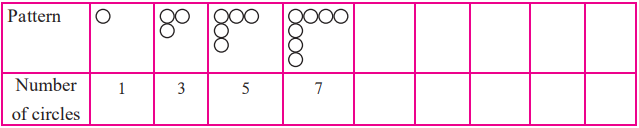
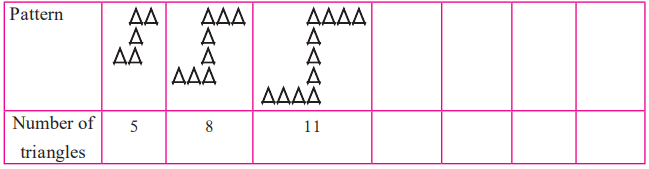
Complete the given pattern. Look at the pattern of the numbers. Try to find a rule to obtain the next number from its preceding number. Write the next numbers.
(i)
(ii)
Answer(i)
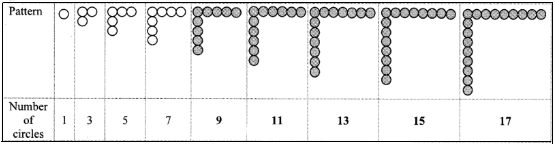
Every pattern is formed by adding a circle in horizontal and vertical rows to the preceding pattern.
∴ The sequence for the above pattern is 1,3, 5, 7,
9,11,13,15,17,….
(ii)
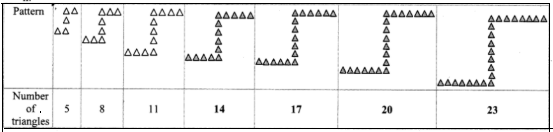
Every pattern is formed by adding 2 triangles horizontally and 1 triangle vertically to the preceding pattern.
∴ The sequence for the above pattern is 5,8,11,14,17,20,23,…
View full question & answer→Question 383 Marks
Divide 207 in three parts, such that all parts are in A.P. and product of two smaller parts will be 4623.
AnswerLet 3 parts of 207 be $a-d, a, a+d$ such that,
$\begin{array}{l}
\Rightarrow(a-d)+a+(a+d)=207 \\
\Rightarrow 3 a=207 \\
\Rightarrow a=\frac{207}{3}=69
\end{array}$
Since, product of two smaller terms is 4623
$\begin{array}{l}
\Rightarrow(a-d) \times a=4623 \\
\Rightarrow(69-d) \times 69=4623 \\
\Rightarrow 69-d=\frac{4623}{69}=67 \\
\Rightarrow d=69-67=2
\end{array}$
Thus, $a-d=69-2=67$
$\begin{array}{l}
a=69 \\
a+d=69+2=71
\end{array}$
Thus, the A.P so formed is $67,69,71$
View full question & answer→Question 393 Marks
Sum of 1 to n natural numbers is 36, then find the value of n.
AnswerList of n natural number is
1, 2, 3, ……n
First term a = 1
Second term t1 = 2
Third term t3 = 3
Thus, common difference d = t3 – t2 = 3 – 2 = 1
Given Sn = 36
Thus, By using sum of nth term of an A.P. we will find it’s sum
$S_n=\frac{n}{2}[2 a+(n-1) d]$
Where, n = no. of terms
a = first term
d = common difference
Sn = sum of n terms
We need to find no. of terms n
$\begin{array}{l}\Rightarrow 36=\frac{n}{2}[2 \times 1+(n-1) \times 1] \\ \Rightarrow 36=\frac{n}{2}[2+n-1] \\ \Rightarrow 36=\frac{n}{2}[1+n]\end{array}$
⇒ n(1 + n) = 36 × 2 = 72
⇒ n2 + n – 72 = 0
⇒ n2 + 9n – 8n – 72 = 0
⇒ n(n + 9) – 8(n + 9) = 0
⇒ (n – 8)(n + 9) = 0
⇒ n – 8 = 0 or n + 9 = 0
⇒ n = 8 or n = – 9
Since, number of terms n can’t be negative
∴ n = 8
View full question & answer→Question 403 Marks
If sum of 3rd and 8th terms of an A.P. is 7 and sum of 7th and 14th terms is – 3 then find the 10th term.
AnswerNow, By using nth term of an A.P. formula
tn = a + (n – 1)d
where n = no. of terms
a = first term
d = common difference
tn = nth terms
Hence, by given condition we get,
t3 + t8 = 7
⇒ [a + (3 – 1)d] + [a + (8 – 1)d] = 7
⇒ [a + 2d] + [a + 7d] = 7
⇒ 2a + 9d = 7 …..(1)
t7 + t14 = – 3
⇒ [a + (7 – 1)d] + [a + (14 – 1)d] = – 3
⇒ [a + 6d] + [ a + 13d] = – 3
⇒ 2a + 19d = – 3 …..(2)
Subtracting eq. (1) from eq. (2)
⇒ [2a + 19d] – [2a + 9d] = – 3 – 7
⇒ 10d = – 10
$\Rightarrow d =-\frac{10}{10}=-1$
Substituting, “d” in eq. (1)
⇒ 2a + 9 × ( – 1) = 7
⇒ 2a – 9 = 7
⇒ 2a = 7 + 9 = 16
$\Rightarrow a=\frac{16}{2}=8$
Now, we can find value of t10
Thus, t10 = 8 + (10 – 1)× ( – 1)
⇒ t10 = 8 – 9 = – 1
View full question & answer→Question 413 Marks
The A.P. in which 4th term is – 15 and 9th term is – 30. Find the sum of the first 10 numbers.
Answert4 = – 15 and t9 = – 30
Now, By using nth term of an A.P. formula
tn = a + (n – 1)d
where n = no. of terms
a = first term
d = common difference
tn = nth terms
Hence, by given condition we get,
t4 = – 15
⇒ a + (4 – 1)d = – 15
⇒ a + 3d = – 15 …..(1)
t9 = – 30
⇒ a + (9 – 1)d = – 30
⇒ a + 8d = – 30 …..(2)
Subtracting eq. (1) from eq. (2)
⇒ [a + 8d] – [a + 3d] = – 30 – ( – 15)
⇒ 5d = – 30 + 15 = – 15
$\Rightarrow d=-\frac{15}{5}=-3$
Substituting, “d” in eq. (1)
⇒ a + 3 × ( – 3) = – 15
⇒ a + – 9 = – 15
⇒ a = – 15 + 9 = – 6
Thus, By using sum of nth term of an A.P. we will find it’s sum
$S _{ n }=\frac{ n }{2}[2 a +( n -1) d ]$
Where, n = no. of terms
a = first term
d = common difference
Sn = sum of n terms
We need to find S10
$\Rightarrow S_{10}=\frac{10}{2}[2 \times(-6)+(10-1) \times(-3)]$
⇒S10 = 5 [ – 12 + 9 × ( – 3)]
⇒S10 = 5 [ – 12 – 27]
⇒S10 = 5 × ( – 39) = – 195
View full question & answer→Question 423 Marks
If m times the mth term of an A.P. is equal to n times nth term then show that the (m + n)th term of the A.P. is zero.
AnswerWe use nth term of an A.P. formulatn = a + (n – 1)d
where n = no. of terms
a = first term
d = common difference
tn = nth terms
Thus mth term = tm = a + (m – 1)d
Given: m × tm = n × tn
⇒ m × [ a + (m – 1)d] = n × [a + (n – 1)d]
⇒ am + m(m – 1)d = an + n(n – 1)d
⇒ am – an + m(m – 1)d – n(n – 1)d = 0
⇒ a(m – n) + d[m(m – 1) – n(n – 1)] = 0
⇒ a(m – n) + d[ m2 – m – n2 + n] = 0
⇒ a(m – n) + d[ (m2 – n2) – m + n] = 0
⇒ a(m – n) + d[ (m – n)(m + n) –(m – n)] = 0
(since, (a – b)(a + b) = a2 – b2)
⇒ a(m – n) + d(m – n)[(m + n) –1] = 0
⇒ (m – n) [a + d(m + n –1)] = 0
Since, m ≠ n
∴ m – n ≠ 0
⇒ a + d(m + n –1) = 0
⇒ tm + n = 0
Hence proved
View full question & answer→Question 433 Marks
In the natural numbers from 10 to 250, how many are divisible by 4?
AnswerList of number divisible by 4 in between 10 to 250 are
12, 16,20,24,……….. 248
Let us find how many such number are there?
From the above sequence, we know that
tn = 248, a = 12
t1 = 16, t2 = 20
Thus, d = t2 – t1 = 20 – 16 = 4
Now, By using nth term of an A.P. formula
tn = a + (n – 1)d
we can find value of “n”
Thus, on substituting all the value in formula we get,
248 = 12 + (n – 1)× 4
⇒ 248 – 12 = (n – 1)× 4
⇒ 236 = (n – 1) × 4
$\Rightarrow n -1=\frac{236}{4}=59$
⇒ n = 59 + 1 = 60
View full question & answer→Question 443 Marks
11, 8, 5, 2, . . . In this A.P. which term is number – 151?
AnswerBy, given A.P. 11, 8, 5, 2, . . .
we know that
a = 11, t1 = 8, t2 = 5
Thus, d = t2 – t1 = 5 – 8 = – 3
Given: tn = – 151
Now, By using nth term of an A.P. formula
tn = a + (n – 1)d
we can find value of “n”
Thus, on substituting all the value in formula we get,
– 151 = 11 + (n – 1)× ( – 3)
⇒ – 151 – 11 = (n – 1)× ( – 3)
⇒ – 162 = (n – 1) × ( – 3)
$\Rightarrow n -1=\frac{-162}{-3}=54$
⇒ n = 54 + 1 = 55
View full question & answer→Question 453 Marks
The 11th term and the 21st term of an A.P. are 16 and 29 respectively, then find the 41th term of that A.P.
AnswerGiven: $t _{11}=16$ and $t _{21}=29$
To find: $t _{41}$
Using $n ^{\text {th }}$ term of an A.P. formula
$t_n=a+(n-1) d$
we will find value of "a" and "d"
Let, $t_{11}=a+(11-1) d$
$\Rightarrow 16=a+10 d$
$\begin{array}{l}
t_{21}=a+(21-1) d \\
\Rightarrow 29=a+20 d \ldots
\end{array}$
Subtracting eq. (1) from eq. (2), we get,
$\begin{array}{l}
\Rightarrow 29-16=(a-a)+(20 d-10 d) \\
\Rightarrow 13=10 d \\
\Rightarrow d=\frac{13}{10}=1.3
\end{array}$
Substitute value of "d" in eq. (1) to get value of "a"
$\begin{array}{l}
\Rightarrow 16=a+10 \times \frac{13}{10} \\
\Rightarrow 16=a+13 \\
\Rightarrow a=16-13=3
\end{array}$
Now, we will find the value of $t_{41}$ using $n^{\text {th }}$ term of an A.P. formula
$\begin{array}{l}
\Rightarrow t_{41}=3+(41-1) \times \frac{13}{10} \\
\Rightarrow t_{41}=3+40 \times \frac{13}{10} \\
\Rightarrow t_{41}=3+4 \times 13=3+52=55
\end{array}$
Thus, $t _{41}=55$
View full question & answer→Question 463 Marks
Find how many three digit natural numbers are divisible by 5.
AnswerList of three digit number divisible by 5 are
100, 105,110,115,……….. 995
Let us find how many such number are there?
From the above sequence, we know that
tn = 995, a = 100
t1 = 105, t2 = 110
Thus, d = t2 – t1 = 110 – 105 = 5
Now, By using nth term of an A.P. formula
tn = a + (n – 1)d
we can find value of “n”
Thus, on substituting all the value in formula we get,
995 = 100 + (n – 1)× 5
⇒ 995 – 100 = (n – 1)× 5
⇒ 895 = (n – 1) × 5
$\Rightarrow n -1=\frac{895}{5}=179$
⇒ n = 179 + 1 = 180
View full question & answer→Question 473 Marks
Find the 27th term of the following A.P.
9, 4, – 1, – 6, – 11, . . .
AnswerGiven A.P. is 9, 4, – 1, – 6, – 11, . . .Where first term a = 9
Second term t1 = 4
Third term t2 = – 1
Common Difference d = t2 – t1 = – 1 – 4 = – 5
We know that, nth term of an A.P. is
tn = a + (n – 1)d
We need to find the 27th term,
Here n = 27
Thus, t27 = 9 + (27 – 1)× ( – 5)
t27 = 9 + (26)× ( – 5) = 9 – 130 = – 121
Thus, t27 = – 121
View full question & answer→Question 483 Marks
Find the 19th term of the following A.P.
7, 13, 19, 25, . . .
AnswerGiven A.P. is 7, 13, 19, 25, . . .Where first term a = 7
Second term t1 = 13
Third term t2 = 19
Common Difference d = t2 – t1 = 19 – 13 = 6
We know that, nth term of an A.P. is
tn = a + (n – 1)d
We need to find the 19th term,
Here n = 19
Thus, t19 = 7 + (19 – 1)× 6
t19 = 7 + (18)× 6 = 7 + 108 = 115
Thus, t19 = 115
View full question & answer→Question 493 Marks
Given Arithmetic Progression 12, 16, 20, 24, . . . Find the 24th term of this progression.
AnswerGiven A.P. is 12, 16, 20, 24, . . .
Where first term a = 12
Second term t1 = 16
Third term t2 = 20
Common Difference d = t2 – t1 = 20 – 16 = 4
We know that, nth term of an A.P. is
tn = a + (n – 1)d
We need to find the 24th term,
Here n = 24
Thus, t24 = 12 + (24 – 1)× 4
t24 = 12 + (23)× 4 = 12 + 92 = 104
Thus, t24 = 104
View full question & answer→Question 503 Marks
Decide whether following sequence is an A.P., if so find the 20th term of the progression.
– 12, – 5, 2, 9, 16, 23, 30, . . .
AnswerGiven A.P. is – 12, – 5, 2, 9, 16, 23, 30, . . .
Where first term a = – 12
Second term t1 = – 5
Third term t2 = 2
Common Difference d = t2 – t1 = 2 – ( – 5) = 2 + 5 = 7
We know that, nth term of an A.P. is
tn = a + (n – 1)d
We need to find the 20th term,
Here n = 20
Thus, t20 = – 12 + (20 – 1)× 7
t20 = – 12 + (19)× 7 = – 12 + 133 = 121
Thus, t20 = 121
View full question & answer→Question 513 Marks
In an A.P. 17th term is 7 more than its 10th term. Find the common difference.
AnswerGiven: t17 = 7 + t10 ……(1)
In t17, n = 17
In t10, n = 10
By using nth term of an A.P. formula,
tn = a + (n – 1)d
where n = no. of terms
a = first term
d = common difference
tn = nth term
Thus, on using formula in eq. (1) we get,
⇒ a + (17 – 1)d = 7 + (a + (10 – 1)d)
⇒ a + 16 d = 7 + (a + 9 d)
⇒ a + 16 d – a – 9 d = 7
⇒ 7 d = 7
$\Rightarrow d =\frac{7}{7}=1$
Thus, common difference “d” = 1
View full question & answer→Question 523 Marks
In year 2015, Mrs. Shaikh got a job with salary ₹ 1,80,000 per year. Her employer agreed to give ₹ 10,000 per year as increment. Then in how many years will her annual salary be ₹ 2,50,000?
Answer| Year | First Year
(2015) | Second Year
(2016) | Third Year
(2017) | … |
| Salary (₹) | [1,80,000] | [1,80,000+10,000] | | … |
$\begin{array}{l}
a=1,80,000 \quad d=10,000 \quad n=? \quad t _{ n }=2,50,000 ₹ \\
t _{ n }=a+(n-1) d \\
2,50,000=1,80,000+(n-1) \times 10,000 \\
(n-1) \times 10000=70,000 \\
(n-1)=7 \\
n=8
\end{array}$
In the $8^{\text {th }}$ year her annual salary will be $₹ 2,50,000$.
View full question & answer→Question 533 Marks
Find the sum of all odd numbers from 1 to 150.
Answer1 to 150 all odd numbers are $1,3,5,7, \ldots, 149$.
Which is an A.P.
Here $a=1$ and $d=2$. First let's find how many odd numbers are there from 1 to 150 , so find the value of $n$, if $t_{ n }=149$
$\begin{array}{ll}
t_{ n }=a+(n-1) d & \\
149=1+(n-1) 2 & \therefore 149=1+2 n-2 \\
& \therefore n=75
\end{array}$
Now let's find the sum of these 75 numbers $\quad 1+3+5+\ldots+149$.
$\begin{array}{c}
a=1 \text { and } d=2, n=75 \\
S _{ n }=\frac{n}{2}\left[ t _1+ t _{ n }\right] \\
S _{ n }=\frac{75}{2}[1+149] \\
S _{ n }=37.5 \times 150 \\
S _{ n }=5625
\end{array}$
View full question & answer→Question 543 Marks
How many two digit numbers are divisible by 4 ?
AnswerList of two digit numbers divisible by 4 is
$
12,16,20,24, \ldots, 96 \text {. }
$
Let's find how many such numbers are there.
$
t_{\mathrm{n}}=96, \quad a=12, \quad d=4
$
From this we will find the value of $n$.
$
\begin{aligned}
t_{\mathrm{n}} & =96, \therefore \text { By formula, } \\
96 & =12+(n-1) \times 4 \\
& =12+4 n-4 \\
\therefore 4 & =88 \\
\therefore n & =22
\end{aligned}
$
$\therefore$ There are 22 two digit numbers divisible by 4 .
View full question & answer→Question 553 Marks
Check whether 301 is in the sequence
$5,11,17,23, \ldots \text { ? }$
AnswerIn the sequence $5,11,17,23, \ldots$
$
\begin{array}{l}
t_1=5, t_2=11, t_3=17, t_4=23, \ldots \\
t_2-t_1=11-5=6 \\
t_3-t_2=17-11=6
\end{array}
$
$\therefore$ This sequence is an A.P.
First term $a=5$ and $d=6$
If 301 is $n^{\text {th }}$ term, then.
$
\begin{array}{l}
t=a+(n-1) d=301 \\
\therefore 301=5+(n-1) \times 6 \\
=5+6 n-6 \\
\therefore 6 n=301+1=302 \\
\end{array}
$
$\therefore n=\frac{302}{6}$. But it is not an integer.
$\therefore 301$ is not in the given sequence.
View full question & answer→Question 563 Marks
The sixth term of an A.P. is 5 times the $1^{\text {st }}$ term and the eleventh term exceeds twice the fifth term by 3. Find the $8^{\text {th }}$ term.
View full question & answer→Question 573 Marks
The first and the last terms of an A.P. are 17 and 350 respectively. If the common difference is 9 , how many terms are there and what is their sum?
Question 583 Marks
Split 69 in three parts such that they are in A.P. and product of two smaller parts is 483.
Question 593 Marks
Obtain the sum of 56 terms of an A.P. whose $19^{\text {th }}$ and $38^{\text {th }}$ terms are 52 and 148 respectively.
View full question & answer→Question 603 Marks
In an A.P., if the $5^{\text {th }}$ and 12 th terms are 30 and 65 respectively, what is the sum of the first 20 terms.
View full question & answer→Question 613 Marks
If $10^{ th }$ term and the $18^{ th }$ term of an A.P. are 25 and 41 respectively, then find the $38^{\text {th }}$ term.
View full question & answer→Question 623 Marks
How many two digit natural numbers are divisible by 5 ?
Question 633 Marks
How many three digit natural numbers are divisible by 4 ?
Question 643 Marks
How many terms of the A.P.: 9, 17, 25, .... must be taken to give a sum of 636 ?
Question 653 Marks
For what value of $n$, the nth term of the following two A.P.s are equal?
$23,25,27,29$,.... and $-17,-10,-3,4$, ....
View full question & answer→Question 663 Marks
Find three consecutive terms in an A.P. whose sum is -3 and the product of their cubes is 512.
Answer$-4,-1,2$ or $2,-1,-4$
View full question & answer→Question 673 Marks
Find the sum of all natural numbers between 100 and 1000 which are multiples of 7 .
Question 683 Marks
Find the eighteenth term of the A.P. 1, 7, 13, 19.
Question 693 Marks
Find the $10^{\text {th }}$ term from the end of the A.P. $4,9,14, \ldots, 254$.
View full question & answer→Question 703 Marks
Find four conseculive terms in an A.P. such that the sum of the middle two terms is 18 and product of the two end terms is 45.
Answer$3,7,11,15$ or $15,11,7,3$
View full question & answer→