MCQ
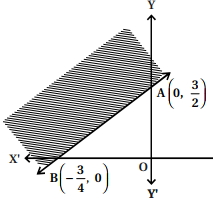
છાયાકિંત ભાગ શેનો આલેખ દર્શાવે છે 
  • A
    $4 x-2 y \leq 3$
  • $4 x-2 y \leq-3$
  • C
    $2 x-4 y \geq 3$
  • D
    $2 x-4 y \leq-3$

Answer

Correct option: B.
$4 x-2 y \leq-3$
b
(B) $4 x-2 y \leq-3$

The given line intersects $\mathrm{X}$ - axis at $\left(-\frac{3}{4}, 0\right)$ and $\mathrm{Y}$ - axis at $\left(0, \frac{3}{2}\right)$

$\therefore$ Equation of the line $\frac{x}{-\frac{3}{4}}+\frac{y}{\frac{3}{2}}=1$

$\begin{array}{l}\therefore-4 x+2 y=3 \\\therefore 4 x-2 y=-3\end{array}$

Taking $x=y=0 \Rightarrow 0-0 \leq-3$ which is not true. $\therefore 4 x-2 y \leq-3$ is a half plane not containing (0,0)

Need a full question paper?

Generate a complete, print-ready paper with questions like this in minutes — across 16+ boards, with answer keys.

Start Generating Free

Similar questions

જો $f( x )=\left\{\begin{array}{cc}2 x ^2+3 x +4, & x <1 \\ kx +9- k , & x \geq 1\end{array}\right.$ વિકલનીય હોય, તો $k =\ldots \ldots . . . .$.
$\frac{{dy}}{{dx}} = 1 + x + {y^2} + x{y^2},y\left( 0 \right) = 0,$ નો ઉકેલ $............$
ધારોકે $\vec{a}, \vec{b}$ અને $\vec{c}$ ત્રણ શૂન્યેતર અસમતલીય સદિશો છે. ધારોકે ચાર બિંદુુુ $A, B, C$ અને $D$ નાં સ્થાન સદિશો અનુક્રમે $\vec{a}-\vec{b}+\vec{c}, \lambda \vec{a}-3 \vec{b}+4 \vec{c},-\vec{a}+2 \vec{b}-3 \vec{c}$ અને $2 \vec{a}-4 \vec{b}+6 \vec{c}$ છે. જો $\overrightarrow{A B}, \overrightarrow{A C}$ અને $\overrightarrow{A D}$, સમતલીય હોય, તો $\lambda=........$
મર્યાદાઓ $2 x+3 y \leq 6,5 x+3 y \leq 15$ અને $x \geq 0, y \geq 0$ થી રચાતા શકય ઉકેલ પ્રદેશનું નીચેનામાંથી ............... બિંદુ શિરોબિંદુ નથી. 
$A (1, 0, 0), B(0, 1, 0), C (0, 0, 1)$ જેના શિરોબિંદુઓ હોય તેવા ત્રિકોણ $ABC$ માટે ખૂણો $A = ……$
વૃતાંશની પરિમિતી $p$ છે. જો વૃતાંશનું ક્ષેત્રફળ મહત્તમ હોય ત્યારે તેની ત્રિજ્યા ?
$f( n )= n$ નો મહત્તમ અવિભાજ્ય અવયવ, દ્વારા વ્યાખ્યાયિત વિધેય $f: N -\{1\} \rightarrow N$ એ
જો $y = y\, (x)$ એ વિકલ સમીકરણ $\frac{{dy}}{{dx}} + 2y = f\left( x \right) $  નો ઉકેલ છે કે જ્યાં  $f\left( x \right) = \left\{ \begin{array}{l}1,\,\,\,\,\,x \in \left[ {0,1} \right]\\0,\,\,\,\,\,\text{otherwise} \end{array} \right.$ જો $y\, (0)$ = $0$, તો  $y\left( {\frac{3}{2}} \right)$ મેળવો.
${d \over {dx}}{e^{x + 3\log x}} = $
$\int_{}^{} {\frac{{dx}}{{\sqrt {1 - x} }}} $ =