ચોક્કસ પ્રક્રિયાના પ્રથમ ક્રમમાં વિઘટન માટેનો દર સતત એ સમીકરણ $\ln k\left(s^{-1}\right)=14.34-\frac{1.25 \times 10^{4} K}{T}$ દ્વારા વર્ણવવામાં આવે છે.આ પ્રક્રિયા માટે સક્રિયકરણની ઊર્જા શું હશે ?
AIIMS 2018, Medium
Download our app for free and get started
d
Given that,
Given that,
\(\ln k\left(s^{-1}\right)=14.34-\frac{1.25 \times 10^{4}}{T} K \ldots(i)\)
We know that,
\(\ln k\left(s^{-1}\right)=\ln A-\frac{E_{a}}{R T} \ldots( ii )\)
On comparing equation \((i)\) and \((ii)\), we get
\(\frac{E_{a}}{R}=1.25 \times 10^{4} \,K\)
\(\therefore E_{a}=1.25 \times 10^{4} K \times R\) \(cal\) \(K^{-1} mol ^{-1}\)
\(=1.25 \times 10^{4} K \times 2\) \(cal\) \(K^{-1} mol ^{-1}\)
\(\left[\because R=2 \operatorname{cal} K^{-1} mol ^{-1}\right]\)
\(=2.50 \times 10^{4}\) \(cal\) \(mol ^{-1}\)

Download our appand get started for free
Experience the future of education. Simply download our apps or reach out to us for more information. Let's shape the future of learning together!No signup needed.*
Similar Questions
- 1વાયુરૂપ ઘટકો વચ્ચેની પ્રક્રિયા : $2A + B\rightarrow C + D. $ માટે પ્રક્રિયા વેગ $= K[A][B] $ છે. તો પહેલા કરતા પાત્રનું $1/4$ કદ જેટલુ ઓછુ લેવામાં આવે તો પહેલાના પ્રક્રિયા વેગ કરતાં અંતિમ પ્રક્રિયા વેગ કેટલા ગણો મળશે ?View Solution
- 2રાસાયણિક ગતિકીમાં સમીકરણ $K = A{e^{ - {E_a}/RT}}$ ના સંદર્ભમાં નીચેનામાંથી ક્યુ વિધાન સાચું છે ?View Solution
- 3$A\rightarrow$ નિપજ ચોક્કસ પ્રક્રિયાનો અર્ધઆયુ સમય $1$ કલાક છે. જ્યારે પ્રક્રિયક $ 'A' $ ની શરૂઆતની સાંદ્રતા $2.0$ મોલ $L^{-1}$ હોય તો જો શૂન્ય ક્રમની પ્રક્રિયા હોય તો તેની સાંદ્રતા $0.50$ થી $0.25$ મોલ $L^{-1}$ સુધી આવતાં ......... $h$ લેશે.View Solution
- 4એક પ્રક્રિયા $2$ કલાકમાં $50 \%$ પૂર્ણ થાય છે. તથા $4$ કલાક માં $75 \%$ પૂર્ણ થાય છે. તો પ્રક્રિયાનો ક્રમ ..........View Solution
- 5એક પ્રક્રિયા નો અર્ધ આયુષ્ય સમય $1\,min.$ છે તો $99.9\, \%$ પ્રક્રિયાને પૂર્ણ થવા માટે લાગતો જરૂરી સમય ......... $min.$ છે [ઉપયોગ : $\ln\, 2=0.69, \ln \,10=2.3]$View Solution
- 6સમાન તાપમાન પર એક પ્રક્રિયા ત્રણ તબકકકાઓમાં થાય છે. સમગ્ર વેગ અચળાંક $K=\frac{K_1 K_2}{K_3}$ છે. જો $\mathrm{Ea}_1, \mathrm{Ea}_2$ અને $Еаз$ એં અનુક્મે $40,50$ અને $60 \mathrm{~kJ} / \mathrm{mol}$ હોય તો, સમગ્ર Ea $\mathrm{kJ} / \mathrm{mol}$છે.View Solution
- 7એઝોમિથેનના વિધટન માટે,View Solution
$CH _3 N _2 CH _3( g ) \rightarrow CH _3 CH _3( g )+ N _2( g )$
આ એક પ્રથમક્રમ પ્રક્રિયા છે. $600\, K$ પર સમય સાથે આંશિક દબાણમાં વિવિધતા નીચે આપેલ છે. પ્રક્રિયાનો અર્ધ આયુષ્ય $\times 10^{-5}\, s$ છે. [નજીકનો પૂર્ણાંક]
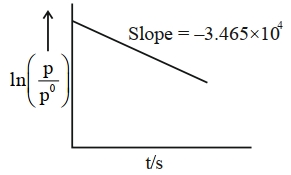
- 8ચોક્કસ પ્રક્રિયા માટેનો પ્રથમ ક્રમની પ્રકિયાનો વેગ અચળાંક $1.667 \times 10^{-6}\, s^{-1}$ $727\,^oC$ તાપમાને થી $1.667 \times 10^{-4}\,s^{-1}$ તાપમાને $1571\,^oC$.આપેલ તાપમાન શ્રેણી ઉપર સક્રિયકરણ ઉર્જાની સ્થાયિતા ધારીને, કયા $1150\,^oC$, પર દર સતત છેView Solution
- 9નીચે આપેલ દર અચળાંક $(k)$ સાથે તાપમાન $(T)$ વચ્ચેનો તફાવત આલેખમાં દર્શાવ્યો છે. તો કયો આલેખ આર્હેંનિયસ સમીકરણનું પાલન કરે છે.View Solution
- 10વાતાવરણના ઉપરના સ્તરમાં ઓઝોન વિઘટન નાઇટ્રિક ઓક્સાઇડ દ્વારા ઉદ્દીપિત થાય છે. પ્રક્રિયાની ક્રિયાવિધિ નીચે મુજબ છે.View Solution
$2NO \rightleftharpoons {N_2}O + \left[ O \right]$
${O_3} + \left[ O \right] \to 2{O_2}\,(slow)$
તો પ્રકિયાનો કમ જણાવો.