MCQ
Choose the correct nuclear process from the below options
[p: proton, n : neutron, $\mathrm{e}^{-}$: electron, $\mathrm{e}^{+}$: positron, $v$ : neutrino, $\bar{v}$ : antineutrino]
  • $n \rightarrow p+e^{-}+\bar{v}$
  • B
    $n \rightarrow p+e^{-}+v$
  • C
    $\mathrm{n} \rightarrow \mathrm{p}+\mathrm{e}^{+}+\bar{v}$
  • D
    $n \rightarrow p+e^{+}+v$

Answer

Correct option: A.
$n \rightarrow p+e^{-}+\bar{v}$
(A)
Sol. Theoretical equation for $\beta^{-1}$ decay
$\mathrm{n}_{0}^{1} \rightarrow \mathrm{p}_{1}^{1}+\mathrm{e}_{-1}^{-0}+\bar{v}$

Need a full question paper?

Generate a complete, print-ready paper with questions like this in minutes — across 16+ boards, with answer keys.

Start Generating Free

Similar questions

${O^{ + + }},\;{C^ + },\;H{e^{ + + }}$ and ${H^ + }$ ions are projected on the photographic plate with same velocity in a mass spectrograph. Which one will strike farthest
The Bhagirathi and the Alaknanda merge at Deoprayag to form the Ganga with their speeds in the ratio $1: 1: 5$. The cross-sectional areas of the Bhagirathi, the Alaknanda and the Ganga are in the ratio $1: 2: 3$. Assuming streamline flow, the ratio of the speed of Ganga to that of the Alaknanda is
A particle initially at rest is subjected to two forces. One is constant, the other is a retarding force proportional to the particle velocity. In the subsequent motion of the particle :
An object is attached to the bottom of a light vertical spring and set vibrating. The maximum speed of the object is $15\, cm/sec$ and the period is $628$ milli-seconds. The amplitude of the motion in centimeters is
A transverse sinusoidal wave of amplitude $a,$ wavelength $\lambda$ and frequency $n$ is travelling on a stretched string. The maximum speed of any point on the string is $v/10,$ where $v$ is the speed of propagation of the wave. If $a = {10^{ - 3}}\,m$ and $v = 10\,m{s^{ - 1}}$, then $\lambda$ and $n$ are given by
The hyper-metropia is a
Hook's law defines
Image formed by a concave mirror of focal length $6 \,cm$, is $3$ times of the object, then the distance of object from mirror is......$cm$
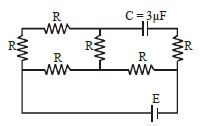
In steady state the potential difference across the capacitor is $10\,\, V.$ Each resistance is of $3\,\Omega $. The cell is ideal. The $emf$ of the cell is .............. $\mathrm{V}$
A $16\  \Omega$ wire is bend to form a square loop. A $9 \mathrm{~V}$ battery with internal resistance $1\  \Omega$ is connected across one of its sides. If a $4\  \mu \mathrm{F}$ capacitor is connected across one of its diagonals, the energy stored by the capacitor will be $\frac{x}{2} \ \mu \mathrm{J}$. where $x=$________.