Question
Classify the elements on basis of electronic configuration.

Answer

SELF

Need a full question paper?

Generate a complete, print-ready paper with questions like this in minutes — across 16+ boards, with answer keys.

Start Generating Free

Similar questions

Write the significance/applications of dipole moment.
Compare the geometry and bond angle of those molecules of type AB₂, AB3, AB4 and AB5 in which the lone (1.p) electron pair is not present on the central atom.
Balance the following equations in basic medium by ion-electron method and oxidation number methods and identify the oxidising agent and the reducing agent.

$\text{P}_4(\text{s})+\text{OH}^{-}(\text{aq})\rightarrow\text{PH}_3(\text{g})+\text{HPO}_2^-(\text{aq})$

Explain Heisenberg's uncertainty principle and also explain its importance.
  1. An athlete is given 100g of glucose of energy equivalent to 1560kJ. He utilises 50% of this gained energy in the event. In order to avoid storage of energy in the body, calculate the weight of water that would need to perspire. The enthalpy of vaporisation of water is 44kJ mol-1.
  2. Compound with carbon-carbon double bond, such as ethylene, C2H4, add hydrogen in a reaction called hydrogenation, C2H4(g) + H2(g) → C2H6(g)

Calculate enthalpy change for the reaction, using the following combustion data,

$\text{C}_2\text{H}_4(\text{g})+3\text{O}_2(\text{g})\overrightarrow{\ \ \ \ \ }\ 2\text{CO}_2(\text{g})+2\text{H}_2\text{O(l)};$ $\Delta_\text{c}\text{H}^\circ=-1401\text{kJ mol}^{-1}\dots(\text{i})$

$\text{C}_2\text{H}_6(\text{g})+\frac{7}{2}\text{O}_2(\text{g})\overrightarrow{ \ \ \ \ \ \ \ }\ 2\text{CO}_2(\text{g})+3\text{H}_2\text{O(l)}$ $\Delta_\text{c}\text{H}^\circ=-1550\text{kJ mol}^{-1}\dots(\text{ii})$

$\text{H}_2(\text{g})+\frac{1}{2}\text{O}_2(\text{g})\overrightarrow{ \ \ \ \ }\ \text{H}_2\text{O(l)};$ $\Delta_\text{c}\text{H}^\circ=-286.0\text{kJ mol}^{-1}\dots(\text{iii})$
Write the expression for the equilibrium constant, $K _{ c }$ for each of the following reactions :
(i) $2 NOCl ( g ) \rightleftharpoons 2 NO ( g )+ Cl _2(g)$
(ii) $2 Cu \left( NO _3\right)_2(s) \rightleftharpoons 2 CuO ( s )+4 NO _2(g)+ O _2(g)$
(iii) $CH _3 COOC _2 H _5( aq )+ H _2 O ( l ) \rightleftharpoons$$CH _3 COOH ( aq )+ C _2 H _5 OH ( aq )$
(iv) $Fe ^{3+}( aq )+3 OH ^{-}( aq ) \rightleftharpoons Fe ( OH )_3(s)$
(v) $I _2(s)+5 F_2(g) \rightleftharpoons 2 IF _5$
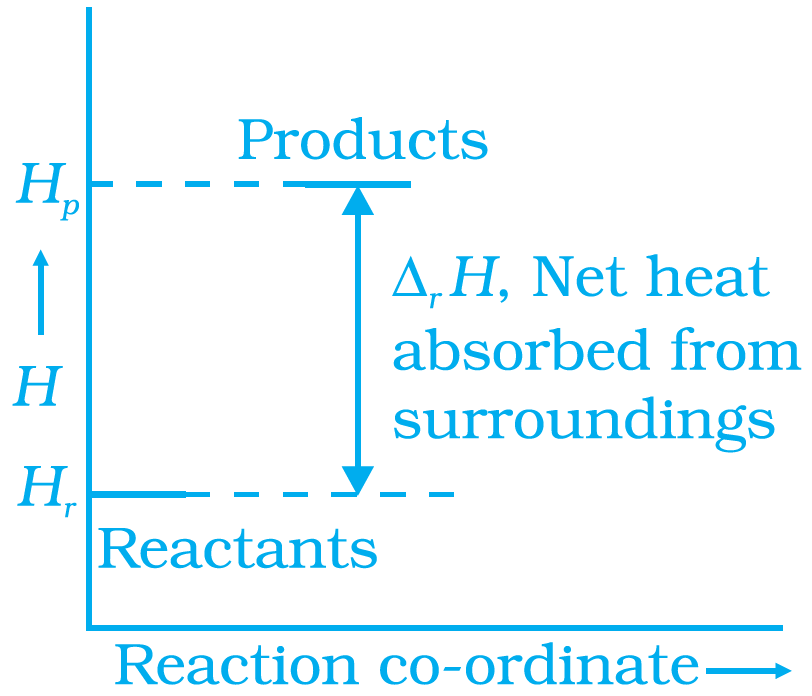
Enthalpy diagram for a particular reaction is given in Fig. Is it possible to decide spontaneity of a reaction from given diagram. Explain.

Sulphuric acid reacts with sodium hydroxide as follows:
H2SO4 + 2NaOH Na2SO4 + 2H2O
When 1 L of 0.1 M sulphuric acid solution is allowed to react with 1 L of 0.1 M sodium hydroxide solution. Calculate the amount of sodium sulphate formed and its molarity in the solution obtained.
Explain the molecular orbital diagram of benzene.
  1. What type of intermediate species are formed by homolytic fission?
  2. Which substance is used as adsorbent in thin layer chromatography?
  3. Why is resonance hybrid is more stable than resonating structures?
  4. In Kjeldahl's method, which compound is formed during digestion i.e., reaction of organic compound with conc. H2SO4 on heating?
  5. Why is HCOOH more acidic than CH3COOH?