Question
Classify the under-mentioned errors into:
  1. Error of Omission
  2. Error of Commission
  3. Compensating Error
  4. Error of Principle
  1. Purchased goods from Bhardwaj on credit for ₹ 600, but were recorded in the purchase book as ₹ 6,000.
  2. Amount paid for the proprietor’s life insurance premium was debited to 'General Expenses Account'.
  3. Goods amounting to ₹ 2,000 have been returned to Chakravarti, but no entry has been made in the books.
  4. An excess debit of ₹ 4,500 has been made in the account of X, whereas Y's account has been credited by ₹ 5,000 instead of ₹ 500.
  5. Goods sold to Suresh for ₹ 650 were recorded as ₹ 560 in the Sales Book.
  6. Typewriter purchased for office use has been debited to Purchases Account.
  7. Wages paid for the construction of Building ₹ 15,000 were recorded in "Wages Account'.
  8. Goods for ₹ 500 have been taken by the proprietor for his personal use, for which no entry has been passed in the books.
Answer

Error of Omission:
  1. Goods amounting to ₹ 2,000 have been returned to Chakravarti, but no entry has been made in the books.
  1. Goods for ₹ 500 have been taken by the proprietor for his personal use, for which no entry has been passed in the books.
Error of Commission:
  1. Purchased goods from Bhardwaj on credit for ₹ 600, but were recorded in the purchase book as ₹ 6,000.
  1. Goods sold to Suresh for ₹ 650 were recorded as ₹ 560 in the Sales Book.
Compensating Error:
  1. An excess debit of ₹ 4,500 has been made in the account of X, whereas Y's account has been credited by ₹ 5,000 instead of ₹ 500.
Error of Principle:
  1. Amount paid for the proprietor’s life insurance premium was debited to 'General Expenses Account'.
  1. Typewriter purchased for office use has been debited to Purchases Account.
  1. Wages paid for the construction of Building ₹ 15,000 were recorded in "Wages Account'.

Need a full question paper?

Generate a complete, print-ready paper with questions like this in minutes — across 16+ boards, with answer keys.

Start Generating Free

Similar questions

Enter the following transactions in proper Subsidiary Books, post them into Ledger Accounts, balance the accounts and prepare a Trial Balance:
2017  
Jan. 1 Assets: Cash in hand ₹ 20,000; Debtors: Sri Gopal ₹ 15,000, Poonam & Co. ₹ 30,000; Stock ₹ 1,75,000, Machinery ₹ 1,20,000; Furniture ₹ 40,000
Liabilities: Bank Overdraft ₹ 33,000; Creditors: Niranjan Lal ₹ 24,000, Bombay Trading Co. ₹ 16,000
Jan. 2 Purchased from Manohar Lal & Sons goods of the list price of ₹ 20,000 at 10% trade discount
Jan. 5 Returned to Manohar Lal & sons goods of the list price of ₹ 2,000
Jan. 10 Issued a Cheque to Manohar Lal & Sons in full settlement of their account
Jan. 12 Sold to Sri Gopal, goods worth ₹ 25,000
Jan. 15 Received Cash ₹ 10,000 and a Cheque for ₹ 8,000 from Sir Gopal. The Cheque was immediately sent to bank
Jan. 16 Withdrew for personal use: Cash ₹ 5,000 and goods ₹ 3,000
Jan. 17 Accepted a bill for 45 days drawn by Niranjan Lal for the amount due to him
Jan. 18 Acceptance received from Poonam & Co. for the amount due from them payable after 30 days
Jan. 19 Sold to Raghubir Brothers, goods valued ₹ 16,000
Jan. 20 Cash purchases ₹ 15,000
Jan. 22 Withdrew from bank fo office use ₹ 10,000
Jan. 23 Purchased from Bombay Trading Co., goods valued ₹ 24,000
Jan. 24 Sri Gopal returned goods worth ₹ 2,000
Jan. 25 Received from Raghubir Brothers ₹ 10,000
Jan. 27 Accepted a bill for ₹ 25,000 for 1 month drawn by Bombay Trading Co
Jan. 27 Paid Rent by Cheque ₹ 2,800
Received Commission in Cash ₹ 800
Jan. 31 Paid salaries ₹ 5,000
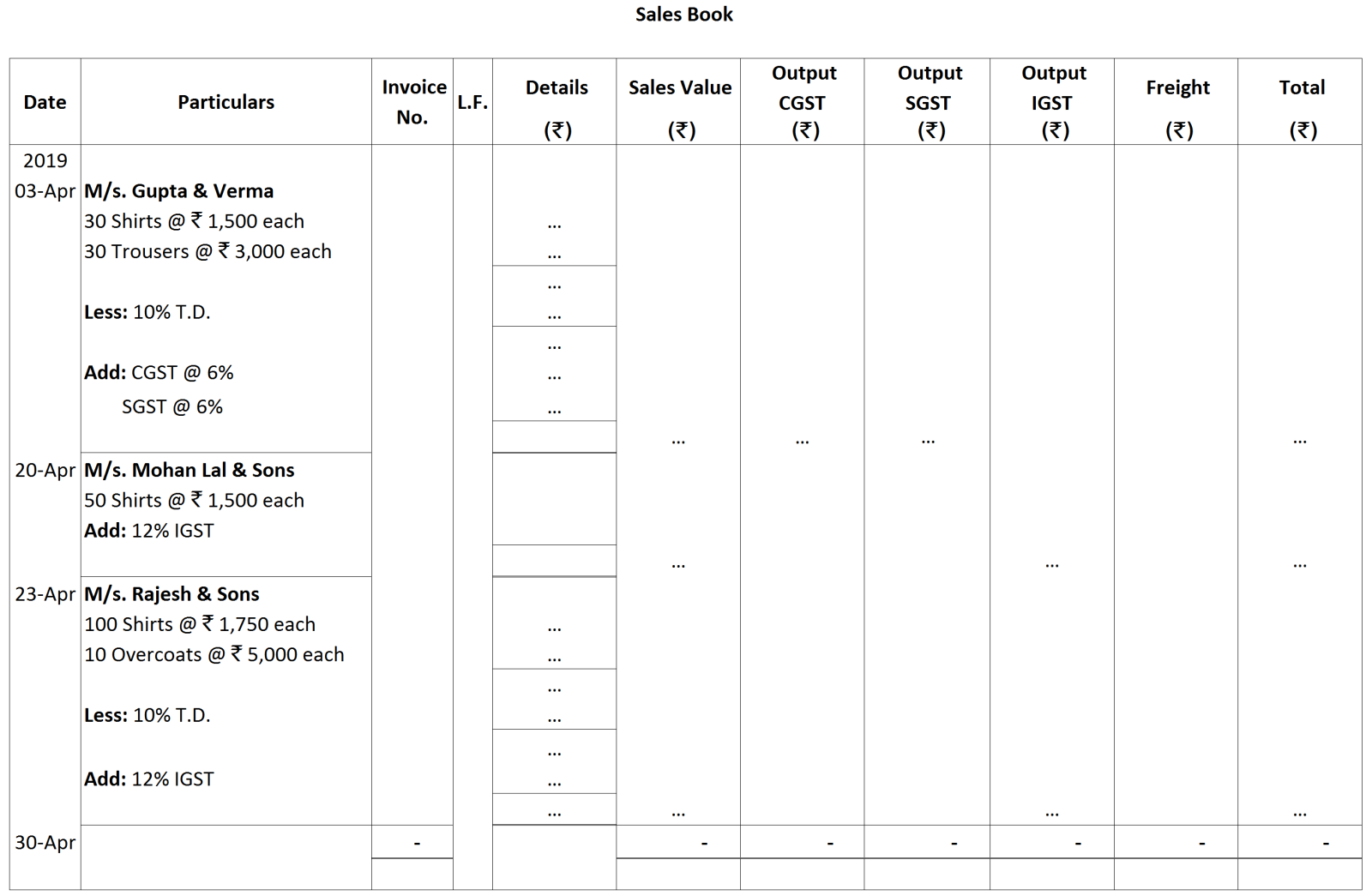
In the following Sales Book, determine the missing information:
Explain Debit and Credit note in five sentences.
Record the following transaction in the Sales Book of Karunakaran & Sons, Chennai (Tamilnadu) assuming CGST @ 90% and SGST @ 9% and post them into Ledger:
2017
 
Dec. 5
Sold of M/s Banwari Lal & Sons, Chennai, goods valued at ₹ 2,00,000 less Trade Discount 10%
Dec. 10
Sold to M/s Kanti Bhai & Sons, Bengaluru (Karnataka):
75 Electric Fans @ ₹ 4,000 each
20 Room Coolers @ ₹ 10,000 each
Less: Trade Discount 8%
Dec. 16
Mahindra & Co., Kochi (Kerala) purchased from us goods of ₹ 1,20,000, less: 5%
Dec. 24
Sold goods for cash ₹ 60,000
Journalise the following entries:
  1. Goods costing ₹ 500 given as charity.
  2. Sold goods to Mayank of ₹ 1,00,000, payable 25% by cheque at the time of sale and balance after 30 days of sale.
  3. Received ₹ 975 from Harikrishna in full settlement of his account of ₹ 1,000.
  4. Received a first and final dividend of 60 paise in a rupee from the Official Receiver of Rajan, who owed us ₹ 1,000.
  5. Charge interest on Drawings ₹ 1,500.
  6. Sold goods costing ₹ 40,000 to Anil for cash at a profit of 25% on cost less 20% trade discount and paid cartage ₹ 100, which is not to be charged from customer.
Prepare Bank Reconciliation Statement as on 31st March, 2019 from the following particulars:
  1. R's overdraft as per Pass Book ₹ 12,000 as on 31st March.
  2. On 30th March, cheques had been issued for ₹ 70,000 of which cheques amounting to ₹ 3,000 only had been encashed up to 31st March.
  3. Cheques amounting to ₹ 3,500 had been paid into the bank for collection but of these only ₹ 500 had been credited in the Pass Book.
  4. Bank has charged ₹ 500 as interest on overdraft and the intimation of which has been received on 2nd April, 2019.
  5. Bank Pass Book shows credit for ₹ 1,000 representing ₹ 400 paid by debtor of Rdirect into the bank and ₹ 600 collected directly by the bank in respect of interest on R's investment. R had no knowledge of these items.
  6. A cheque for ₹ 200 has been debited in the bank column of Cash Book by R but it was not sent to the bank at all.
Journalise the following transactions:
  1. Bought goods from Arun for 2,00,000 at a trade discount of 15% and cash discount of 2%. Paid 80% amount immediately.
  2. Purchased foods for 20,000 from X and supplied it to Y for ₹ 26,000.
  3. Cash withdrawn from bank 5,000 for personal use and 25,000 for office use.
  4. Goods destroyed by fire: Cost Price 40,000.
  5. Provide 20% depreciation on machinery costing 50,000.
  6. Out of insurance paid this year, 3,000 is related to next year.
  7. Allow 5,000 as interest on capital and charge 1,000 as interest on drawings.
  8. Sohan who owed us 25,000 was declared insolvent and a cheque of 40 paise in a is received from him in full settlement.
  9. Paid Income Tax 10,000 by cheque.
  10. Salary paid 80,000 and Salary Outstanding 20,000.
Enter the following transactions in a Two Column Cash Book:
Purchased goods for ₹ 1,00,000; IGST 18%; Payment made by Cheque
2016  
Dec. 1 Started business with cash 50,000
Dec. 2 Pays into Bank 29,000
Dec. 3 Received cheque from Raja & Co. 800
Discount allowed 20
Dec. 5 Withdrew cash from bank for private use 240
Dec. 12 Sold goods for ₹ 1,50,000; Trade Discount 20%; IGST 18%; Payment received by Cheque  
Dec. 14 Received cheque from Kamla 395
Discount allowed 15
Dec. 16 Kamla's cheque endorsed to Bala in full settlement of her account of ₹ 425  
Dec. 29 Paid rent by cheque 1,000
Dec. 30 Deposited into bank, balance of cash in excess of 450
Following balances appeared in the books of Ashok, Delhi on 1st April, 2019:
Assets: Cash ₹ 50,000; Stock ₹ 30,000; Debtors−Ram ₹ 50,000; Machinery ₹ 60,000.
Liabilities: Creditor−Rajesh ₹ 30,000.
The following transactions took place in April, 2019:
2019
 
April 4
Sold goods for cash
7,000
April 6
Goods returned by Ram, Delhi
1,000
April 10
Purchased goods from Rajesh, Jaipur (Rajasthan) of list price 10,000 for
9,000
April 15
Bought goods of list price of ₹ 15,000 from Rakesh, Kolkata less 10% trade discount and 5% cash discount and paid 40% of amount immediately.
 
April 20
Paid to Rajesh in full settlement of his account*
38,600
April 25
Paid for the life insurance premium of the proprietor*
500
April 30
Received commission (Including CGST and SGST @ 6% each)
2,000
CGST and SGST @ 6% each is levied on intra-state transactions and IGST is levied @ 12% on inter-state transactions. Transactions marked with (*) are not subject to levy of GST.
Pass Journal entries for the above transaction, post them into the Ledger and prepare the Trial Balance on 30th April, 2019.
Raja Textiles Co. which closes its books on 31st March, purchased a machine on 1-4-2009 for ₹ 50,000. On 1-10-2010, it purchased an additional machine for ₹ 30,000. The part of the machine which was purchased on 1-4-2009 costing ₹ 10,000 was sold for ₹ 3,600 on 30th Sept., 2012. Prepare the Machine Account for four years, if the depreciation is provided at the rate of 10% p.a. on Diminishing Balance Method.