Question
Column AColumn B
(1) Rooted floating angiosperm(a) Cyperus
(2) Free-floating plant(b) Typha
(3) Reed swamp(c) Pistia
(4) Marsh-meadow(d) Lotus

Answer

Column AColumn B
(1) Rooted floating angiosperm(d) Lotus
(2) Free-floating plant(c) Pistia
(3) Reed swamp(b) Typha
(4) Marsh-meadow(a) Cyperus

Need a full question paper?

Generate a complete, print-ready paper with questions like this in minutes — across 16+ boards, with answer keys.
Start Generating Free

Similar questions

Read the following and answer any four questions from (i) to (v) given below:
Oral administration of small doses of hormones is contraceptive method used by the females. They are used in the form of tablets and hence called the pills. The oral pills are two types; mini pills and combined pills.
  1. Mini pills contain:
  1. Estrogen only.
  2. Progestin only.
  3. Combination of progesterone-estrogen.
  4. Inhibin.
  1. How do hormonal pills prevent pregnancy?
  1. By phagocytosing the sperms.
  2. By inhibiting ovulation.
  3. By preventing sperms from entering the vagina.
  4. All of these.
  1. Pill containing non-steroidal preparation, centchroman is:
  1. Mala D.
  2. Mala N.
  3. I-Pill.
  4. Saheli.
  1. Which among the following is incorrect for oral contraceptives?
  1. Oral pills alter the uterine endometrium and make it unsuitable for implantation.
  2. Oral pills have to be taken daily for 7 days starting within first five days of menstrual cycle.
  3. Oral pills increase the risk of intravascular clotting.
  4. Oral pills contain either progestin alone or combination of progestogen and estrogen.
  1. Assertion: Mala D, a combined contraceptive pill, have to be taken daily without a break.
Reason: Mala D contains synthetic progesterone and estrogen.
  1. Both assertion and reason are true, and reason is the correct explanation of assertion.
  2. Both assertion and reason are true, but reason is not the correct explanation of assertion.
  3. Assertion is true, but reason is false.
  4. Both assertion and reason are false.
Read the following and answer any four questions from (i) to (v) given below:
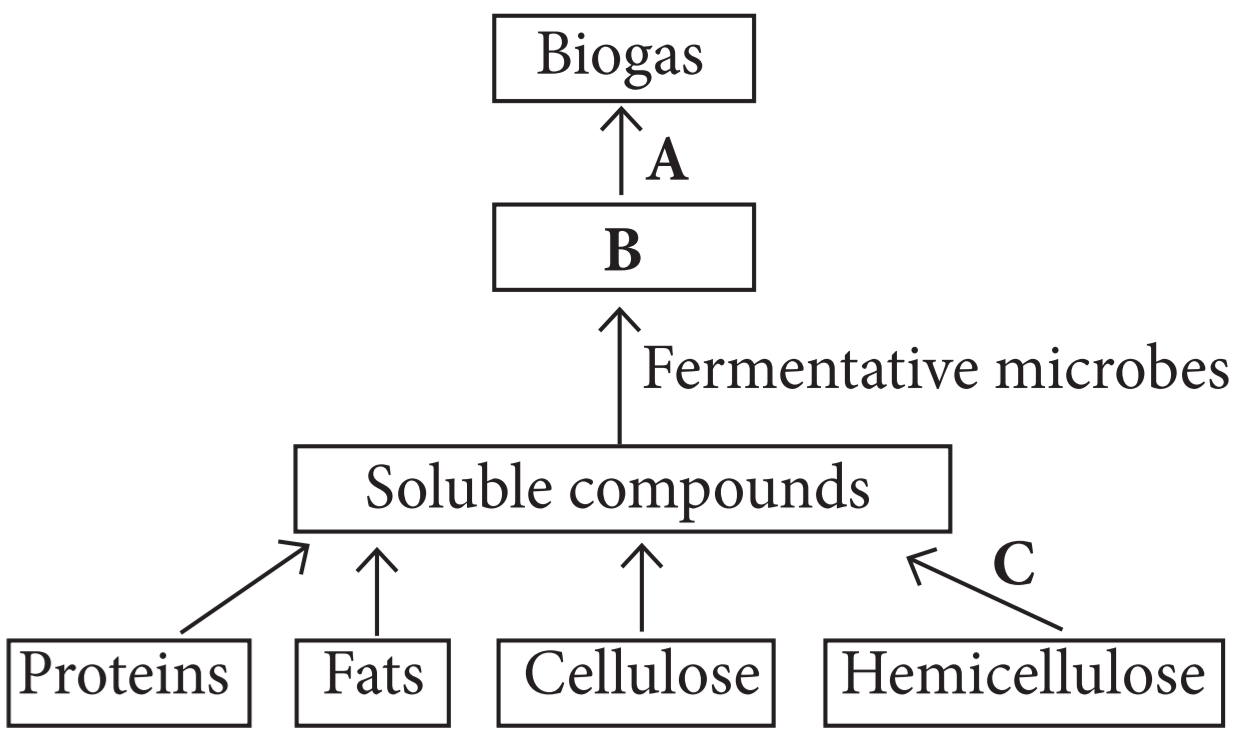
Villagers in a place near Chambur started planning to make power supply for agricultural purposes from cow dung. 'Tiley have started a biogas plant for the purpose. Study the flow chart for biogas production given below and answer the following questions.
  1. Biagas is composed of majorly:
  1. Methane, $CO_2$ and $O_2$​​​​​​​
  2. $CO_2, H_2S$ and H
  3. Methane, $CO_2​​​​​​​$
  4. $H_2S, H$ and $O_2​​​​​​​$
  1. In the given flow chart, 'A' denotes:
  1. Aerobic bacteria.
  2. Methanogenic bacteria.
  3. Cellulose degrading bacteria.
  4. Yeast and protozoa.
  1. What is represented by 'B' in the flow chart?
  1. Carbohydrates.
  2. Protein polymers.
  3. Organic acids.
  4. Fat globules.
  1. 'C' in the given flow chart causes:
  1. Aerobic breakdown of complex organic compounds.
  2. Anaerobic digestion of complex organic compounds.
  3. Fermentation of organic compounds.
  4. Fermentation of monomers.
  1. If 'A' is not added in the procedure.
  1. Methane will not be formed.
  2. $CO_2​​​​​​​$​​​​​​​ will not be formed.
  3. Organic compounds will not be converted to $H_2S$
  4. $O_2​​​​​​​$ will not be formed.
AnimalRespiratory organ
(1) Fishes(a) Trachea
(2) Birds/Reptiles(b) Moist cuticle
(3) Insects(c) Gills
(4) Earthworm(d) Lungs
Distinguish between : Primary and secondary succession.
Distinguish between: DNA in prokaryotic and eukaryotic cells.
Distinguish between : Lymphocytes and Monocytes.
Read the following and answer any four questions from (i) to (v) given below:
Alcohols are important industrial solvents. Ethanol, methanol, propanol and butanol are produced commercially by fermentation activity of some fungi, majorly yeasts. During fermentation, yeast cells convert cereal derived sugars into ethanol and $CO_2$ At the same time hundreds of secondary metabolites that influence the aroma and taste of alcohol are produced. Sugar concentration affects the rate of fermentation reactions. Yeast cannot grow in very strong sugar solution. In case of complex carbohydrate containing nutrient media, 1% malt or Rhizopus is used along with yeasts. Hydrolysis of starch is carried out at high temperature for 30 ruins. 'Tile crushed food mixed with hot water for obtaining malt in called mash. 'Tile nutrient medium prior to fermentation in called wort. Wort is cooled down to appropriate temperature and inoculated with strain of yeast.
  1. Tile rate of alcohol production is measured on the basis of:
  1. Amount of sugar present in the medium.
  2. Amount of $CO_2$ produced per unit time.
  3. Amount of yeast added in the medium.
  4. All of these.
  1. A number of chemicals are produced at the time of alcoholic fermentation with the change of nutrient media, pH and aeration. Select such by-product from the following.
  1. Phenylethanol.
  2. Amyl alcohol.
  3. Glycerol.
  4. All of these.
  1. During alcoholic fermentation of cereals and potato, the crushed food mixed with hot water for obtaining malt is called:
  1. Juice.
  2. Mash.
  3. Wort.
  4. None of these.
  1. Distilled alcohol with 95% ethanol content is called:
  1. Absolute alcohol.
  2. Rectified spirit.
  3. Gin.
  4. Brandy.
  1. Assertion: Rhizopus or 1% malt is used in the nutrient medium when it contains complex carbohydrates.
Reason: Yeast does not possess sufficient diastase or amylase.
  1. Both assertion and reason are true and reason is the correct explanation of assertion.
  2. Both assertion and reason are true but reason is not the correct explanation of assertion.
  3. Assertion is true but reason is false.
  4. Both assertion and reason are false.
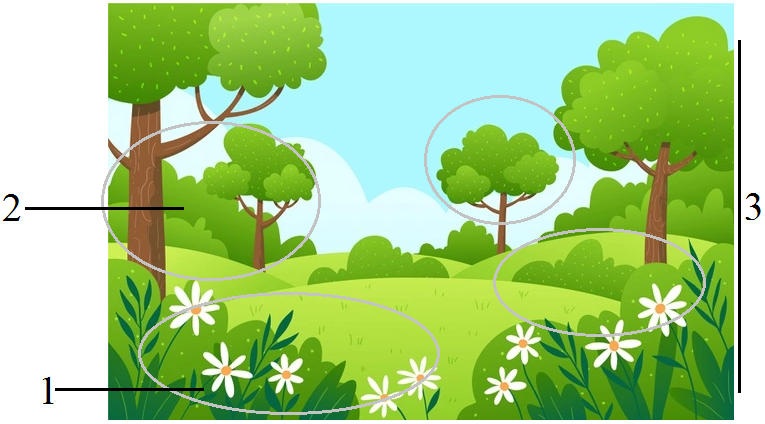
Read the following and answer any four questions from (i) to (v) given below: Ecosystem diversity is the variety of forms in the ecosystem due to diversity of niches, trophic levels and ecological processes like nutrient recycling, food webs, energy flow, etc. Study the given figure.
  1. Identify different types of diversity denoted by 1, 2 and 3 in the given figure.
 
1
2
3
(a)
Alpha diversity
Beta diversity
Gamma diversity
(b)
Gamma diversity
Alpha diversity
Beta diversity
(c)
Gamma diversity
Beta diversity
Alpha diversity
(d)
Beta diversity
Alpha diversity
Gamma diversity
  1. Alpha diversity is biodiversity present.
  1. Within conununity.
  2. Between conununities.
  3. In ranges of communities.
  4. None of these.
  1. Diversity represented by diversity of habitats over a total landscape area is:
  1. $\alpha-\text{diversity}$
  2. $\gamma-\text{diversity}$
  3. $\beta-\text{diversity}$
  4. $\delta-\text{diversity}$
  1. Concept of three types of ecological diversity was given by:
  1. Elton
  2. Odum
  3. Edward Wilson
  4. Whittaker
  1. The diversity of organisms sharing the same habitat or conununity is termed as:
  1. Alpha diversity.
  2. beta diversity.
  3. gamma diversity.
  4. delta diversity.
CellsFunctions
(1) T-lymphocytes(a) Phagocytic in function
(2) Neutrophils(b) Responsible for Humoral immunity
(3) Eosinophils/Acidophils(c) Responsible for cell-medicated immunity
(4) B-lymphocytes(d) Anti-allergic [Antihistamine] in function
Respiratory surfaceOrganism
(1) Plasma membrane(a) Insect
(2) Lungs(b) Salamander
(3) External gills(c) Bird
(4) Internal gills(d) Amoeba
(e) Fish