Question
  1. Complete the following reactions:
  1. $8\text{BF}_3+6\text{LiH}\xrightarrow{\ \ \ \ \ \ \ \ \ \ }\ ........$
  2. $\text{H}_3\text{BO}_3\xrightarrow{\ \ \ \Delta\ \ \ }\ .........$
  3. $2\text{Al}+6\text{HCl}\xrightarrow{\ \ \ \ \ \ \ \ }\ .........$
  1. What are fullerenes? How are they prepared?
Answer

  1.  
  1. $8\text{BF}_3+6\text{LiH}\xrightarrow{\ \ \ \ \ \ \ \ \ \ }\text{B}_2\text{H}_6+6\text{LiBF}_4$
  2. $\text{H}_3\text{BO}_3\xrightarrow{\ \ \ \Delta\ \ \ }\text{HBO}_2+\text{H}_2\text{O}$
  3. $2\text{Al}+6\text{HCl}\xrightarrow{\ \ \ \ \ \ \ \ }2\text{AlCl}_3+3\text{H}_2$
  1. Fullerenes are the purest form of carbon consisting of mainly $\mathrm{C}_{60}$ units. $\mathrm{C}_{60}$ unit has a shape of football and called Buckminster-fullerene. Fullerenes are prepared by heating graphite in an electric arc in the presence of inert gas such as helium or argon.

Need a full question paper?

Generate a complete, print-ready paper with questions like this in minutes — across 16+ boards, with answer keys.

Start Generating Free

Similar questions

Sulphuric acid reacts with sodium hydroxide as follows:
$H_2SO_4 + 2NaOH Na_2SO_4 + 2H_2O$
When $1 L$ of $0.1 M$ sulphuric acid solution is allowed to react with $1 L$ of $0.1 M$ sodium hydroxide solution. Calculate the amount of sodium sulphate formed and its molarity in the solution obtained.
An aqueous solution contains an unknown concentration of $Ba ^{2+}$. When 50 mL of 1 M solution of $Na _2 SO _4$ is added, $BaSO _4$ first begin to precipitate. The final volume is $500 mL$ . The solubility product of $BaSO _4$ is $1.0 \times 10^{-10}$. What is original concentration of $Ba ^{2+}$ ?
Attempt any five of the following:
1. What is electrophile in sulphonation?
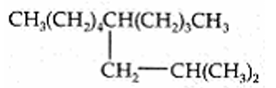
2. Write IUPAC name of following:
Image
3. Write IUPAC name: $CH _3 CH - C \left( CH _3\right)_2$
4. Methane does not react with chlorine in dark. Why?
5. How would you convert ethene to ethane molecule?
6. What is Huckel rule?
7. What is decarboxylation? Give an example.
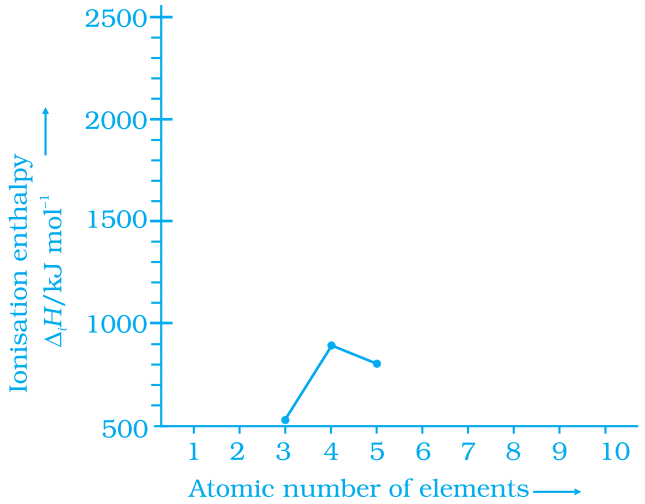
Ionisation enthalpies of elements of second period are given below:
Ionisation enthalpy/ kcal $mol^{-1}, 520, 899, 801, 1086, 1402, 1314, 1681, 2080$.
Match the correct enthalpy with the elements and complete the graph given in also write symbols of elements with their atomic number.
What is the significance of the terms — ‘isolated gaseous atom’ and ‘ground state’
while defining the ionization enthalpy and electron gain enthalpy?
Hint : Requirements for comparison purposes.
When a mixture of ammonium chloride and potassium dichromate was heated, a stable colourless gas ‘A’ is evolved which did not support combustion, but Mg continued burning in it. The gas reacted with $CaC_2$ in electric furnace forming a solid 'B'. Which was slowly hydrolysed by water forming a insoluble substance 'C' and a solution of substance 'D' which turns red litmus blue and gives white fumes with conc HCl to form ‘E'. Identify A to E and write chemical reactions involved.
Discuss the general characteristics and gradation in properties of alkaline earth metals.
Explain the effect of temperature on spontaneity.
Dihydrogen gas is obtained from natural gas by partial oxidation with steam as per following endothermic reaction:
$\text{CH}_4\text{ (g) + H}_2\text{O}\rightleftharpoons\text{CO (g) + 3H}_2\text{ (g)}$
  1. Write as expression for $K_p$ for the above reaction.
  2. How will the values of $K_p$ and composition of equilibrium mixture be affected by.
  1. increasing the pressure
  2. increasing the temperature
  3. using a catalyst?
Why was a change in the Bohr Model of atom required? Due to which important development (s), concept of movement of an electron in an orbit was replaced by, the concept of probability of finding electron in an orbital? What is the name given to the changed model of atom?