Question
Why was a change in the Bohr Model of atom required? Due to which important development (s), concept of movement of an electron in an orbit was replaced by, the concept of probability of finding electron in an orbital? What is the name given to the changed model of atom?

Answer

In view of the shortcoming of the Bohr,s model, attempts were made to develop a more suitable and general model for atoms. Two important devlopments which contributed significantly in the formulation of such a model were:
  1. Dual behavior of matter,
  2. Heisenberg uncertainty principle.
Werner Heisenberg, a German physicist in 1927, stated uncertainty principle which is the consequence of duel behaviour of matter and radiation. One of the important implication of the Heisenberg Uncertainty Principle is that it rules out existence of definite paths or trajectories of electrons and other similar particles.
Quantum mechanics is the theoretical science that deal with the study of the motions of the microscopic objects that have both observable wave like and particle like and properties. The name of the changed model of atom is Quantum Mechanical Model of atom
Need a full question paper?

Generate a complete, print-ready paper with questions like this in minutes — across 16+ boards, with answer keys.

Start Generating Free

Similar questions

What is resonance effect and it is of how many types? Explain with examples.
Write short note on ionisation constant and ionic product of water.
1. Suggest a method to purify
i. a liquid which decomposes at its boiling point.
ii. kerosene oil containing water.
iii. camphor containing traces of common salt.
2. Giving justification, categorise the following molecules/ions as nucleophile or electrophile:
$
\begin{aligned}
& HS^{-}, BF_3, C_2 H_5 O^{-},\left(CH_3\right)_3 N:, \\
& C \stackrel{+}{l}, C H_3-\stackrel{+}{C}=O, H_2 N \stackrel{+}{:}, \stackrel{+}{N} O_2
\end{aligned}
$
Discuss the principle and method of softening of hard water by synthetic ionexchange resins.
In the Solvay process, can we obtain sodium carbonate directly by treating the solution containing $\left(\mathrm{NH}_4\right)_2 \mathrm{CO} 3$ with sodium chloride? Explain.
The pH of $0.005M$ codeine $(C_{18}H_{21}NO_3)$ solution is $9.95$. Calculate its ionization constant and $pK_b$.
What is quantum mechanics? Explain the Schrodinger wave equation for hydrogen.
  1. Consider the following redox reaction that produce electricity in a galvanic cell:
    1. $2\text{Fe}^{3+}+2\text{Cl}^-\xrightarrow{ \ \ \ \ \ \ \ \ \\ }2\text{Fe}^2+\text{Cl}_2\text{(g)}$
    2. $\text{Cd}\text{(s)}+\text{I}_2\xrightarrow{ \ \ \ \ \ \ \ }\text{Cd}^{2+}+2\text{I}^-$
    3. $2\text{Cr}\text{s}+3\text{Cu}^{2+}\xrightarrow{ \ \ \ \ \ \ \\ \ \ }+3\text{Cu}\text{(s)}+2\text{Cr}^{3+}$
Write the anode and cathode reaction for galvanic cell.
  1. Split the following redox reaction into the oxidation and reduction hay reactions:
    1. $\text{Zn}+\text{Cu}^{2+}\xrightarrow{ \ \ \ \ \ \ \ \\}2\text{n}^{2+}+\text{Cu} $
    2. $\text{Sn}^2+2\text{Hg}^+\xrightarrow{ \ \ \ \\ \ \ \ }\text{Sn}^{4+}+\text{Hg}_2^{2+}$
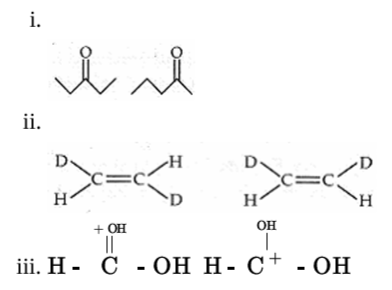
1. What is the relationship between the members of following pairs of structures? Are they structural or geometrical isomers or resonance contributors?
Image
2. A sample of 0.50 g of an organic compound was treated according to Kjeldahl's method. The ammonia evolved was absorbed in 50 mL of $0.5 M H _2 SO _4$. The residual acid required 60 mL of 0.5 M solution of NaOH for neutralisation. Find the percentage composition of nitrogen in the compound.
  1. The energy associated with Bohr's first orbit is $-2.18 \times 10^{-18}J atom^{-1}$. What is the energy associated with fifth orbit?
  2. The work function for Caesium atom is $1.9 eV$.
Calculate the threshold wavelength.
[Given: $1 eV = 1.6 × 10⁻¹⁹J$]
  1. How many subshells are associated with $n = 4$?