MCQ
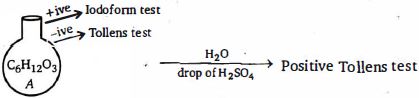
Compound $(A)$ is
  • A
    $\begin{matrix}
       O\,\,\,\,\,\,\,\,\,\,\,\,\,\,\,  \\
       ||\,\,\,\,\,\,\,\,\,\,\,\,\,\,\,\,  \\
       C{{H}_{3}}-C-CH-C{{H}_{2}}  \\
      \,\,\,\, \,\,\,\,\,\,\,\,\,\,\,\,\,\,\,\,\,\,\,\,|\,\,\,\,\,\,\,\,\,\,\,\,\,\,\,\,\,|  \\
      \,\,\,\, \,\,\,\,\,\,\,\,\,\,\,\,\,\,\,\,\,\,\,\,\,\,\,\,\,\,OC{{H}_{3}}\,OC{{H}_{3}}  \\
    \end{matrix}$
  • B
    $\begin{matrix}
      \,\, \,\,\,\,\,\,\,\,\,\,\,O\,\,\,\,\,\,\,OC{{H}_{3}}\,  \\
       ||\,\,\,\,\,\,\,\,|  \\
       C{{H}_{3}}-C-C-C{{H}_{3}}  \\
      \,\, \,\,\,\,\,\,\,\,\,\,|  \\
      \,\,\,\, \,\,\,\,\,\,\,\,\,\,\,\,\,\,\,\,\,OC{{H}_{3}}  \\
    \end{matrix}$
  • $\begin{matrix}
       O\,\,\,\,\,\,\,\,\,\,\,\,\,\,\,\,\,\,\,\,\,\,\,\,\,\,\,\,\,\,\,\,\,\,\,\,\,\,  \\
       ||\,\,\,\,\,\,\,\,\,\,\,\,\,\,\,\,\,\,\,\,\,\,\,\,\,\,\,\,\,\,\,\,\,\,\,\,\,\,  \\
       C{{H}_{3}}-C-C{{H}_{2}}-CH-OC{{H}_{3}}  \\
       \,\,\,\,\,\,\,\,\,\,\,\,\,\,\,\,\,\,\,\,\,\,\,|\,\,  \\
       \,\,\,\,\,\,\,\,\,\,\,\,\,\,\,\,\,\,\,\,\,\,\,\,\,\,\,\,\,\,\,\,OC{{H}_{3}}  \\
    \end{matrix}$
  • D
    $\begin{matrix}
       O\,\,\,\,\,\,\,\,\,\,\,\,\,\,\,\,\,\,\,\,\,\,\,\,\,\,\,\,\,\,\,\,\,\,\,\,\,\,\,\,\,\,\,\,\,\,\,\,\,\,\,\,\,\,\,  \\
       ||\,\,\,\,\,\,\,\,\,\,\,\,\,\,\,\,\,\,\,\,\,\,\,\,\,\,\,\,\,\,\,\,\,\,\,\,\,\,\,\,\,\,\,\,\,\,\,\,\,\,\,\,\,\,\,\,  \\
       C{{H}_{3}}-C-C{{H}_{2}}-C{{H}_{2}}-CH-OC{{H}_{3}}  \\
      \,\,\,\, \,\,\,\,\,\,\,\,\,\,\,\,\,\,\,\,\,\,\,\,\,\,\,\,\,\,\,\,\,\,\,\,\,\,\,\,\,|  \\
      \,\,\,\, \,\,\,\,\,\,\,\,\,\,\,\,\,\,\,\,\,\,\,\,\,\,\,\,\,\,\,\,\,\,\,\,\,\,\,\,\,\,\,\,\,\,\,\,\,\,OC{{H}_{3}}  \\
    \end{matrix}$

Answer

Correct option: C.
$\begin{matrix}
   O\,\,\,\,\,\,\,\,\,\,\,\,\,\,\,\,\,\,\,\,\,\,\,\,\,\,\,\,\,\,\,\,\,\,\,\,\,\,  \\
   ||\,\,\,\,\,\,\,\,\,\,\,\,\,\,\,\,\,\,\,\,\,\,\,\,\,\,\,\,\,\,\,\,\,\,\,\,\,\,  \\
   C{{H}_{3}}-C-C{{H}_{2}}-CH-OC{{H}_{3}}  \\
   \,\,\,\,\,\,\,\,\,\,\,\,\,\,\,\,\,\,\,\,\,\,\,|\,\,  \\
   \,\,\,\,\,\,\,\,\,\,\,\,\,\,\,\,\,\,\,\,\,\,\,\,\,\,\,\,\,\,\,\,OC{{H}_{3}}  \\
\end{matrix}$
c

Need a full question paper?

Generate a complete, print-ready paper with questions like this in minutes — across 16+ boards, with answer keys.

Start Generating Free

Similar questions

Express which of the following setups can be used to verify Ohm’s law
A convex lens of focal length $0.5 m$ and concave lens of focal length $1 m$ are combined. The power of the resulting lens will be
According to classical physics, $10^{-15}\ m$ is distance of closest approach $(d_c)$ for fusion to occur between two protons. A more accurate and quantum approach says that ${d_c} = \frac{{{\lambda _p}}}{{\sqrt 2 }}$ where $'\lambda _p'$ is de-broglie's wavelength of proton when they were far apart. Using quantum approach, find equation of temperature at centre of star. [Given: $M_p$ is mass of proton, $k$ is boltzman constant]
A capillary tube of radius $r$ is dipped in a liquid of density $\rho$ and surface tension $S$. If the angle of contact is $\theta$, the pressure difference between the two surfaces in the beaker and the capillary
A cyclist on a level road takes a sharp circular turn of radius $3 \;m \;\left( g =10 \;ms ^{-2}\right)$. If the coefficient of static friction between the cycle tyres and the road is $0.2$, at which of the following speeds will the cyclist not skid while taking the turn?
A heater $A$ gives out $300\, W$ of heat when connected to a $200\, V$ $d.c.$ supply. Asecond heater $B$ gives out $600\, W$ when connected to a $200\,v$ $d.c$. supply. If a series combination of the two heaters is connected to a $200\, V$ $d.c$. supply the heat output will be ................. $W$
If $a$ cylinder is rolling down the incline with sliding.
A conducting sphere $A$ of radius $a$, with charge $Q$, is placed concentrically inside a conducting shell $B$ of radius $b$. $B$ is earthed. $C$ is the common centre of the $A$ and $B$. 
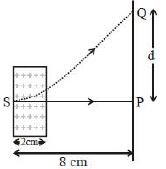
An electron, moving along the $x-$ axis with an initial energy of $100\, eV$, enters a region of magnetic field $\vec B = (1.5\times10^{-3}T)\hat k$ at $S$ (See figure). The field extends between $x = 0$ and $x = 2\, cm$. The electron is detected at the point $Q$ on a screen placed $8\, cm$ away from the point $S$. The distance $d$ between $P$ and $Q$ (on the screen) is :......$cm$ (electron's charge $= 1.6\times10^{-19}\, C$, mass of electron $= 9.1\times10^{-31}\, kg$)
Two resistors of resistance, $100\,\Omega$ and $200\,\Omega$ are connected in parallel in an electrical circuit. The ratio of the thermal energy developed in $100\,\Omega$ to that in $200\,\Omega$ in a given time is: