Three blocks $A$, $B$ and $C$ of equal mass $m$ are placed on a smooth surface as shown. Coefficient of friction between any block $A, B$ and $C$ is $μ$. The maximum value of mass $D$ so the block $A, B$ & $C$ move without slipping over each other is
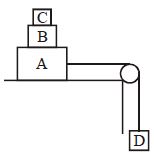
Difficult
Download our app for free and get started
Maximum acceleration of $\mathrm{B}$ of $\mathrm{C}$ can be $\mathrm{mgso}$ that they do not slip with each other or $A$
For the system of $(A+B+C)$
$T=3 m a=3 \mu m g$
For $D$
$M g-T=M a$
$\Rightarrow M g-3 \mu m g=M \mu g$
$\Rightarrow M=\frac{3 \mu m}{1-\mu}$

Download our appand get started for free
Experience the future of education. Simply download our apps or reach out to us for more information. Let's shape the future of learning together!No signup needed.*
Similar Questions
- 1A $2\,kg$ block slides on a horizontal floor with a speed of $4\, m/s$. It strikes a uncompressed spring, and compresses it till the block is motionless. The kinetic friction force is $110\,N$ and spring constant is $1000\, N/m$. The spring compresses by ........ $cm$View Solution
- 2A uniform rope lies on a horizontal table so that a part of it hangs over the edge. The rope begins to slide down when the length of the hanging part is $25\%$ of the entire length. The coefficient of friction between the rope and the table isView Solution
- 3An isolated rail car originally moving with speed $v_0$ on a straight, frictionles, level track contains a large amount of sand. $A$ release valve on the bottom of the car malfunctions, and sand begins to pour out straight down relative to the rail car. What happens to the speed of the rail car as the sand pours out?View Solution
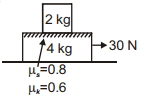
- 4Figure shows two block system, $4 \,kg$ block rests on a smooth horizontal surface, upper surface of $4 \,kg$ is rough. A block of mass $2 \,kg$ is placed on its upper surface. The acceleration of upper block with respect to earth when $4 \,kg$ mass is pulled by a force of $30 \,N$, is ......... $m / s ^2$View Solution
- 5A mass of $2 \,kg$ is whirled in a horizontal circle by means of a string at an initial speed of $5$ revolutions per minute. Keeping the radius constant the tension in the string is doubled. The new speed is nearly ....... $rpm$View Solution
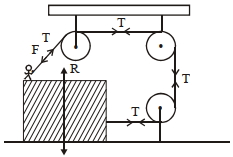
- 6A boy of mass $4\, kg$ is standing on a piece of wood having mass $5 \,kg$. If the coefficient of friction between the wood and the floor is $0.5,$ the maximum force that the boy can exert on the rope so that the piece of wood does not move from its place is ......$N.$(Round off to the Nearest Integer) [Take $g=10 \,ms ^{-2}$ ]View Solution
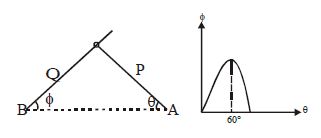
- 7A rod $P$ of length $1\ m$ is hinged at one end $A$ and there is a ring attached to the other end. Another long rod $Q$ is hinged at $B$ and it passes through the ring. The rod $P$ is rotated about an axis which is perpendicular to plane in which both the rods are present and the variation between the angles $\theta$ and $\phi $ are plotted as shown. The distance between the hinges $A$ and $B$ is ....... $m$.View Solution
- 8View SolutionWhich of the following statements is not true
- 9The tension $T$ in the string shown in figure isView Solution
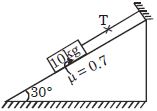
- 10View SolutionA block is stationary on a rough inclined plane. How many forces are acting on the block?