Question
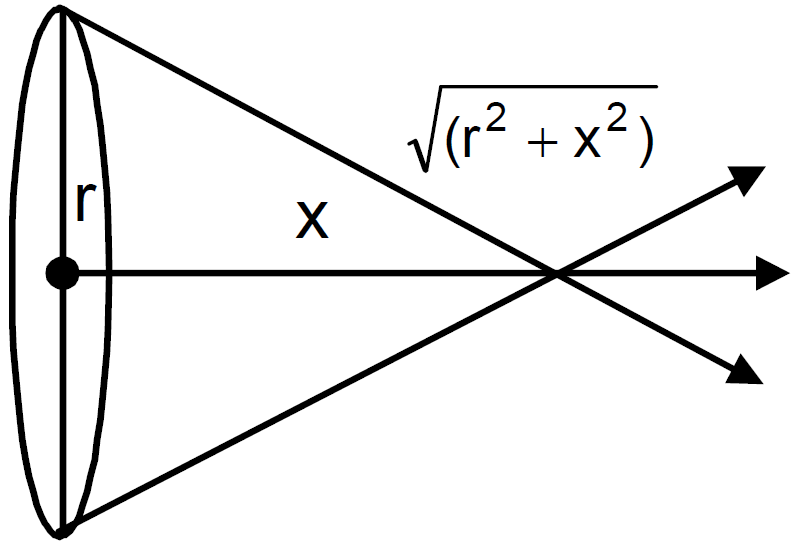
Consider a circular ring of radius r, uniformly charged with linear charge density $\lambda.$ Find the electric potential at a point on the axis at a distance x from the centre of the ring. Using this expression for the potential, find the electric field at this point.
Answer


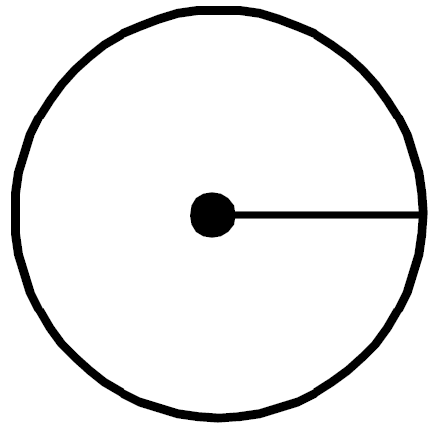
Radius = r
So, $2\pi\text{r}=$ Circumference
Charge density $=\lambda$
Total charge $=2\pi\text{r}\times\lambda$
Electric potential $=\frac{\text{Kq}}{\text{r}}$
$=\frac{1}{4\pi\in_0}\times\frac{2\pi\text{r}\lambda}{\big(\text{x}^2+\text{r}2\big)^{\frac{1}{2}}}$
$=\frac{\text{r}\lambda}{2\in_0\big(\text{x}^2+\text{r}^2\big)^{\frac{1}{2}}}$

So, Electric field $=\frac{\text{V}}{\text{r}}\cos\theta$
$=\frac{\text{r}\lambda}{2\in_0\big(\text{x}^2+\text{r}^2\big)^{\frac{1}{2}}}\times\frac{\text{x}}{\big(\text{x}^2+\text{r}^2\big)^{\frac{1}{2}}}$
$=\frac{\text{r}\lambda\text{x}}{2\in_0\big(\text{x}^2+\text{r}^2\big)^{\frac{3}{2}}}$

Need a full question paper?

Generate a complete, print-ready paper with questions like this in minutes — across 16+ boards, with answer keys.

Start Generating Free

Similar questions

A box weighing 2000N is to be slowly slid through 20m on a straight track having friction coefficient 0.2 with the box.
  1. Find the work done by the person pulling the box with a chain at an angle $\theta $ with the horizontal.
  2. Find the work when the person has chosen a value of $\theta $ which ensures him the minimum magnitude of the force.
Before the neutrino hypothesis, the beta decay process was throught to be the transition,
$\text{n}\rightarrow\ \text{p}+\overline{\text{e}}$
If this was true, show that if the neutron was at rest, the proton and electron would emerge with fixed energies and calculate them.Experimentally, the electron energy was found to have a large range.
Can the work by kinetic friction on an object be positive? Zero?
A long, straight wire is fixed horizontally and carries a current of 50.0A. A second wire having linear mass density $1.0 \times 10^{-4}kg/m$ is placed parallel to and directly above this wire at a separation of 5.0mm. What current should this second wire carry such that the magnetic repulsion can balance its weight?
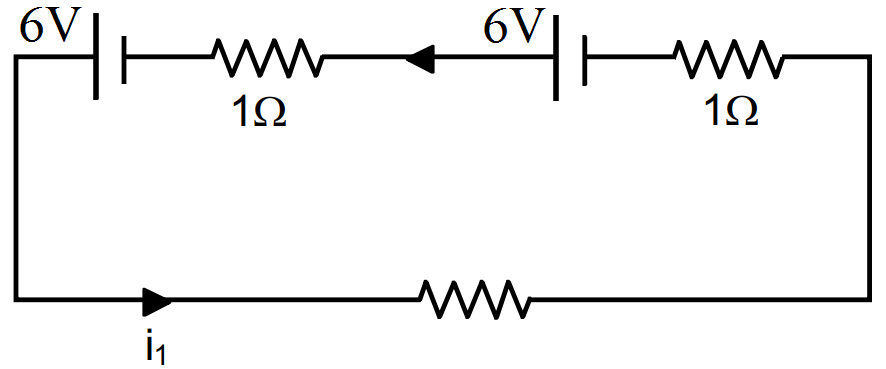
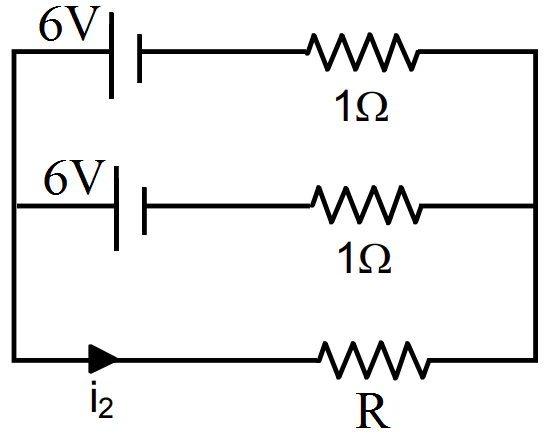
Find the value of $\frac{\text{i}_1}{\text{i}_2}$ in the figure. if (a) $\text{R}=0.1\Omega$ (b) $\text{R}=1\Omega$ and (c) $\text{R}=10\Omega.$ Note from your answers that in order to get more current from a combination of two batteries, they should be joined in parallel if the external resistance is small and in series if the external resistance is large, compared to the internal resistance.
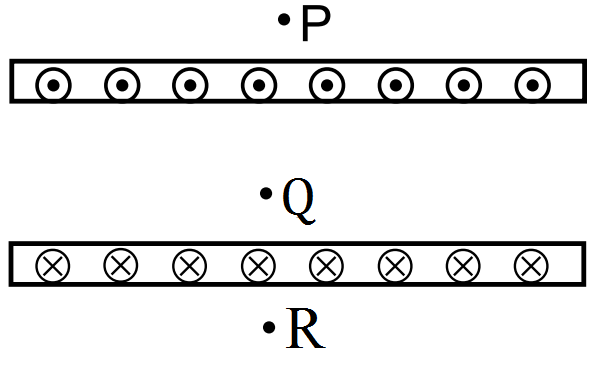
Two large metal sheets carry surface currents as shown in figure. The current through a strip of width dl is Kdl where K is a constant. Find the magnetic field at the points P, Q and R.
A point object 'O' is kept in a medium of refractive index $n_1$ in front of a convex spherical surface of radius of curvature R which separates the second medium of refractive index $n_2$ from the first one, as shown in the figure.
  1. Draw the ray diagram showing the image formation and deduce the relationship between the object distance and the image distance in terms of $n_1, n_2$ and R.
  2. When the image formed above acts as a virtual object for concave spherical, surface separating the medium $n_2$ from $n_1 (n_2> n_1)$, draw this ray diagram and write the similar (similar to (a) relation. Hence obtain the expression for the lens maker's formula.
Distinguish the magnetic properties of dia, para- and ferro-magnetic substances in terms of (i) susceptibility, (ii) magnetic permeability and (iii) coercivity. Give one example of each of these materials. Draw the field lines due to an external magnetic field near a (i)diamagnetic, (ii) paramagnetic substance.
  1. Draw a labelled ray diagram to obtain the real image formed by an astronomical telescope in normal adjustment position. Defineits magnifying power.
  2. You are given three lenses of power 0.5 D, 4 D and 10 D to design a telescope.
  1. Which lenses should he used as objective and eyepiece? Justify your answer.
  2. Why is the aperture of the objective preferred to be large?
  1. Draw a labelled ray diagram showing the formation of image by a compound microscope in normal adjustment. Derive the expression for its magnifying power.
  2. How does the resolving power of a microscope change when.
  1. The diameter of the objective lens is decreased,
  2. The wavelength of the incident light is increased.
Justify your answer in each case.