- Draw a labelled ray diagram to obtain the real image formed by an astronomical telescope in normal adjustment position. Defineits magnifying power.
- You are given three lenses of power 0.5 D, 4 D and 10 D to design a telescope.
- Which lenses should he used as objective and eyepiece? Justify your answer.
- Why is the aperture of the objective preferred to be large?
CBSE OUTSIDE DELHI - SET 2 CENTRAL 2016
Download our app for free and get started
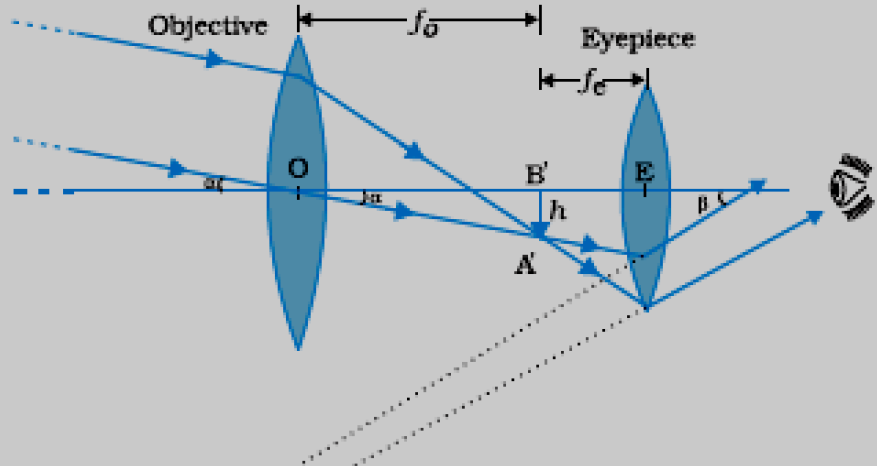
Definition - It is the ratio of the angle subtended at the eye, by the final image, to the angle which the object subtends at the lens, or the eye.
- Objective=.5D
$\text{M} = \frac{\text{f}_{o}}{\text{f}_{e}} = \frac{\text{p}_{e}}{\text{p}_{o}}$
- High resolving power/Brighter image/lower limit of resolution.

Download our appand get started for free
Experience the future of education. Simply download our apps or reach out to us for more information. Let's shape the future of learning together!No signup needed.*
Similar Questions
- 1View Solution
- Draw a ray diagram to show refraction of a ray of monochromatic light passing through a glass prism.
- Explain briefly how the phenomenon of total internal reflection is used in fibre optics.
- 2A biconvex thick lens is constructed with glass $(\mu=1.50)$ Each of the surfaces has a radius of 10cm and the thickness at the middle is 5cm. Locate the image of an object placed far away from the lens.View Solution
- 3View SolutionIn many experimental set-ups the source and screen are fixed at a distance say D and the lens is movable. Show that there are two positions for the lens for which an image is formed on the screen. Find the distance between these points and the ratio of the image sizes for these two points.
- 4Show that for a material with refractive index $\mu\geq\sqrt{2}$, light incident at any angle shall be guided along a length perpendicular to the incident face.View Solution
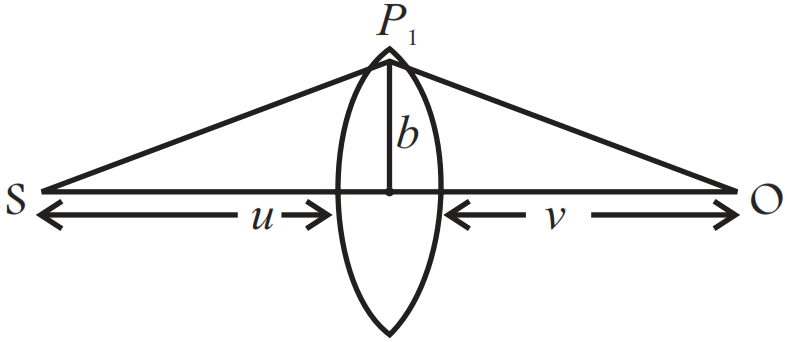
- 5Consider a thin lens placed between a source (S) and an observer (O) (Fig). Let the thickness of the lens vary as $\text{w}\text{(b)}=\text{w}_0-\frac{\text{b}^2}{\alpha}$, where b is the verticle distance from the pole. $w_0$ is a constant. Using Fermat’s principle i.e. the time of transit for a ray between the source and observer is an extremum, find the condition that all paraxial rays starting from the source will converge at a point O on the axis. Find the focal length.View Solution
- 6View SolutionDraw the labelled ray diagram for the formation of image by a compound microscope.Derive the expression for the total magnification of a compound microscope. Explain why both the objective and the eyepiece of a compound microscope must have short focal lengths.
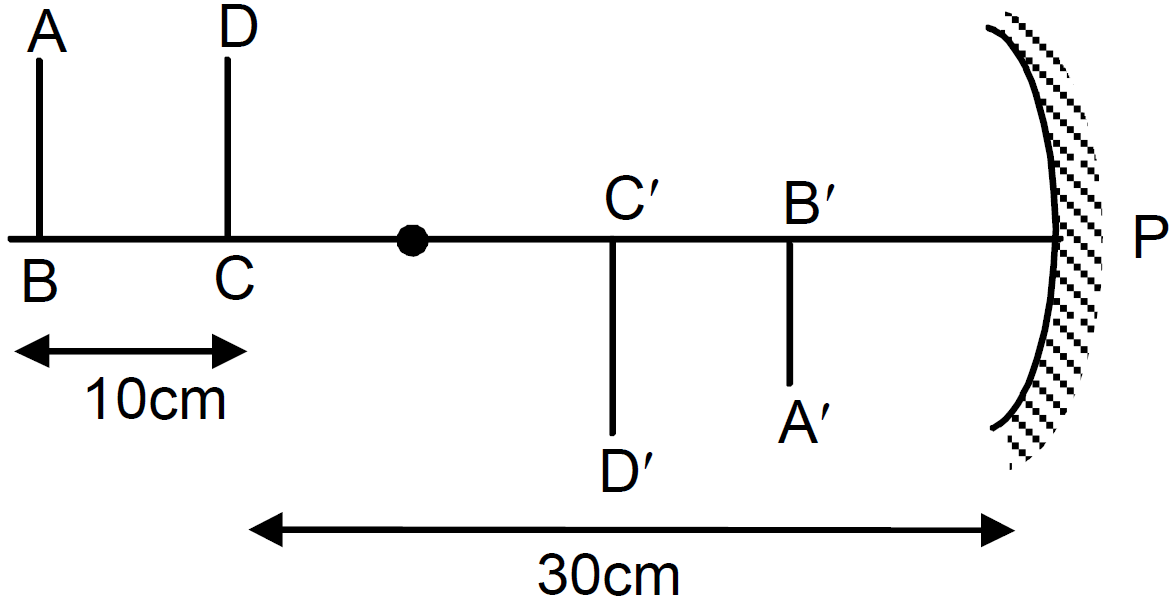
- 7View SolutionA U-shaped wire is placed before a concave mirror having radius of curvature 20cm. Find the total length of the image.
- 8A gravitational lens may be assumed to have a varying width of the formView Solution
$\text{w}(\text{b})=\text{k}_1\text{ In }\Big(\frac{\text{k}_2}{\text{b}}\Big)\ \ \text{b}_\text{min}<\text{b}<\text{b}_\text{max}$
$=\text{k}_1\text{ In }\Big(\frac{\text{k}_2}{\text{b}_\text{min}}\Big)\ \ \text{b}<\text{b}_\text{min}$
Show that an observer will see an image of a point object as a ring about the center of the lens with an angular radius
$\beta=\sqrt{\frac{(\text{n}-1)\text{k}_1\frac{\text{u}}{\text{v}}}{\text{u}+\text{v}}}$ - 9View SolutionLenses are constructed by a material of refractive index 1.50. The magnitude of the radii of curvature are 20cm and 30cm. Find the focal lengths of the possible lenses with the above specifications.
- 10View SolutionA particle is moving at a constant speed V from a large distance towards a concave mirror of radius R along its principal axis. Find the speed of the image formed by the mirror as a function of the distance x of the particle from the mirror.