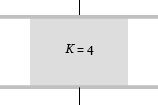
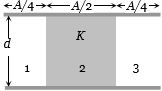
Consider a parallel plate capacitor of $10\,\mu \,F$ (micro-farad) with air filled in the gap between the plates. Now one half of the space between the plates is filled with a dielectric of dielectric constant $4$, as shown in the figure. The capacity of the capacitor changes to.......$\mu \,F$
Medium


Download our appand get started for free
Experience the future of education. Simply download our apps or reach out to us for more information. Let's shape the future of learning together!No signup needed.*
Similar Questions
- 1A uniform electric field of $20\, N/C$ exists along the $x$ -axis in a space. The potential difference $(V_B -V_A)$ for the point $A(4\,m, 2\,m)$ and $B(6\,m, 5\,m)$ is.....$V$View Solution
- 2Two identical thin metal plates has charge $q _{1}$ and $q _{2}$ respectively such that $q _{1}> q _{2}$. The plates were brought close to each other to form a parallel plate capacitor of capacitance $C$. The potential difference between them is.View Solution
- 3Two identical charged spherical drops each of capacitance $C$ merge to form a single drop. The resultant capacitance isView Solution
- 4To obtain $3\,\mu F$ capacity from three capacitors of $2\,\mu F$ each, they will be arrangedView Solution
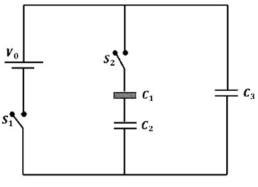
- 5. Three identical capacitors $C _1, C _2$ and $C _3$ have a capacitance of $1.0 \mu F$ each and they are uncharged initially. They are connected in a circuit as shown in the figure and $C _1$ is then filled completely with a dielectric material of relative permittivity $\varepsilon_{ r }$. The cell electromotive force (emf) $V_0=8 V$. First the switch $S_1$ is closed while the switch $S_2$ is kept open. When the capacitor $C_3$ is fully charged, $S_1$ is opened and $S_2$ is closed simultaneously. When all the capacitors reach equilibrium, the charge on $C _3$ is found to be $5 \mu C$. The value of $\varepsilon_{ r }=$. . . . .View Solution
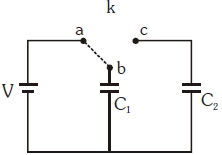
- 6Two Identical capacttors $\mathrm{C}_{1}$ and $\mathrm{C}_{2}$ of equal capacitance are connected as shown in the circult. Terminals $a$ and $b$ of the key $k$ are connected to charge capacitor $\mathrm{C}_{1}$ using battery of $emf \;V\; volt$. Now disconnecting $a$ and $b$ the terminals $b$ and $c$ are connected. Due to this, what will be the percentage loss of energy?.....$\%$View Solution
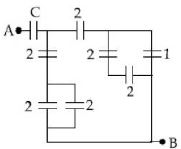
- 7In the circuit shown, find $C$ if the effective capacitance of the whole circuit is to be $0.5\,\mu F.$ All values in the circuit are in $\mu F.$View Solution
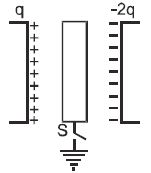
- 8The metal plate on the left in figure carries a charge $+q$. The metal plate on the right has a charge of $-2q$. What charge will flow through $S$ when it is closed, if central plate is initially neutralView Solution
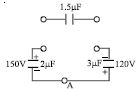
- 9Two capacitors of $2$ $\mu F$ and $3$ $\mu F$ are charged to $150$ $volt$ and $120$ $volt$ respectively. The plates of capacitor are connected as shown in the figure. A discharged capacitor of capacity $1.5$ $\mu F$ falls to the free ends of the wire. ThenView Solution
- 10A parallel plate capacitor has plate area $A$ and separation $d$. It is charged to a potential difference $V_o$. The charging battery is disconnected and the plates are pulled apart to three times the initial separation. The work required to separate the plates isView Solution