A uniform electric field of $20\, N/C$ exists along the $x$ -axis in a space. The potential difference $(V_B -V_A)$ for the point $A(4\,m, 2\,m)$ and $B(6\,m, 5\,m)$ is.....$V$
Easy


Download our appand get started for free
Experience the future of education. Simply download our apps or reach out to us for more information. Let's shape the future of learning together!No signup needed.*
Similar Questions
- 1Two capacitors of capacitance $2\ \mu F$ and $3\,\mu F$ are joined in series. Outer plate first capacitor is at $1000\, volt$ and outer plate of second capacitor is earthed (grounded). Now the potential on inner plate of each capacitor will be......$Volt$View Solution
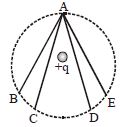
- 2In the electric field of a point charge $q$, a certain charge is carried from point $A$ to $B, C, D$ and $E$. Then the work doneView Solution
- 3The election field in a region is given by $\vec E = (Ax + B)\hat i$ where $E$ is in $N\,C^{-1}$ and $x$ in meters. The values of constants are $A = 20\, SI\, unit$ and $B = 10\, SI\, unit$. If the potential at $x =1$ is $V_1$ and that at $x = -5$ is $V_2$ then $V_1 -V_2$ is.....$V$View Solution
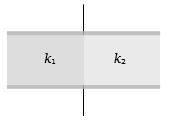
- 4A parallel plate condenser is filled with two dielectrics as shown. Area of each plate is $A\;metr{e^2}$ and the separation is $t$ $metre$. The dielectric constants are ${k_1}$ and ${k_2}$ respectively. Its capacitance in farad will beView Solution
- 5Consider a sphere of radius $R$ with uniform charge density and total charge $Q$. The electrostatic potential distribution inside the sphere is given by $\theta_{(r)}=\frac{Q}{4 \pi \varepsilon_{0} R}\left(a+b(r / R)^{C}\right)$. Note that the zero of potential is at infinity. The values of $(a, b, c)$ areView Solution
- 6View SolutionCan a metal be used as a medium for dielectric
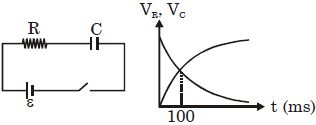
- 7In the $RC$ circuit shown, switch is closed at $t = 0$ . Graphs showing variation of potential $(V_R)$ across resistor and potential $(V_C)$ across capacitor are given. Time constant of circuit is approximately equal to.....$ms$View Solution
- 8In a spherical condenser radius of the outer sphere is $R$. The different in the radii of outer and inner sphere in $x$. Its capacity is proportional toView Solution
- 9The area of the plates of a parallel plate capacitor is $A$ and the gap between them is $d$. The gap is filled with a non-homogeneous dielectric whose dielectric constant varies with the distance $‘y’$ from one plate as : $K = \lambda \ sec(\pi y/2d)$, where $\lambda $ is a dimensionless constant. The capacitance of this capacitor isView Solution
- 10A particle $A$ has charge $ + q$ and a particle $B$ has charge $ + \,4q$ with each of them having the same mass $m$. When allowed to fall from rest through the same electric potential difference, the ratio of their speed $\frac{{{v_A}}}{{{v_B}}}$ will becomeView Solution