Consider a sample of oxygen behaving like an ideal gas. At $300 \,K ,$ the ratio of root mean square (rms) velocity to the average velocity of gas molecule would be :
(Molecular weight of oxygen is $32 \,g / mol$ $\left. R =8.3 \,J K ^{-1} mol ^{-1}\right)$
JEE MAIN 2021, Medium


Download our appand get started for free
Experience the future of education. Simply download our apps or reach out to us for more information. Let's shape the future of learning together!No signup needed.*
Similar Questions
- 1In the isothermal expansion of $10\,g$ of gas from volume $V$ to $2V$ the work done by the gas is $575\,J$. What is the root mean square speed of the molecules of the gas at that temperature ..... $m/s$?View Solution
- 2View SolutionThe number of translational degrees of freedom for a diatomic gas is
- 3The root mean square velocity of a gas molecule of mass $m$ at a given temperature is proportional toView Solution
- 4A flask is filled with $13\, gm$ of an ideal gas at ${27}^o C$ and its temperature is raised to ${52}^o C$. The mass of the gas that has to be released to maintain the temperature of the gas in the flask at ${52}^o C$ and the pressure remaining the same is ..... $g$View Solution
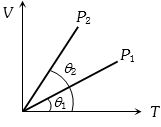
- 5View SolutionWhich of the following statement is true
- 6View SolutionThe specific heat of an ideal gas is
- 7The temperature of a gas is $-78^{\circ} \mathrm{C}$ and the average translational kinetic energy of its molecules is $\mathrm{K}$. The temperature at which the average translational kinetic energy of the molecules of the same gas becomes $2 \mathrm{~K}$ is :View Solution
- 8A container $X$ has volume double that of contianer $Y$ and both are connected by a thin tube. Both contains same ideal gas. The temperature of $X$ is $200\,\,K$ and that of $Y$ is $400\,\,K$. If mass of gas in $X$ is $m$ then in $Y$ it will be:View Solution
- 9One mole of an ideal gas requires $207\, J$ heat to raise the temperature by $10 \,K$ when heated at constant pressure. If the same gas is heated at constant volume to raise the temperature by the same $10\, K,$ the heat required is ...... $J$View Solution
(Given the gas constant $R = 8.3J/mol{\rm{ - }}K$)
- 10The figure shows the volume $V$ versus temperature $T$ graphs for a certain mass of a perfect gas at two constant pressures of ${P_1}$ and ${P_2}$. What interference can you draw from the graphsView Solution